Wednesday, October 21, 2015

Crocodile tears for "real world" math

We recently had another installment in the series: tough math question that provoked a lot of hand wringing in the UK: crocodile maths. I'm linking to the Aperiodical because (a) those folks are awesome and (b) that's where I first read about the problem. If you want to see the worked solution, that's your destination.

The rest of this post is my comment to the article, making a point that I fear I will reference again and again.

Fake Real World

My issue with this problem is that it tries to embed some math into a “real world” context, but then actual knowledge of that context is in conflict with the math. In this case, there are two conflicts.
First, the crocodile can probably swim faster than it can move on land. They are animals that spend most of their time in the water and are great swimmers. For very short bursts on land, they can also move quickly, but 12m seems too long for one of these short bursts. Also, short land sprints are rare and most footage of crocodiles moving on land shows them going quite slowly. FWIW, there are web references to land speeds of 11kph and swimming speeds of 18 kph or higher (though see below for a caveat on this one).
In any case, given that knowledge, the student’s intuition will be in conflict with the dictated model and should tell them that the crocodile swims the entire distance.
Second, and more importantly, this model is not consistent with the crocodiles’ attack strategy. They don’t make long, wild dashes after prey. Instead, they make use of stealth and patience. The crocodile in this scenario would swim slowly underwater, get as close as possible without detection, and then launch itself out of the water over a short distance. Better yet, the crocodile would already be waiting near the drinking spot, taking advantage of its ability to stay submerged and wait for a very long time.
Because stealth is such a key, it is rare for them to need to swim as fast as possible in the water, hence our lack of clarity about what their maximum swimming speeds are. Contrast with cheetahs, for example, where there is a natural situation in which they need to demonstrate their maximum running speed.
I’ll throw in a third objection: crocodiles and zebra aren’t really part of the “real world” for those sitting the Scottish higher math’s exam. It sits in a strange and uncomfortable third universe that isn’t mathematics and isn’t the actual real world. Perhaps the best name for this odd place is “home of maths word problems.”
Finally, if anyone wants to see a version of the concepts in this problem done well, Dan Meyer’s Taco Cart is the way to go: http://blog.mrmeyer.com/2012/3acts-taco-cart/

A loop-de-loop mash-up and some extensions

The mash-up idea

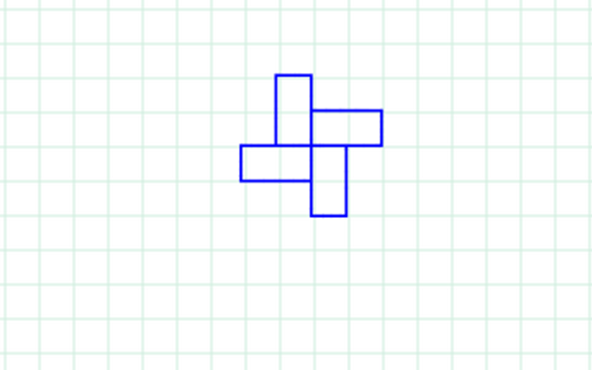
We had an idea to combine Anna Weltman's loop-de-loops with one of Vi Hart's doodle games, making a knots/doodle braids:


Questions from our noticing and wondering about these:
  1. Is it possible to make a VH doodle out of every loop-de-loop? If not, can we tell in advance which ones don't give us legitimate VH doodles?
  2. Does this method always produce a knot distinct from the unknot?
  3. Will any resulting knot/braid have a single string or could there be multiple separate strings? Can we tell in advance how many there will be?

Transcendentalism

Another set of ideas were inspired by John Grade & his daughter, the winners of Dan Meyer's loop-de-loop contest:

Their loop-de-loop was made using the digits in the decimal expansion of π as the step sizes. I think there were 49 digits used.

The immediate question was, why 49 digits? That led us to create a (not entirely successful) program that allows us to choose how many digits of π to use to generate a loop-de-loop. Of course, this quickly led to a second extension: what about other irrationals? For now, our code will let you choose whether to use π or e as the reference. The code is here.

Playing around with these a little, we came up with another extension.  Instead of a single loop-de-loop, consider a family of loops-de-loop {Fn(α)} where the n-th element of our family is the loop-de-loop generated by the 2n+1 terms of the decimal expansion of  α. Here are our questions about these families:

  1. If An(α) is the area bounded by the loop-de-loop Fn(α), is the sequence An(α) bounded?
  2. Does the sequence  Aconverge?
  3. Does the answer to either 1 or 2 depend on α?
  4. If there are α for which the area isn't bounded, does it grow with some power of n? Does that power depend on α?
  5. We have similar questions about the perimeters of the family.

Take us to another world

One last idea was to think about drawing on a surface that isn't a flat plane. In order of interest:
  1. sphere: my idea is to show the stereographic projection of the motion on a sphere. This doesn't seem too hard. Someone with stronger coding skills might have fun making a version that shows the loop appearing on the sphere itself.
  2. disc model of hyperbolic geometry: our intuition is that this could look cool
  3. torus: should be easy to write a program for this, but intuition is that it won't be all that interesting.
  4. Klein bottle and Möbius strip: like the torus, not too hard, but we guess this won't look very exciting.

By the way

Go back and watch the Vi Hart video again (the link, for your convenience) and make sure to play those doodle games and think about all the connections. It has to be one of the coolest things ever and is well worth taking the time to appreciate it.

Monday, October 19, 2015

Loop-de-loops

Like many mathy families and classes in the past couple of weeks, we've been playing with Anna Weltman's Loop-de-Loop patterns.

Note: to give credit where it is due, my introduction came via Mike Lawler's blog that linked with Dan Meyer's blog.

Our first loops-de-loop

To start us out, I drew one example, then gave two different sequences to J1 and J2 to draw: (3, 7, 6) and (3, 1, 4).


As you can see from the picture, that led quickly to their own questions:
  1. What if we did (3, 4, 1) instead of (3, 1, 4)?
  2. What if we had four numbers in our sequence instead of 3? Their first test was  (1, 1, 2, 2)
  3. How can we figure out where we should start drawing? This was a pressing problem, since we had fairly course graph paper (the grid was hand made!)

A tool

Ahead of introducing this to the J's, I had made a short pencilcode program to automate drawing the loops-de-loop: Draw a rectangular loop-de-loop with your choice of step lengths

This let us easily try many different combinations of step lengths and build up our menagerie very quickly. As usual, the kids came up with ideas that wouldn't have occurred to me. These are behind some of the challenges below.

Some challenges

For each of the following, what sequence of numbers defines the loop-de-loop pattern we created?
Challenge 1: a basic l-d-l

Challenge 2: test your assumptions about loops-de-loop


Challenge 3: Where's my 4-fold symmetry?!

Challenge 4: Whoa! Do we turn clockwise sometimes? 

Our favorite, so far


Damult dice extension

Apologies that it has taken me so long to post. We are on break between terms right now, which actually means I have less time than usual!

We played an extension of damult dice with the third grade class during the last week of classes that was very successful. Here is the quick story:

First, we played a round of the standard game, with a point target of 200. Every student had a chance to roll 3 dice, add two of them, then multiply the result by the third. At one point, on my turn, I had 124 points and the kids had 199 points. We stopped and I asked what they thought would happen. They quickly saw that I had no chance to win.

Next, we drew a card from a playing deck. In this case, it was a 5. Based on that draw, we then played damult dice again, but players are only allowed to count points that are multiples of 5. To soften this additional constraint, we added a fourth dice. In other words, players throw four dice, choose two values to add together, and choose a third value to multiply by that sum. If the result is a multiple of 5, they can add those points to their running total.

For the next game, we chose a different card to determine the multiplication family for that round.

Multiplication families practice

At the basic level, this variation made the game a really good way for the kids to practice their multiplication families. To focus the practice, I had actually doctored the playing cards ahead of time and took out many of the cards (face cards, 10, aces, and 2s).  For other student groups, I might take out the fives or the threes, if they were already very comfortable with those families, or I might include the twos and tens if they needed more work there.

Their observations were great

During play, the students quickly launched into observations and hypotheses about how to make use of their new degree of freedom (the extra dice) to overcome the constraint. For example, they realized that the only multiples of 5 possible are where one of the factors is already a multiple of 5. That means (a+b) * 5, a+b = 5, or a+b = 5. They had different observations when looking for multiples of 6 and again for multiples of 8.

These conversations became a natural step into thinking about the factors of our constraint and, even better, the prime factorization.

Another possible twist

For the class, we chose one multiplication family for each complete play of the game.  In subsequent play at home, we've tested two other versions. In one version, the player starts her turn by drawing a card, then needs to score points that are a multiple of that card's value. This adds a further element of randomness to the game as each player potentially faces different constraints on their turn.

Alternatively, we drew one card to constrain the next two turns. In other words, each player faces the same constraint as the other, but the multiplication family can change between a complete set of turns. 

My recommendation is to be flexible and try the version that suits your players the best. I think the first version is my favorite for encouraging the players to really think about what is required to make a point value that is a multiple of their specific constraint, to make observations and hypotheses.


Thursday, September 3, 2015

math games class catch up

It has been a while since I posted a summary of our math games, so this is just a quick catch up to summarize what we've been doing:

Grade 1

Addition war
2 players
pack of playing cards (A to 10)

Deal out all cards to both players and keep the cards face down in a stack. Each round, both players turn over the top two cards and add their values. The player with the higher sum wins and collects the cards in their points pile.

If there is a tie, those 4 cards are kept to the side as a bonus for the winner of the next battle. Repeat this with ties until there is a winner for one round.

After playing through the original stack, look to see who has collected more cards in their points pile. That person is the winner.

For a more challenging version, use face cards and assign values J = 11, Q = 12, K = 15.

Solo addition bridge
2 - 4 players (we played with 3)
pack of playing cards (A to 10 for beginner game, add face cards for extra challenge)

Deal out 5 cards to all players. They pick up these cards to form their hand. Proceeding clockwise, each player lays down one card from their hand, going twice around the group. Each player adds together the value of the two cards they played. The highest sum wins and collects all the cards played. That is one "trick."

After each trick, deal out 2 cards to each player to refill the hands to 5 cards.

The player who won the last trick is the first to play a card on the new round.

When there aren't sufficient cards to deal equally to all players, deal the hands equally (all players start each round with the same number of cards) and keep the remaining cards as a bonus for the player who takes the last trick.

We played with 3 players and, for the advanced game added 2 jokers to make a deck of 54 cards. Based on popular consensus, the jokers were assigned a value of 1,000,000. Interestingly, the extremely large value meant that the players were reluctant to play their jokers and, twice, both players kept them to the final trick so that the winner was actually decided by the higher of the second card!

Group addition bridge
4 players working as pairs (partners) with the partners sitting opposite each other
pack of playing cards (A to 10 for beginner game, add face cards for extra challenge)

Generically, play is the same as solo addition bridge, but each round the partners each play one card and the team that has the higher sum wins the trick. While there are still reserve cards in the deck, hands get refreshed up to 5 by dealing a single card to each player. The leader for each trick rotates clockwise so that everyone gets a chance to be first (second, third, and last) to play.

Second and Third Grade

Multiplication Blind Man's Bluff
3 players
pack of playing cards using A to 10 (A counts as 11)

One player deals a single card to each of the other players. They hold that card up to their forehead. The dealer announces the product of the two cards. Then, the two players try to figure out the value of the card on their own forehead.

Role of the dealer rotates after each round.

We played this as a cooperative exercise. To make it competitive, you can award points to the first player to get their card value.

There are two ways to make this more difficult. Adding face cards with made up values is one way. Instead, we had the dealer give one player two cards, add those, then multiply that sum by the value of the other card. 

Yet another step is to deal each player two cards, then multiply the two sums.
When playing this version at home, J1 came up with the idea of giving clues to figure out the value of the two individual cards. This was a really interesting activity because it got him to think about what characteristics help specify the two cards and which clues actually don't provide new information.
For example, if I know the sum of my two cards is 11, does it help me to know that I have one odd and one even number?

To make a standardized version, the second round of clues is to tell each player the product of their values. 

Largest Difference/Smallest difference
many players (at most 9 per deck of cards, fewer with advanced versions)
pack of playing cards A to 9

Deal out 4 cards to each player. They then form two 2-digit numbers and subtract the smaller from the larger. The player with the greatest difference wins that round.

For slightly greater challenge, deal out 6 cards (for two 3-digit numbers) or more (forming 4 or 5 digit numbers). Again, the aim is to form two numbers with the same number of digits that have the greatest difference.

For a much more interesting game, we shift the goal: now, we try to find two numbers with the smallest difference (larger minus smaller). After playing a bit, we had some good conversations about what the students noticed, what strategies they used, and whether there was always a unique answer.

Multiplication Pig (variation of addition Pig)
2 dice (we used 2d6)
2-3 players (or more, grouped into teams)

Players start with 200 points and try to work to 0 (or below).

Each turn, the player rolls both dice. If neither is a 1, they multiply the two values and add this to their score for the round. They can either choose to roll again or take their score for the round and subtract that from their cumulative score.

If two 1's are rolled, then  their overall score is set back to 200. If one 1 is rolled, then their score for that round goes to 0 and they lose their turn.

Variations come from varying to characteristics of the game:
- Start with 0 overall points and, each round, add the points for your round to try to break a target (practices addition instead of subtraction in forming the overall target)
- Add the two dice instead of multiplying (shifts the practice to addition instead of multiplication)
- Use dice other than 2d6, possibly more dice or differently shaped dice (note: the overall target and/or penalty conditions might require some adjustment)

Some PIG observations

Dice games are loud games, compared with card games. I think this is because the value of the dice is revealed to everyone at the same time.

Based on expected values, the optimal decision whether to keep rolling to bank the points for that round depends on how many cumulative points you have and your score for that round. However, we observed that the students chose to bank their points very early, relative to an expected value maximizing strategy. I think this is because their experience with the game causes them to over estimate the likelihood of rolling a 1 (or two 1's) and/or to underestimate how many points they can earn on a single roll because of the multiplication.

Monday, August 17, 2015

Language games (first class)

We had an opportunity to spend some time with the 2nd grade class today playing some language games.

Warm-up
Not exactly a game, we got them started with a quiz on some frequently written words:
a, the, and, I, to, was, my, of, we, he, she

After the quiz, the kids took turns writing the words on the board and we talked about a couple of tricky points:
  1. "to" vs "two:" yes, they sound exactly the same, but mean different things. No one thought about "too" at this time (isn't English wonderful?)
  2. "th" sound: one of the English sounds that doesn't appear in Thai. Actually, there are two distinct sounds made by the "th" combination, but even most native speakers don't realize this (compare "this" and "with.") The fun thing about "th" is that we can exaggerate and stick out our tongues!
  3. "sh" is another one that doesn't exist in Thai
We gave out a list of top 100 sight words and will quiz another 10 (or so) next week. We talked through some practice/memorization strategies so everyone can prepare.

Making words (PDQ variation)
We have a set of cards to make 3 letter words. On one side, the cards have parts of pictures and a letter, so when you put the 3 matching cards together it will spell out a 3 letter word that describes the picture. For example: cow, zoo, hat, pin, fin, etc. The other side just has the letter in larger size.

For our game, I drew out two cards and showed the letter side. We then competed to make words that contained those two letters. To practice, we all worked together.  After getting comfortable, we split into two groups. For each round, two kids would go head-to-head, but their teammates could give them suggestions. The winner of each round was the person who came up with the longest word that uses both letters (though we sometimes awarded the person who came up with the most words). and that team would get the two cards.  Each round took 1-2 minutes.

A boggle twist
After going through all the players a three or four times, each team had collected a decent collection of letters. We then gave them 5 minutes to write down all the words they could make using only the letters they had collected.

Summary
Together, we found these activities were fun and engaging for the kids and good practice spelling. I think the slightly different mental processes involved in the two games made a good combination for the session.

The kids were making active use of their 100 sight words lists, so this turned into a good way to familiarize them with the list and give them some extra motivation for learning all the words.

Friday, August 14, 2015

math games class: 24 game and connect 4 dice

First grade

As a warm-up, the first grade played tic-tac-toe. This was to prepare them for the main game of they day: dice connect 4.

Dice Connect 4
Two players alternate occupying spaces on this grid:

The constraint is that, each turn, the player first throws two dice and then can only select a space in the column that corresponds to the sum. The winner is the first to get four in a row (horizontally, vertically, diagonally.) In our version, the winning spaces need to be a chain of neighbors, in the sense that each space has 8 neighbors.

Second and third grade

In both older grades, we played the 24 game. I saw this mentioned recently on Benjamin Leis's blog about his own math club (maybe just in passing here, I thought he had a more extensive post about the game elsewhere, too).

We played the "war" variation:
players: 4 (when necessary, three players can have a ghost player, or two players can modify each round slightly)
material: deck of playing cards with face cards removed
set-up: deal out all cards to the four players, cards stay in piles face down.
each round: players all turn over the top card in their pile and then race to get as close to 24 using the values of the four cards and standard arithmetic operations. In our version, we allowed addition, subtraction, multiplication, and division, but we didn't insist on using all four cards. When we played, someone would call out a value they could make and the number of cards, say "21 with 3 cards." The other players would then have a minute to try to improve that, either getting closer to 24 or making the same value with more cards.

The player who wins each round collects the four cards and puts them on the bottom of their pile, face down.

Ending the game: when any player runs out of cards, the game is over. The player with the most cards wins. Note: you can also keep going until only one player remains, but this wasn't suited for classroom play.

Playing at home: As mentioned above, you can play the game with 2-4 players. With two players, just have each player turn over their top two cards. With three, we used a dummy/ghost pile of cards to make sure each turn had four open cards. Another variation that is flexible is to keep all cards in one pile, turn over four each round, and then the player who is fastest or has the best result collects them. After the main pile is exhausted, the winner is the player who collected the most cards.

If no one else is available, this can also become a practice or puzzle session. Just turn over 4 cards and see how close you can get to 24. Write down your equations!