Showing posts with label crafts. Show all posts

Monday, June 15, 2015

Bath-time math

Who: J3
When: bath before bedtime
Where: bathtub (of course)

A simple, but classic bath-time investigation: which container holds more water? We've got three, and it is easy to see that the white cup holds less than the other two. However, comparing the silver and blue isn't so easy. Are they the same size? If not, which is larger?


J3 started with the basic technique filling one with water and then using that to try to fill the other. Then, she moved on to usin a common measure, counting how many white cups were required to fill each of the larger containers. Her technique was very splashy, so I wouldn't say every cup of water was equally full or that every drop successfully made the transition from cup to bucket. At this stage, the play was about the spirit of the investigation, the joy of counting, and the fun of splashing water around the bathroom.

More math around the house

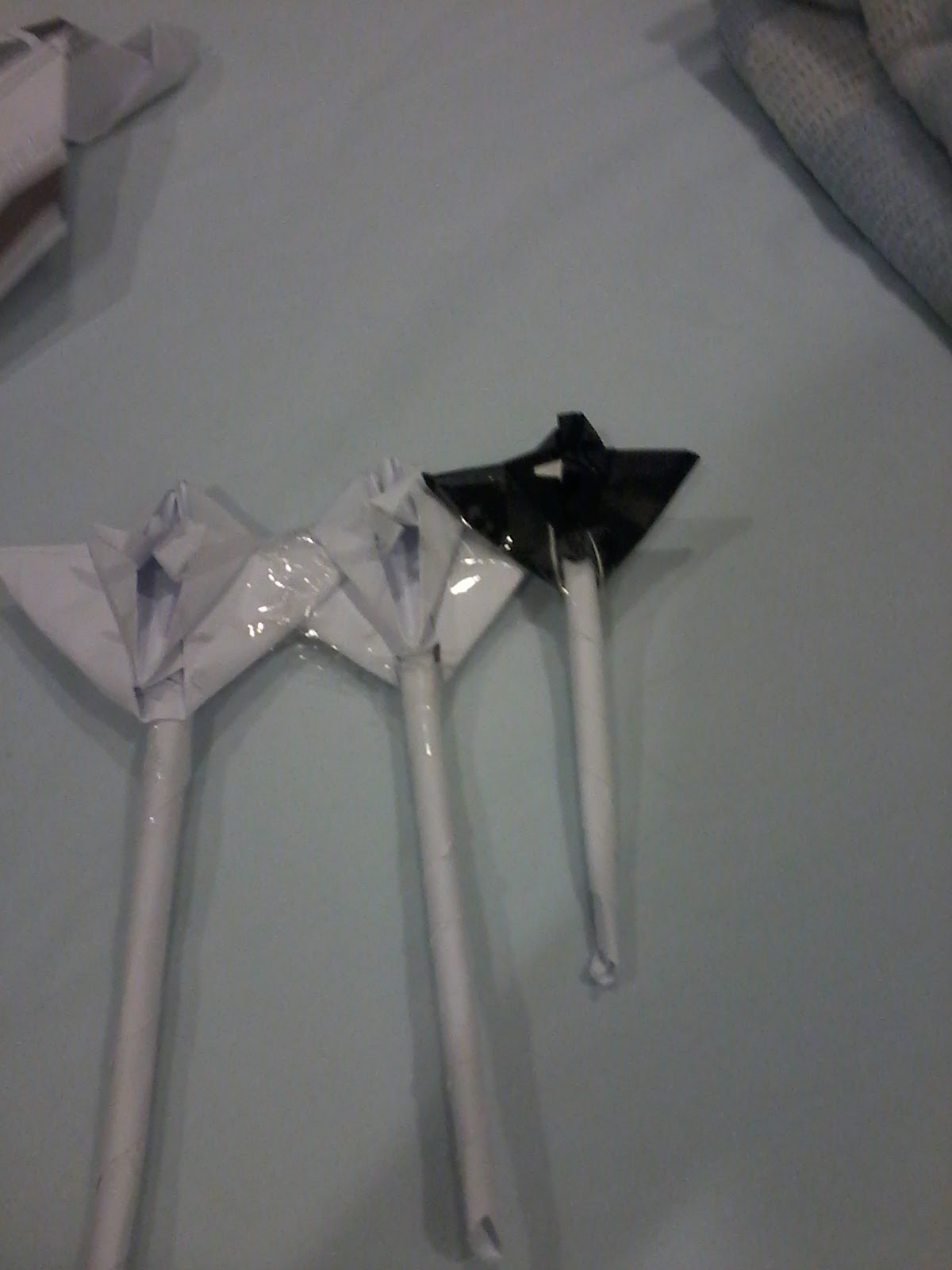
Triplet of decorative paper airplanes (courtesy of J1)

A mathematical pizza (courtsey of J2 who made the dough and J1 who snapped the picture)

What's mathematical about pizza? Measuring ingredients, tracking the time to mix the dough, talking different shapes for the base (circle and rectangle are never quite achieved, of course), temperature of the oven, time to cook, ways of cutting, probability that any will be left for mommy or daddy to taste....

Saturday, May 23, 2015

15 piece tangram (more math from trash)

who: J0 and J2
what did I use: a postcard advertising some property for sale

Note: when I originally wrote this, J2 and J1 were busy doing something else. By the time I had half composed this post, J2 had noticed what I was doing and started playing with the tangrams again. More evidence that the easiest way to get kids into an activity is just to have it out and available or doing it yourself.

15 piece tangram

In Bangkok, we get a lot of junk mail touting property viewings. One postcard was just the right size and durability to use for a 15 piece tangram set. I would encourage you to make and play with your own 15 piece set (or a 7 piece, if you don't already have one).

In fact, you should do what I didn't do this time: work with your kids to cut apart the original square or have them make their own sets by themselves. Even just following the diagram is a geometry experience as well as an exercise in scaling.  Our card was 15cm on a side, the diagram I used gave dimensions based on a 3 inch side.

I was a little concerned about the dissection of the central square because of the circular curves. I traced out the dissection with a ballpoint pen that made a slight indentation in the card, then traced over that outline with the tip of a very sharp knife. It isn't perfect, but I'm very pleased with the result:

The image adds some hints when we want to reform the basic square. Good or bad?

I was, perhaps, remiss in not providing full credit to the tangram book we are using. here it is, in all its Dover Publications glory, Tangrams 330 Puzzles by Ronald C Read.  Looking over my shoulder, J2 said, "the book actually had 334 puzzles." So, boom, 4 free puzzles!

Platonic Solids Defying Gravity I

Unrelated, J2 made a temporary installation of mathematical art today in the kitchen: Gravity Defying Platonic Solids I. Except for the obvious one, he also took the pictures included here:


Wednesday, May 13, 2015

Cake is wonderful

who: J1 and J2
where: kitchen
when: afternoon during J3's nap
what material did we use: dish soap, water, a plastic drink bottle, zometool set, and two small blocks of solid CO2

Last weekend, a generous uncle brought two pieces of chocolate cake for the older J's (littlest J can't eat dairy, so has to make due with dark chocolate squares). The cake was nice, but the real delight was in two small pieces of dry ice that we part of the packaging to keep the cake cool. While J2 had his violin lesson, J1 and I looked for good activities to take advantage of this bounty.

We hit on the Crazy Russian Hacker's 8 dry ice activities (video linked below). Of those, we selected the smoke bubbles and the smoke rings since they seemed cool and possible with our resources. These turned out to be really easy and fun activities.

Here are some videos of the smoke rings:


By coincidence, our friend Pongskorn Saipetch was also playing with dry ice recently, you can see his video here. From the size of his piece of dry ice, I have to guess he had a lot of cake!


After the dry ice had melted, we made bubble wands out of zometool and continued to play with the soapy water:


Our video inspiration. While our photos and video didn't turn out this well, the actual experience was at least as much fun as what you see here:

Friday, January 9, 2015

Stairway to (number) heaven

Who: J1, J2, J3
Where: our stairs
When: permanently (ha!)

J2's school has a set of stairs used by the kids with numbers posted on each step. I finally realized we could copy this at home. It has been great fun for each of them, in slightly different ways:
  • J3 feels like these are "her" numbers. Everyone else has told her we made them for her and the sense of ownership makes her pay a lot of attention to them.
  • J2 really likes having numbers and shapes posted around the house, so he is the one who is encouraging us to continue to the top floor.
  • J1 likes taking J3 on a tour of the numbers and admiring the pictures. He also likes coming up with new things to add (like writing a related number expression)
  • They all like talking about the ones they made and their contribution to the project
I have three recommendations for you replicating:
  1. Start with zero
  2. Be open to a lot of interesting number and shape conversations while making the cards.
  3. Do it! if you don't have stairs, make it into a horizontal number line on the walls. 

J2 almost finished decorating the 12 card

Cards in situ, ready to be enjoyed

Detail of the 8 Card: such craftsmanship!

Saturday, January 3, 2015

Pseudosphere Hat and our Robot begins (some arts and crafts)

Who: J1
When: around lunchtime
where: on the floor

Today, we tried making a couple of things. First up, was a pseudosphere.  The inspiration for this is a really nice post from Daniel Walsh: Sudo Make me a Pseudosphere. By all means go to the original post as the pictures, animations, and video he posted are far better than what we managed, but it was still a fun conversation about shapes, angles, slope, and fractions.

The process is easy:
  1. cut out a bunch of equally sized circular discs
  2. cut the discs into different sized (different angle) sectors
  3. make all the pieces into cones
  4. stack them from shallowest to steepest
Daniel mentioned something about calculating the optimal sizes, but I didn't really know what he meant. We went for a child's dinner plate for our circular template and cut sectors in multiples of 45 degrees.

Only the finest used newsprint for us!
One good question came up along the way: if I cut out a larger angle, will the cone we make be steeper or flatter?

Pseudosphere taking shape


There was another point where I'd cut out a 135 degree sector and J1 said: that's 1/3.  When he measured very roughly, it did seem to be a third, so I asked him to try it more precisely. He had a sudden realization when he saw the 90 degree remainder.

The cone of our dreams!
We went one step farther and permanently attached all the cones together, then re-purposed the whole thing to create 2015's fashion must-have item: the pseudo-rocket pseudosphere hat:


Starting our Robot

Our other activity is really the beginning of a longer project.. J1 has been talking about making a robot and we are starting to work on some of the main functions. Of course, he is really excited about camera eyes and a laser cannon, which we'll get to eventually (will we?) For now, I have some ideas about how to get the robot to walk.

My plan is to connect a basic rotating electric motor we have, so that leaves us solving an old problem: how to convert rotational motion into straight-line motion. Of course, wasteful methods are easy, but we want our robot to have the maximally powerful stride. For now, we are investigating multiple linkages, in the footsteps of Chebyshev.

Below is a first test: three linked arms:

  1. Arm 1 has a fixed end and is intended to rotate in a circle
  2. Arm 2 has one end fixed to the rotating end of arm 1. The other end of arm 2 is the motion we want to examine
  3. Arm 3 has one end fixed and the other end attached to the mid-point of arm 2. This constrains that midpoint to travel along a circular arc

You can see our ultra-high tech implementation below, using card paper as the arms, a large cardboard box as the base, nails (into the base) to create fixed points, nails point up to create hinge joints, and extra bits of cardboard to cover the point ends of our hinges and past muster with  the health-and-safety inspectors:


The action of the multiple hinges is pretty wild. J1, J2, and I enjoyed cranking arm 1 and watching arm 2 fiddle around. Carefully holding a pencil in place, we managed to draw he path of arm 2's free end. It is the rounded wedge that looks very close to a circular quadrant.


If you want to see some great animations of multi-hinge contraptions, check out the animations at Mathematical Etudes. I'd be delighted if we could get close to this one.

Avocado update

I'm pleased to announce that another family member, D, has started sprouting her own avocado pit and, apparently, has made this into a race.  When told the news, J1 and J2 immediately started guessing what type of sabotage techniques would be employed by D. I think this says more about them than her.

Total mass: 67 grams
Length from root tip to sprout top: 21 cm
Length from pit to sprout top: 12.3 cm

Wednesday, July 16, 2014

Number sense, calculating, and stuff

Apologies, this post is a bit of a grab-bag of different things we have been doing recently. They are a mix of activities across each of the age groups, done at different times of the day and different levels of engagement, though most of the one-on-one time with J1 comes just before bedtime.

Number Sense: J3
We have made a conscious effort to surround the children with numbers and are often looking for good ways to present concepts in a different format, especially one that has physical objects and some relationship to their body.  Meals are often rich with opportunity, especially if you don't mind a little bit of playing with the food.  Here, J3 has matched up 10 almonds with each of her fingers, counting as we made the layout , then counting again as the almonds got put in a little cup, then counting again as she ate them.

Similar ideas:


  • counting stairs going up and down
  • counting musical beats as you listen to a song
  • weighing food, weighing each other
  • estimations (amount, length, weight)
Snakes and Ladders, err, Dinosaurs and Dinosaurs
I've mentioned before and will repeat frequently that I enjoy playing games, but snakes-and-ladders format aren't really games since you can't actually do anything. For now, though, the kids like them and the provide an opportunity for two things: (1) asking interesting questions about structure and (2) introduction to probability.  Along the way, there is practice calculating, but this is just small addition problems and not especially rich.

Tonight, J1 and I played a dinosaur version, you go down if you land on a land-dinosaur head square and up if you land on a designated square associated with a flying reptile:


We made one big modification to the game: playing with two dice instead of one.

The main point of interest is hearing J1 calculate dice sums, which square he is jumping to, and analyzing the size of the boost (or drop) from hitting the bonus squares and the penalty squares. It fun to talk about the probabilities of hitting the bonus and penalty squares, particularly because he asked all the questions and did most of the talking.

Simple starter cues, if you want them:
  • is it possible to get to x from where you are now?
  • how many squares away are you from y?
  • How many ways are there to roll a 5?
Toys
Really, all of this post is just leading up to praise for some toys the kids really like and that can soothe parental anxiety about "stimulating development."  Frankly, I don't really care, since I enjoy playing with these, too!

Rainbow Loom
Extremely popular in J1's school group and even J2 can weave a nice design on his own.


They also discovered that youtube has useful how-to videos and they even worked together!


So, what are the (future) mathematical benefits:
- pattern building and recognition
- building a mental model of how the structure fits together
- understanding algorithms (especially with repeated loops)

Snap Circuits
A fantastic kit with electronic components that all snap into a grid-circuit board for easy assemble and disassembly.


 There is a book of projects which show circuit layouts and give some commentary about what you should be examining to understand the operation of the circuit.  Usually, they introduce each new component in a show piece of its own so the kids can build a sense of function.

I do have one complaint about the kits, though: a lot of the projects depend on using an integrated circuit.  These are black-boxes, so it misses a bit of the fun of building everything up from truly elementary components.  For now, that's certainly fine for our kids level of sophistication since it is fast to build a fully functional circuit. We do miss out on really understanding what is going on inside the box, though.
Trains
Really just an excuse to post a picture that reminds me how much fun J3 had playing with one of our toy train sets:


Tuesday, July 15, 2014

Post XXVII (Roman Numerals and ninja stars)

Who: J1 and P
When: after bath, before bedtime
Where: In J1 and J2's bedroom
What: doing roman numeral calculations on the mini-white board
Why: hmm? Some ideas below
How: facilitated by J0 folding ninja stars to appease the restless on-lookers

Roman Numerals
In our RightStart math book, we got to a series of activities relating to roman numerals.  Mainly this consisted of translating back and forth between arabic numerals and roman numerals, along with debating the actual rules for roman numerals.  I will have to get P to write about how she introduced the topic. When I joined the conversation, J1 was in the process of writing out the natural numbers up to 40 (XXXX or XL?) in roman numeral form. Later, he went up to L (50), but he already knew the symbols for 100 (C), 500 (D) and 1000 (M). Next activity was converting from roman numerals back to arabic (for example: 377 = CCCLXXVII) and then he did a round of conversion back.

All of that is pretty straightforward . . . and probably not very interesting. So far, what he's getting is some practice calculating simple addition in his head, added flexibility of thinking of numbers using different representative symbols, and a familiarity with a number representation system that is justifiably extinct.

However . . .

Anything can be interesting
Basically, what questions do you ask, what questions does the child ask, and what questions do you explore?

For example, Who used this numbering system? Who uses it now? What other systems were used around the same time? When and why did it get replaced? Are the rules clear, how can you cheat, how can  you make the number expression as efficient as possible (within the basic spirit)? How does it compare to the arabic numbering system?

All of these are fun topics for exploration.  Let me expand on two that we discussed.

Comparison
"How do roman numerals compare with Arabic ones (or the Thai system)?"
"What's the same?"
"What is missing in one that exists in the other?"
"What are the advantages/disadvantages of each?"
"When would you want to use this one? that one?"

All generic questions that can be asked, in some form, about anything new you experience/see/learn and making a comparison like this is probably the most important habit in truly understanding the new idea.

I'm sure you can come up with a lot of similarities and differences. In case you didn't get them, though, here are two cool features that the roman numeral system lacks:

  • symbol for 0
  • place value
Cheating (aka are the rules clear?)
More ingrained than comparison, our 7 year old J1 has the habit that when he hears a list of rules, he immediately starts thinking of how to break them, alternatives, or cases that haven't clearly been covered. This was how he made the numerals up to 50 more fun:

"Can I write 5 as VX?"
"How do you know that XI doesn't mean -9?"
"I'm going to write 39 as (XI)L"
"What about VLI for 46?"

Throwing stars
Of course younger siblings J2 and J3 were enthralled by this discussion.  The alternative activity tonight was folding stars. If you don't know how to fold a paper star, these two videos will get you going: Ninja Star and Puffy Pentagon Stars.


Cute little projects.  My recommendations for when you do these with very small children:
(1) have a bunch of extra material
(2) expect a lot of mistakes and destroyed products
(3) have everyone try to make something
(4) give them plenty of opportunity to examine what you've done
(5) ask questions, get them to talk about what they see and what they are doing. Use the comparison questions above!