Showing posts with label 4 year old. Show all posts

Wednesday, March 29, 2017

Some simple dice games

J3 and I played several simple games recently that I want to record. One of them, race to the top, is a variation of a more sophisticated game that can be used more generally.

Digits three in a row

Materials: a 100-board, 2d10, colored tiles
Players: 2
Goal: mark three spaces in a row
Basic play:
Two players take turns rolling the two dice. On a player's turn, they form a 2 digit number using the two digits and then claim that space on the 100 board. If the space has previously been claimed, they lose their turn.

The first player to claim three adjacent spaces in a line (horizontal, vertical, or diagonal) is the winner.

Variations:
(1) we used one dice marked 0-9 and another marked 00 - 90 (all multiples of 10) and then added the values to get our two digit numbers. This eliminated any player choice, but helped reinforce the idea that the value in the 10's digit is the number of tens.

(2) the winning condition can be increased to require a line of 4 spaces

(3) the winning condition can be changed to allow any three (or four) spaces that are colinear; these spaces would not have to be adjacent.

Notes:
This is a very simple game, especially the variation we played, but J3 found it fun. It was a useful exercise to practice locating the numbers on the 100 board.

Race to the top

Materials: An 11x 6 grid with one side labelled 2 to 12, 4d6, 3 tokens. Optional: 11 distinct tokens/small objects per player.
Players: 2 - 4
Goal: capture 3 columns.
Basic play:
This game is fairly simple, but has resisted our attempts to succinctly summarize the rules. Here is an explanation as we play two turns.

Here's our playing material, the three green squares are temporary markers:

First player, J1 rolls two ones and two fours. With this roll, J1 could group them into two fives or a two and an eight:

J1 decides on two fives and puts a temporary marker on the second level of the 5's column. After you understand the rules consider whether this choice is better or worse than the 2 and 8.

J1 chooses to continue rolling and gets 1, 1, 4, and 6. J1 groups these as a 5 and a 7, then moves the temporary marker in the 5's column up one level and adds a marker at the bottom of the 7's column.

J1 rolls a third time, getting 1, 1, 2, and 6. The only option is to group these as 3 and 7, so J1 places a temporary marker in the 3's column and advances the marker in the 7's column.

At this point, J1 ends his turn and marks his progress. On his next turn, if he gets a 5, for example, the temporary marker will start at the fourth level of the 5's column (building on his consolidated progress).

D has the next turn. He gets 1, 4, 4, and 5, which he chooses to group as 5 and 9:

D chooses to roll again, getting 4, 5, 5, and 6. This has to be grouped as 9 (advancing in that column) and 11:

D chooses to roll again and gets 2, 3, 5, and 6. This is a lucky roll that can be grouped as 5 and 11, allowing two tokens to advance:

D presses his luck and rolls a fourth time, getting 1, 3, 3 and 5. The dice can't be paired to get a 5, 9 or 11 and there are no more temporary markers available to place, so D loses his progress. J1 will have the next turn.

To be clear about the failure condition: the player must be able to place or advance a temporary token for both pairs of dice. For example, if D had rolled 1, 3, 3, and 6, he still would have lost his progress.

Further rules:

  • the first person to end their turn on the sixth level of a column "claims" that column.
  • the first person to claim 3 columns wins the game.
  • columns that have been claimed by any player are safe values for all players. Players do not need to allocate a temporary token to those columns.
  • Players can occupy a square that an other player has marked.


Variations:
(1) Change the winning condition so that the first player to capture a column wins
(2) Change the height of the columns, either fewer than 6 for a faster game or more than 6 for a slower game
(3) Change the failure condition so that only one pair of dice needs to be playable and reduce the temporary tokens to 2.
(4) only allow each player to roll one time. This eliminates the "press-your-luck" aspect of the game and is much more basic.
(5) allow players to jump over a square that has been occupied by another player. This rule particularly fits well if you use objects to record your consolidated progress (which also makes the grid re-usable).

Notes:
I was originally taught this game by Mark Nowacki of Logic Mills.
J3 and I played the variation where each player only rolled one time on their turn.

Thursday, February 23, 2017

A bit of 3D(ish) geometry

Note: this post started out focused on two recent geometry projects. However, the Desmos Function Carnival, which I originally just included as a miscellaneous item, is also worth your time.

Nets and solids

The most ambitious project recently was led by P (the mom, of course). She found nets for 3-d shapes and supervised J1 and J2 as they created a nice display to take to school.

Here are the nets: SenTeacher Polyhedral nets. They have a collection of other printables, but this collection of nets seems to be the most interesting. Take a look and let me know if you see anything else worthwhile.

Here's the completed board:

A profile picture to show that these are really 3-d:

Solid Shapes and Their Nets (I think Jo Edkins is the author) has a nice discussion of nets and a little puzzle game to distinguish nets that fold into the platonic solids and which don't. Feel free to try to do this for the icosahedron or dodecahedron!

A two dimensional challenge?

J2 asked me about a triangle with two right angles. Of course, we all know that a triangle can't have two 90 degree angles, right? Well, this fits in my list of math lies from this old post: 23 isn't prime.

We talked briefly about triangles on a plane and agreed that two 90 degree angles wouldn't work. If we try by starting with a side and building two right angles on that side, we just get parallel lines. Ok, that's standard.

However, what about this:

We discussed spherical geometry for a bit. Not shown is our first attempt on the other side of the tennis ball that did have two right angles, but the third wasn't. He wanted to see an equiangular triangle on a sphere. This led to further discussion of life on a sphere:

  • what is the largest interior angle sum for a triangle?
  • what is the smallest interior angle sum?
  • are there any parallel lines?
  • are there any squares? are there even any rectangles?
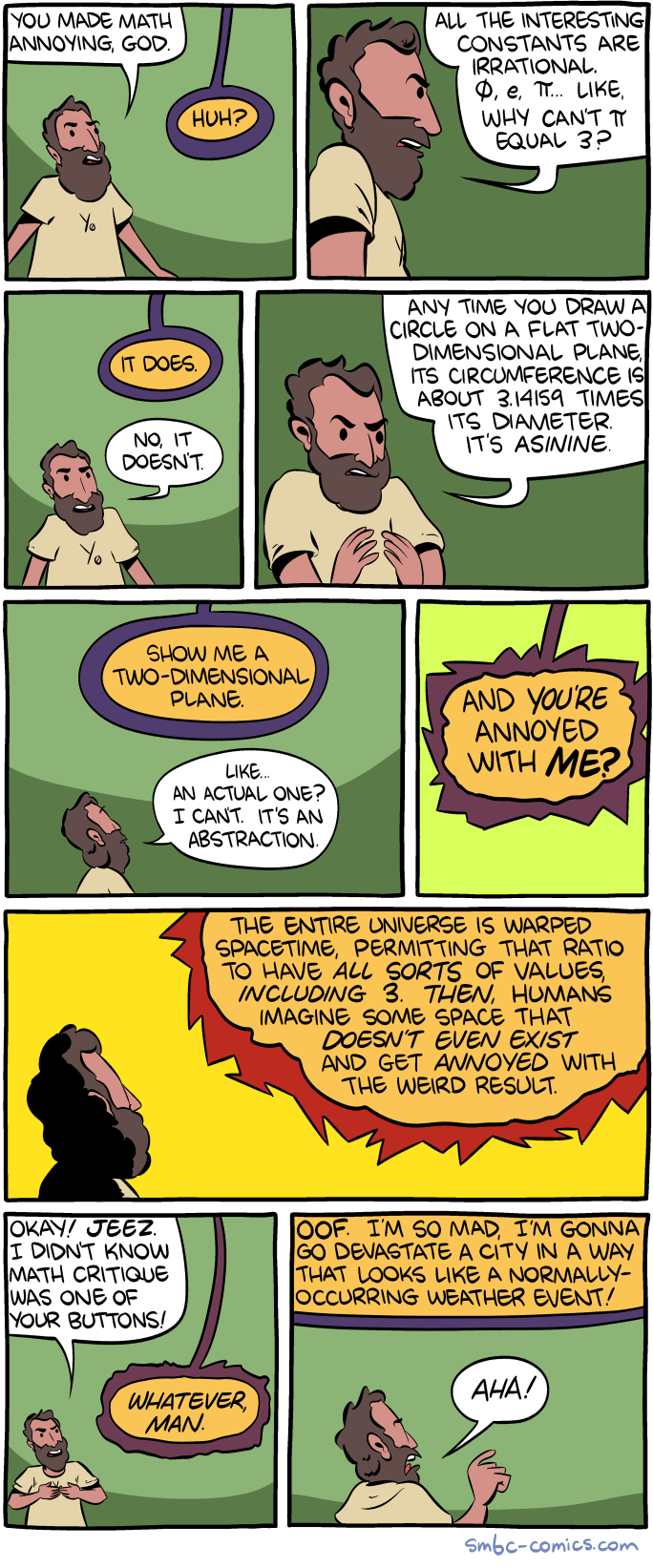
  • is π (the ratio of the circumference to diameter of a circle) a constant?
  • do we have to think like this in real life because the earth is close to a sphere?
Picking up the point about π, it occurs to me that this is another math lie. This point got a nice treatment recently by SMBC:

I made this pic small so you will go to the site and look at Zach Weinersmith's other awesome work
Some open follow-ups:
  • what is an equiangular quadrilateral on the sphere?
  • what about hyperbolic geometry? I think no triangles with two right angles. If I recall correctly, triangles there have angle sums smaller than 180 degrees (or π radians, ha!)

Other Misc Math

Now for my usual grab bag of other things we've been doing. Some of these are really great activities, so don't skimp on this section!

Desmos Function Carnival
We learned about the Desmos Function Carnival activity from a post by Kent Haines which, in turn, we learned about via Michael Pershan's post. They both were writing about teaching functions to their students and have outlined a really nice sequencing of lessons, if you're into that kind of thing.

In case you are, you might like to know that there is another flavor of Function Carnival available through the Desmos teacher site with 2 other activities. Each version is worth checking out because both of worthwhile activities that aren't in the other. Also, Kent links to this nice graphing activity from the Shell Center which also worked well with J1 and J2.

For our purposes, I was more interested in the mathematical physics (plots of position vs time or velocity vs time) and the fun of creating wacky animations with impossible plots.

If I can figure out how to post the animations, I will update this page, since the animations really enhance the experience. For now, let me give you some screen caps of some of their proposed graphs from the Cannon Man (height) activity:

Have a free-form drawing tool? Make your name!

Note: the vertical stripe doesn't really work with this animation, but the patriotic spirit is there!

Our first attempt at Quantum Field Theory


Here is J2 playing with the function carnival, but J3 (4 years old) enjoyed it just as much:

Different representations
J3 is working on place value and playing with different representations of numbers. Here, she's got the 100 board, an abacus, and foam decimal models. Sometimes I challenge her to make a number, sometimes she challenges me.


Monday, January 23, 2017

Fractions and Farey Addition

Benjamin Leis (who posts at Running a Math Club) flagged this video in response to our recent fractions work: Funny Fractions and Ford Circles (Numberphile). 

Ex ante discussion ideas
The video gave me several ideas for possibly interesting conversations with the kids:
(1) Some basic geometry, particularly for J3. Circles that are tangent, nesting pictures, pictures that have fractal qualities.
(2) Comparing Farey addition and regular addition
(3) Well-defined operations on fractions. I always like to discuss whether the operations gives us the same results regardless of the equivalent form we start with? Farey addition is a good example where the choice of representation is important (indeed, Prof Banahon is careful to keep reminding us that he wants the fractions in lowest terms.)
(4) why do we want the fractions in simplest terms? Possibly relate this to the Cat in Numberland (showing rationals are countable).
(5) what happens if we try Farey addition of three fractions in a row: e.g., (1/5) @ (1/3) @ (1/2)? This is one of the few "naturally occurring" non-associative operations I know.
(6) Since associativity doesn't work, surely distribution of multiplication over Farey addition must not work, right? What about commutativity?
(7) Linking back with our comparison game, if a<b, how do a@c and b@c compare? If a@c < b@c, what can we say about a and b?
(8) what if we allow negative numbers? How should we define Farey addition, then?

How the conversation actually went
J2 was especially taken with the picture of the Ford circles and immediately had two requests: he wanted to draw them and he wanted me to create a pencilcode program to draw them.

The former was a great activity with a lot of figuring and fraction practice. Here he is, hard at work:


Along the way, there was lots of discussion about where to position each fraction on the number line (he scaled with 20 cm as the unit distance from 0 to 1), and how big to make each circle. Tangency condition was a nice check on his work. He would see right away when something was wrong (which did happen several times:


We did talk through some of the ideas on my pre-planned list: is Farey addition well-defined on fractions (no! point 3), does associativity work (no! point 5), could we extend to negative numbers (yes, make the numerator negative seems to work best, point 8).  Other areas are still open for future discussion.


Pencilcode result
I wrote a quick program here: FareyFord. You'll notice that it doesn't actually generate Farey sequences. Instead, it creates generations of fractions, starting from 0 and 1 as the original parents. For each new generation, it uses Farey addition to create a new fraction between each adjacent pair in the previous generation.

Here's a picture of the associated Ford circles:

This method raised an interesting question: what is the largest denominator in each generation? If you don't know, it is cute and worth considering.

More Go (miscellaneous)
Note: this part is unrelated to fractions or farey sequences.

J3 wasn't in the mood to play more capture go with me, but I had an idea. I noticed in one of Nick Sibicky's lectures that one of his students was a young girl, roughly around the age of our three kids. I showed that part of the video to J3 and she made the connection: "this is something girls like me do."

We went and played some silly games on very small boards: 1x1, 2x2, 3x3. In the picture below, we set out a blue-green alternating boundary around a 3x3 board. Then, I asked J3 how many different moves were available. She pointed first to the center, then I asked if there were any other spaces that were the same as the center, if we moved the board around or tipped ourselves upside down.

No, so we made the center red. What other moves? She then chose a side square and figured out that there were three other places that were equivalent. Those became yellow. Finally, we figured out that the four corners were also identical, so that gave us the final picture:


Later, I was playing 9x9 with J2. Instead of go stones, we used Banangram tiles for the white stones. At the end of the game, we tried to make words with the captured tiles from the game. Here was one case where we could (sort of?) make a complete scrabble chain with all the captures:

Monday, December 12, 2016

Some sort of number talks with J3

Based on conversations about the dots pictures from Math4Love:

Day 3
I notice

  1. there's a number 3, but the number of dots isn't the same (it isn't 3)
  2. five over here (pointing to dots) and zero on the down part (the bottom half of the 10 frame)
  3. J0: I see some letters...
  4. I even noticed that. I noticed there's this plus (points to dash - )
  5. J0: I noticed this square
  6. I noticed it was a line (bottom row of the 10 frame)
  7. I noticed these triangles (the white space in 10 frame sections that have dots)
  8. I noticed these are 5 and an extra one (on second page of day 3)
  9. I noticed that there are four left (empty cells on second page)
  10. J0: you saw 5+1, I see 2 + 4
  11. Those two are together. The other ones are lonely.

I wonder

  1. Why didn't they make 10 dots?
  2. Why did they only cover the middle of the square (points to a dot in the upper left square of teh 10 frame)?
  3. I wonder, how do numbers talk? (after I read the title of the slide to her)
  4. I wonder, why do they only put 1 on the bottom row?
  5. I wonder, can we arrange them so none are lonely
Day 4
I notice
  1. Five on the top and five on the bottom
  2. Ten
  3. five and four, nine
Day 5
I notice
  1. This doesn't have a box to go in (a 10 frame)
  2. It has a dot in the middle
  3. we can count them 2, 2, 2 (pairing them up)
  4. if we take 2 away, there will be four
  5. the sides are the same (it has a line of symmetry in the middle)
  6. it looks like an animals footprint
  7. the top four make a diamond
  8. If we turn our body to the side, the top four make a rectangle
  9. taking out the two in the middle, we have a square
  10. it has 8 dots.
  11. the number of dots doesn't match the day number
I wonder
  1. is it a real footprint?
  2. I wonder, if we take the bottom five, it would be 3?

Sunday, July 24, 2016

Beast Academy and Dreambox (reviews)

Conflict of interest statement: I do not have a current or pending financial relationship with Art of Problem Solving, but I have several friends on their board and have had direct contact with several other people there. We purchased and currently own all of the books I review below.

I have no relationship with Dreambox. We tested the program using their free trial and then paid for a 6 month subscription.

Beast Academy

What is it?
Beast Academy (from Art of Problem Solving) is a book series with 10 "guidebooks" and 10 parallel "practice" books targeted to 3rd, 4th, and fifth graders. Note that the first of 4 books for fifth grade has only recently come out and they are planning to extend to 16 x 2 books covering 2nd to 5th. We do not have either 5A or 5B yet.

We have read all 8 books from 3a to 4d; J1 and J2 have gone through practice books 3A - 3C.

While these are not math exercise apps, I'm going to borrow some of the elements I've used in past app reviews. One key point I want to emphasize for both books and apps: the way you use them can also determine their benefits or costs.

TZB3
To drive this point home, let's start with Tracy Zager's Big Three criteria (see here):

1. No time pressure: Neutral since this is really up to you, parents.
Do you set a timer when they start a page of practice or a question? Do you require a certain amount of time spent on math practice? While the books do not suggest or impose a sense of time pressure, there are story segments involving math competitions that imply speed is important.

One time element that is and has always been great about physical books is that they sit around. This means they are available and tempting. Almost every day, there will be someone flipping open one of the BA guidebooks, even J3 for whom the material is too advanced right now.

2. Conceptual basis: yes (pass)
The books introduce models, contexts, and conceptual ways of considering problems and techniques. 

3. How are mistakes handled: again, this depends on you and your kids
My approach is to go through the problems and select ones to discuss. I don't use the answer key, so I do the problems myself. This means we have three categories of questions to discuss (a) answered correctly and I found interesting, (b) answered incorrectly, (c) answered correctly by the kid, but I made a mistake. 

Also, I am very positive in how I talk about mistakes. The key message is that these are actually the best learning opportunities and create a chance for us to understand our own thinking.

Preliminary summary: whether Beast Academy (or any printed material) passes the thresholds depends on how  you plan to use it. If you want to deviate from Tracy's guidelines, either adding time pressure or incentives based on minimizing mistakes, you probably should think carefully about whether that's wise.

The good

For my kids, the stories and themes in the guidebooks hit the right tone. They are engaging and funny, with a humor that is occasionally silly or corny. An extended quote from The Princess Bride certainly wins some extra points as well. More bonus points for becoming, via malapropism, the source of J3's current catch-phrase, "I get it: pointillism!"

For me, the organizing theme of the material seems to be "ideas you encounter when playing with math." In some cases, the exercises create "aha moments," like when J1 realized he didn't always have to calculate side lengths of a polygon to use his knowledge of its perimeter in a challenge. In other cases, like calculating (n+1) x (n-1) there are interesting patterns to notice and connections to make.

I'd note that the workbooks are absolutely essential as there is a lot of material that is introduced in the context of exercises. I think these books are excellent, well selected, well sequenced, with enough repetition to facilitate mastery and enough variation to avoid boredom. In fact, I really enjoy doing the problems myself.

Overall, we find the practice books an especially good source of cues for quick (5-15 minute) math conversations.

The Bad
Any worksheet-based system is weak in generating exploration and deeper investigation. Beast Academy partially addresses this by including open-ended games and an occasional investigation. While nice, this point remains a weakness. I don't want to belabor this point, since it is not a unique problem with Beast Academy. Indeed, I think it is a universal issue with static educational material.

Unfortunately, the only solution I know is to involve a human guide. Fortunately, I am able to play that role, asking their thoughts about interesting problems, helping them form connections with earlier or other material, getting them to follow useful side-branches or to continue more deeply into a particular area.

Eventually, of course, we hope to develop enough mathematical habits of mind that the kids will do these things on their own. Realistically, I don't think that will happen until they are well clear of any elementary age material!

The Ugly
I don't see any fatal flaws in Beast Academy.

Grand Summary
If you can use the material the way we do, I highly recommend Beast Academy.
If you can't or don't feel comfortable engaging as your kids' mathematical guide, these books are probably still one of the best options. Just don't set up a timer and demand perfect answers to all the questions!

Dreambox

Dreambox is a math facts, basic skills system. It has material from pre-school through high school. We have spent a lot of time with the elementary grade material and a little sampling of the high school content.

TZB3
Dreambox was one of Tracy Zager's positive examples in her app post, so we already expected it would pass these three criteria. After spending so much time with the system, though, we've seen that not all activities within DreamBox completely satisfy the checklist:

1. No time pressure
Some activities do include time pressure. For example, there are a family of "games" around multiplication automaticity where a collection of calculations stream across the screen. This really does raise the stress level for kids.

In a slightly different form, there are other activities involving virtual manipulatives that require the student to do something using the minimum number of moves. Like the time pressure, this seems to create confusion where the kids can get something right, but still get it wrong.

2. Conceptual Basis
I mostly concur with Tracy's original assessment. Almost all activities have a conceptual component. The timed calculations mentioned above don't, so those get a double demerit.

3. How errors are handled
Again, mostly agree with Tracy. However, there are some activities where, for a minor mistake, one is required to redo a number of manipulations, rather than fix the earlier work.

The good
The underlying math curriculum here is solid, if basic. The clear strength of this system is the pictorial representation of manipulatives offering models that build number sense, reflect operations, and show place value. In the early years section, where we have been spending most of our time, almost every activity is based around one of the manipulatives.

The other thing Dreambox does well is present a sensible progression for the different activity streams. I think this works especially well for J3 who is going through much of the material for the first time. As she encounters a new formulation, she will study it for a while and then there is a clear moment when she has figured out the new complication.

I'll give two examples. For J3, there is an activity to replicate a number bead pattern and then click the number of beads in the arrangement. Her primary tool is to count the beads one-by-one. In the most recent module, she gets a short view of the arrangement and then it is hidden (it can be revealed again, if you choose). This is forcing her to build new skills, either memorizing the arrangement to mentally count or a more advanced counting technique.

For J2, one of the place value exercises involves grouping items into pallets (1000s), cases (100s), boxes (10s) or loose items (1s). The current module asks him to consider multiple different ways to pack a given number. For example, 1385 items could be packed in 1 pallet, 3 cases, 8 boxes, and 5 loose items, or 13 cases and 85 loose items (among many other options).

One other strength of DreamBox is the email feedback to parents. Christopher Danielson recently noted this in a post: Parent Letters.


The Bad
I have seen three areas of weakness with Dreambox: the way mathematical tasks are presented, the pace of adaptive adjustment, and the absence of rich tasks. I'll talk about each of these in turn.

The theme gives an irritating appearance of choice. For example, in the early elementary section, the kids can play with dinosaurs, pirates, pixies, or animals. Under each of these, they have a further choice about what story to explore. Those choices, at least, lead them to different narratives and animated sequences.

At that point, all of the stories involve finding missing items. Users then see another choice asking where in 6 map regions they want to look for the missing items, but this isn't really a choice as there are no differences between regions and they will have to go through each region eventually.

Similar to Prodigy Game, the math tasks are presented as an annoyance to be overcome, the cost the student has to pay to move on with the story. Again, I find this creates unfortunate subtext to the mathematical experience.

Second, the adaptive adjustment is very slow, if it actually exists. In their FAQ, I see that they get questions about how to increase the challenge level, so this seems to be a common experience. Part of the problem is that they intentionally start students with material below their grade level.

Finally, the tasks in Dreambox are basic. While they may present a challenge for a new learner, as J3 is experiencing, they should eventually become so easy that they are boring. In some way, this feels like learning to solve math class tasks without having to develop or use any mathematical habits of mind.  Further, the thrill and fun of playing Dreambox lies in unlocking the animated stories and collecting tokens, not in doing math.

For J1 and J2, this thrill has worn off after about 2 months with the system.

The ugly
Nothing in Dreambox is a show-stopper.

Summary
Properly understood as a basic curriculum substitute or source of practice exercises, Dreambox is a solid application. Just don't make the mistake of thinking it will either foster a love of math nor deeper mental habits.

*Update* A quick comparison with ST Math
I was sitting on this review, partially written, for a long time. One thing that got me to finalize the review was going through the demo challenges on ST Math with J2. We had previously tested ST Math many years ago with J1 and it was really good. Once again, this is what I saw with J2: really cleverly presented scenarios that gave us good models for the math and a really fun user experience. After playing for about 30 minutes, J2 said: "this is a lot more fun than DreamBox."

If I can get a subscription, we'll test it more extensively and write a review to see whether that really holds up.

Monday, June 6, 2016

Broken Ruler and Multiplication refresh

Ruler Explorations

We noticed that one of our tools, a ruler, had gotten broken.

Is it still useful? As a challenge, J2 looked at measuring a noodle from his soup.


There were two ideas:
  1. the noodles were too long, so had to be broken in pieces to measure with the remaining ruler
  2. Our ruler doesn't have to start at 0, we can use subtraction!
While we were talking about this, I recalled the idea of Golomb Rulers. We came up with a ruler that was marked only with 0, 1, 3, 7, 11, 12 cm. This lets us measure 1, 2, 3, 4, 5, 6, 7, 8, 9, 10, 11, and 12cm distances.

What if this ruler gets broken? For example, we imagined cutting our ruler between the 1cm and 3cm markings. What measurements are still possible? Is there anything interesting in the relationships between how many ways there were to measure a distance before the break and how many ways to measure after?

Multiplication Refresh

We recently re-watched Graham Fletcher's Progression of Multiplication. Both J1 and J2 did some practice around this. The most interesting point was J2's reaction to Graham's comment at 4:54: "This sucks!"

"Why did kid's say that?"  "Hmm, let's try out a couple of examples..."

We rolled dice to randomly generate digits for an example and were lucky to get 35 x 34. J2 quickly saw this as 35 x 35 - 35 and knows a pattern that let him quickly calculate 35 x 35 = 1225. As a result, 35 x 34 was pretty easy for him to calculate.

Then, he worked through a graphical representation and a powers-of-ten version. At the end, we got to compare and contrast the different approaches.


Continuing to play with some old activities

Fold-and-punch
We did some more fold-and-punch activities. This time, we folded the paper, then drew a location for the punch, and tried to figure out how many holes would result and where they would be. We broke out our serious hole-puncher:
Unfortunately, must be operated by an adult
In this example, we got a small surprise that the result wasn't a power of 2:


Chairs (and tables)
Another round of building chairs, following the NRICH activity. This time, with J3:


We got to compare and contrast our designs:

  • how many cubes were used for the legs? Which one had more and how many more?
  • How many cubes were used for the whole chair? How did they compare?

Sunday, May 15, 2016

Hive at the beach (quickie)

Have been at the beach for the last couple of days before school starts. We got to play with one of my recent impulse buys: Hive (carbon).

Chance for discovery

As an experiment, I started by laying out the pieces with the blank sides up. One at a time, I asked the J's to come in and tell me what they noticed. For each of them, at some point, there was a moment when they tipped or turned a piece over and discovered the insects. Their reactions were a real delight and they realized it was special feeling, so quickly helped rearrange the pieces and get another sibling so that they could have the same experience.

Making patterns

Having started with the blank sides of the pieces, it felt natural to the kids to sometimes play with these tiles just to make patterns. Here is one example:

Playing the game

Of course, there is also delight in playing the game itself:


From this detail, you can see that J3 (playing black pieces) is following an unorthodox strategy. At this stage, she is really learning the rules and sees the whole activity as a strange way to play together to create unusual patterns and combinations of the bugs: