Showing posts with label extension. Show all posts

Monday, May 30, 2016

Improv Math and Division Dice follow-up

We had a really good experience playing Division Dice, the game that we introduced a couple of posts ago.  Mainly, I want to illustrate something fun that came out of really listening and paying attention to what the kids are doing and saying. I like to think of this as "improv math," as a way to credit my improv comedy experiences for heightening my awareness of how important this is.

Division Dice for number sense

I was really pleased about the quality of thinking stimulated by the game. We played with the most loose rules (1s are wild, the components of the 2 digit value can be flipped to their 7s complement). That gave a lot of opportunity for the kids to think through options to (a) make whole number divisions and (b) maximize values.

For example, rolling 3, 4, 6:
  • what are the allowed groupings that give a whole number division? Remember, in the 2 digit number, we can use any of the values 1, 3, 4, 6, and it is possible for us to use two 3s or two 4s in our calculation.
  • What is the highest scoring choice?

Division Dice for arithmetic exercises

As a way to create virtual worksheets, this game is mediocre. The basic structure means that students are never dividing by a divisor larger than 6. This leave out a lot of fact families. However, because the kids are trying to maximize their scores, they quickly realize that they can almost always get away with division by 2, occasionally must divide by 3, and rarely get stuck dividing by 4 or 5. I haven't yet seen a case in a live game where division by 6 was necessary.

Fun exploration: what scenarios will require division by 6?

Using playing cards or other dice shapes allows us to extend the possible values and reduce the likelihood of dividing by 2 or 3. However, it also increases the number of cases that don't have a whole number division relationship. We are thinking about ways to incorporate division with remainder and will try out a variant tomorrow.

Improv Extension

Playing at home, the 3, 4, 6, case led J1 to consider: how do 63 ÷ 3 and 64 ÷ 4 compare?
As he contemplated that, I realized that we had a nice sequence of multiples, meaning all of these are whole numbers:


There were several cool things for J1 to observe here:

  • 4 of the 6 quotients end in 1
  • The quotients are all decreasing
  • The drops between successive quotients are themselves decreasing
  • the dividends are equal to the divisors + 60

We pursued this in two ways:
Extension 1: what if we add something else to the dividends?
We tried three versions.

  1. starting with 60 and adding 6 at each step
  2. Starting with 60 and adding 60 at each step.
  3. starting wit 1 and adding 7 at each step

You can see our notes mid-discussion below:


Later, when J2 was also involved, I offered them another sequence: starting with 66 and adding 6 for each increment:
66 ÷ 1
 72 ÷ 2 
78 ÷ 3
84 ÷ 4
90 ÷ 5
96 ÷ 6
120 ÷ 10
132 ÷ 12
150 ÷ 15
180 ÷ 20
240 ÷ 30
420 ÷ 60
3660 ÷ 600
36060 ÷ 6000
We're breaking the rule about the dividends being multiples of the divisors, but the last two calculations are still easy and nicely illustrate the limiting behavior.

Extension 2: can we find other chains of whole number division equations?
We started this by thinking more simply: for chains shorter than 6. For example, what are the smallest K, L, M, N larger than 1 such that all of the following are whole numbers:

K ÷ 1
 (K+1) ÷ 2 

L ÷ 1
(L+1) ÷ 2
(L+2) ÷ 3

M ÷ 1
(M+1) ÷ 2
(M+2) ÷ 3
(M+3) ÷ 4

N ÷ 1
(N+1) ÷ 2
(N+2) ÷ 3
(N+3) ÷ 4
(N+4) ÷ 5

After getting the shorter cases under our belt, we then went for a chain of length 7. J2 worked by himself for a while, then came back and announced that no chain with dividends smaller than 100 would work.  He went away and then came back quickly with the idea that maybe we could add 7! to each divisor.


Tuesday, May 24, 2016

Logic Puzzle collection and Dropping Phones

Recently, Mathbabe put out a request for riddles. There are some good links in the comments:
We've played with puzzles from almost all of these sources in the past, but this was a good opportunity to put together a nice list.

The one that stood out to me was on FiveThirtyEight. That's a site I read frequently, especially during this US election season ... and I was totally unaware of The Riddler feature. We kicked off with the oldest puzzle from their archive: Best way to drop a smartphone.

Breaking stuff

Right away, J1 and J2 loved the theme and were into questions about whether they could somehow keep the phones, if they weren't broken, or utterly destroy them, if they were broken. We talked about setting an upper bound with a very simple strategy of starting on the 1st floor and working up each floor. That's not a great answer, but it got them into modifications and improving strategies.

Through the conversation, it was interesting to see them start with the idea that the drops for one of the phones would be de minimis and could be ignored, but then start to pay attention to that aspect. Also, they had to grapple with the idea of balancing the number of drops that would be required in different cases.

While we didn't get to the optimal strategy, but the kids managed to get a version that, at worst, would take 19 drops for the 100 story building. Their intuition was based around taking the square root of 100. They could see that this probably wasn't the best answer, since there were still cases that, at worst, would take 10 drops and others that, at worst, would take 19.

Can you do better?

Smaller before bigger

The puzzle page poses the same challenge for a 1000 story building. However, we found something interesting when working on the version for a 10 story building: there is  strategy where all worst cases take the same number of drops, but it is not the optimal strategy!

It is a little hard to write about this without disclosing the strategy, but here's a hint:

  • 4 + 3 + 2 + 1 = 10 and 5 + 4 = 9
  • We are always allowed to assume that the phones will break if dropped from the top floor of the building

This led to another extension: what size buildings will have the same issues as for a 10 story building?

Probability comes in

Another extension is to think about the expected number of drops required and strategies that minimize this. Crucially, this extension introduces the idea about our prior beliefs about the sturdiness of the phones: where do we think the phones are likely to break, what is our confidence?

We didn't pursue this extension very far, but it did lead to some interesting conversations about terminal velocities. For those who want to follow that thread, this (other) stack exchange thread might suit you: How to figure out height to achieve terminal velocity.

Sunday, May 22, 2016

Build the chair (part 2)

In class, we played with the NRICH Chairs and Tables activity (our outline here). We came up with an extension that we explored at home: making a sequence with smaller and larger chairs.

Kick-off

I knew that J2 had incorrectly counted the cubes in the NRICH sample chair, so I kicked-off by asking him to show me how he counted them. This was a surprising, and unintentional, kick-off. His method was to decompose the chair into three sections: seat, back, and legs. This upper left 2/3rd of this picture show how he determined the number of cubes in each section.


First Sequence

The previous picture also shows notes about how J2 thought of making the chair bigger or smaller. His idea was to keep the same size seat, but make the legs and back of the chair longer or shorter. You can see our drawing of back for the two next smaller chairs.

Along the way, we looked at the total number of cubes in each chair. A simple pattern jumped out to him: each step is a difference of 6 cubes. He quickly realized this was because each leg required one more cube (4) and there are two on the sides of the back.

I asked him how many cubes would be in the 10th chair. When I asked him to explain his thinking, he said, well, going backwards, the 0th chair should have 10 cubes, each step is +6, so I need 10 + 6x10.

From algebra back to geometry

His idea of the 0th chair really excited me as this was one of the ideas I had been hoping we would uncover. We talked about how this chair would look (a 3x3 seat with one cube in the middle of a side as the back). This was not something we would naturally have created when asked to build a chair.

What we had done is gone through a sequence translate from geometry to algebra, naturally extend the algebra to a new case, translate the new algebraic case back to geometry.

Second Sequence

One other delight in this activity was that J2's sequence was not one I had in mind when outlining the activity. Of course,  wanted to share my version, as well.

I followed his decomposition into seat, back, and legs. See if you can understand my notes and picture how my chairs are growing through the sequence. Chair D3 is the starting example from NRICH.


I asked J1 to fill in the D1 chair to see if he got the pattern.

Not linear

J2 noticed that, this time, the gaps between cube totals were not the same, but the second difference is constant.

To round up the discussion, we wrote down an equation for the nth chair and calculated how many cubes would be in the 10th chair. Finally, we tried our trick of extending to the 0th chair. 


This time, we realized that there could be something interesting in the 1st chair, too. See if you can build a version of our D1 chair, using whatever your favorite building material might be.


Tuesday, May 17, 2016

Build the chair spatial reasoning (Gr 1 and 2)

who: Baan Pathomtham grades 1 and 2
where: in school

Here in Thailand, summer is over and we are back to school! We are kicking off the math games and exploration class today with an activity from NRich (chairs and tables) that has a surprising depth. Also, keep your eyes opened for the hidden reasons why we are starting with this activity.

Build a chair

The starting directive is simple: use unifix cubes to make a chair. Here's an example, from NRich:


To start, we ask the kids to get 15 cubes each. What does 15 mean? How do they know they've got 15? Do they think they will need more or less than 15 to make a chair?

After they have built their chairs, how many did they need? If it was less than 15, how many are left over? If it was more than 15, how many more did they need to add?

Chairs for bears

Once we've all got one chair, can we make two more for the three bears from Goldilocks and the 3 Bears? We need a small one for baby bear, a medium sized one for mama bear, and a large one for papa bear.

As the final construction challenge, we ask them to make a table sized to accompany their original chair.

Homework


  1. Based on the pictures above:  (a) find out how many cubes would be needed to build these shapes, (b) draw a 2d perspective of one of the shapes from one direction.
  2. For those who have construction sets at home, try making chairs of different sizes. What things were similar to using the cubes at school, what was different?

Extension

Building off the three bears activity is a nice extension:

  • What is the smallest chair we could make? How many cubes do you use?
  • How would you make the next larger chair? The next chair larger than that? How many cubes are used for those?
  • What about the tenth chair in this sequence? What would it look like? How many cubes would we use to make it?
  • Same questions for the 100th chair?
  • What is an equation for the number of cubes in the nth chair?
I'd note that these are challenging questions which go well beyond first and second grade. Also, there is no single correct answer, particularly as different students will have different ideas about what is required to be a chair or how the form should grow through the sequence.

Note: these questions follow the thinking of Fawn Nguyen's Visual Patterns.

Monday, February 1, 2016

All your base are belong to us (cryptarithm extension)

If you don't know Futility Closet, I suggest you take a look. It is a fun and quirky combination of math puzzles, chess puzzles, and historical anecdotes

This recent post had a nice puzzle, Hidden sum, that led to a fun conversation with J2 and J1.
This was a fun puzzle on its own that I knew would appeal to J2, since one of his familiar number friends, 111, is lurking in the solution.

The base

Before I got a chance to discuss with J2, however, I spent some time considering a small clause in the question: "in base 10." Strangely, if this clause hadn't been included, I probably would never have thought to investigate in other bases. This restriction, though, seemed like an invitation to go exploring in other bases. Since the older J's had recently done some work in non-decimal bases, I thought they would enjoy this extra exploration.

I told J2 this puzzle. First, he worked through the base 10 version, including seeing an old friend (and familiar factorization) along the way, I asked what he thought about doing it in other bases. He was interested, so we started with binary. Luckily, his first idea was to consider possibilities for TTT. In binary, the only three digit TTT is 111, aka 7 in decimal. He saw that was prime, so couldn't be factored into two 2-digit factors. That proved to be the first key insight of the exploration.

We moved on to base 3, 4, 5, 6, 7, 8, 9, 10, and 11. At some point, J1 joined the game. Along the way, they made the following observations and conjectures:

  1. if 111 is prime, there is no solution. This is because TTT will have to have a 3 digit factor.
  2. If 111 is not prime, it will have one 1-digit and one 2-digit factor (why?)
  3. If 111 is not prime, neither factor will end with a 0 in the ones place (why?)
  4. Given a 2-digit number (ME) with a non-zero ones digit in the ones place (E not 0), and a (non-zero) one digit number X, there is a single digit value T such that multiple of T x X is of the form YE (a 2-digit number sharing the earlier value in the ones place). 

For the first three conjectures, "(why?" means that most of you should be able to prove these. For the fourth, this conjecture isn't true! However, there is something extra that happens in the scenario for the puzzle that gives extra information and makes it true when ME x X = 111

The sum

One other point is lingering for me: why does the original puzzle ask for the sum of E, M, T, and Y? Sometimes, this form of question is a clue that there is some interesting relationship that allows us to calculate the answer without finding values for all the variables. Though it is common, I still get a kick out of this, probably because there is such a strong instinct to solve for all the variables.

In this case, I really don't see a way to get the sum directly, without finding values for E, M, T, and Y. Any ideas?

If there isn't a direct path, why did they phrase the question this way? Without seeing the exam, my guess is that this is an information reduction operation that allows this to be a multiple choice question.

Friday, May 22, 2015

Tangrams and math at the market

who: J2 and J1
when: all day (sick kids at home)
what did we use: tangrams

A quick-start activity and conversation from our kids' recent home-sick days.

Tangrams

(Note: people like pictures, but I don't like spoilers. I've included some of our tangram pictures at the bottom of this post)

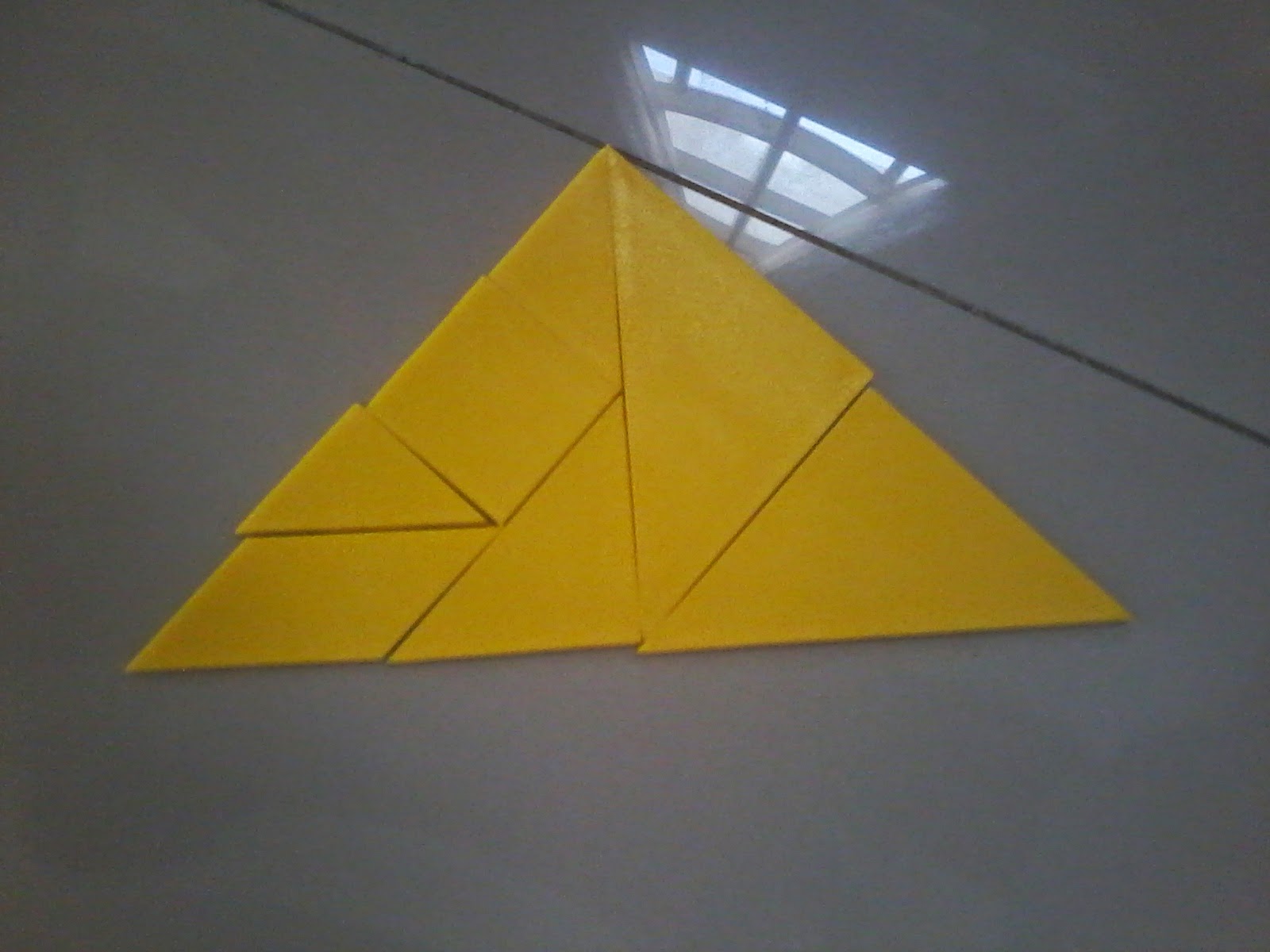
We got a book of tangram puzzles from the grandparents when we were visiting. It was a good catalyst for getting out the nice tangram set that came with our RightStart math kit. While the book gave us some good ideas, the best one was a simple progression we (J2 and I) came up with on our own: make isosceles right triangles with 1, 2, 3, 4, 5, 6, and 7 pieces.

When we did attempt puzzles from the book, we quickly noticed that we never came up with the same solution that the book had. Admittedly, we only did about half a dozen puzzles, but this led to the natural question of how many solutions we could find for our triangle progression. That naturally opens a really interesting discussion about when you should consider two solutions to be the same (rotations, reflections)?

Another path to follow is related to dissections: we had a sense that some solutions are more satisfying than others because they can't be broken into "typical" sub-shapes. Making this idea more precise is difficult, but worth pursuing.

One last path for the triangle progression is to see what solutions are possible simultaneously. There are several ways to specify this, but here is a specific challenge for you:
Let P be a set of positive integers summing to 7. Using the 7 traditional tangram pieces at one time, make isosceles right triangles so that, for each p in P, there is exactly one triangle with p pieces.
Can you find a set P that works?

Math at the market

Someone was nice enough to buy me a bag of passion fruit. For some reason, the price came up: 80 baht for 1 kg (we weighed it, just to confirm). I recalled another market where I had purchased 800 grams for 100 baht. Of course, that leads to instant discussion:

  • Which seller has a cheaper price? How do you know?
  • How much cheaper is one price than the other? What are sensible ways to compare?
  • Why might the prices be different? Different place and time are obvious ones.
  • If the two sellers were next to each other in the market at the same time, would people only buy from the cheaper source? Why/why not? What factors complicate this?
Also, if you were paying attention, you will realize that, yes, this is how I thank someone for giving me a gift: lead them along a mathematical conversation!

Some pictures

Avoid this section if you don't want hints about some tangram configurations.

We thought our approach to making a letter "L" shape was better than the one suggested by the book. Both have an annoying triangle tip poking out. Our version otherwise has a common and consistent width on the two legs which the book didn't have.


Simple rectangle. This is an example of something that comes quickly once you figure out the classic 7-piece square.


One of the members of our triangle family and a cousin of the class square. This gives away solutions for 1, 2, 5, and 7 piece triangles, so sorry about that.

Thursday, January 29, 2015

Advancing the calendar trick

I've written twice (first and second) about classroom experiences with a simple calendar trick that I originally got from Calendar Puzzles via Denise Gaskin's monthly newsletter. As happens so many times with these things, ideas from the kids make these activities into deeper and more interesting than I could have imagined on my own.

Tricked
On Tuesday, some of the first graders gave me their sums: 168 and 198. I immediately knew something was up. In the original calendar game, the square with the largest possible sum is the 23-24-30-31 square:

2324
3031

This has a sum of 108. I asked the students if they were sure of 168 and 198. They giggled, then the teacher smiled and told me she had checked it. What was going on?

My homework
I didn't have any immediate ideas, so I promised the kids that I would work on their puzzles. I told the kids that it was great to get my homework from them this time!

See through paper
One clue was that we were using a special calendar today and the paper was slightly see-through. This gave me an idea that the kids had turned the paper over and were seeing the numbers through the page with digits reversed. At first, I thought they were transforming 2s to 5s and vice versa, but was able to find 168 just by reversing digits.

How many carries?
For the original game, the crucial insight is simply that there are 7 days in a week and the calendar is organized into weeks. That means there is a simple relationship between each of the numbers in our 2x2 squares. Add a bit of simple algebra and you have an easy formula relating the upper left square of your 2x2 matrix to the sum (or, if you want to be fancy, a different formula relating whichever square you want to the sum).

For the reversed game, though, it isn't quite so easy. The relationship between the numbers can take one of several forms and is rather messy. I did manage to get 168. Can you?

But, I still couldn't get 198.

Two little helpers to the rescue
Last night, I "cheated" and asked for help. As J1 and J2 got ready to sleep, I asked what they thought their friend might have done to get 198. Their ideas from brainstorming:

  • maybe the friend made an addition error
  • maybe the friend also transformed 2s to 5s when reversing the paper
  • maybe he summed a 3x3 square instead (which quickly gave rise to 4x4 and 5x5)
3x3 square? Interesting! Work through the algebra again and you can quickly see that there is (always!) a 3x3 square whose contents sum to 198.

Some further exploration, for you
More fun follow-on questions:

  1. If the kids are allowed a choice of 2x2 or 3x3 section, but they still only tell you the sum and not the size of their square, can you still figure out which days they chose? Are there any conditions you might put on which month is chosen that allow you certainty in finding the square?
  2. What if you allow 4x4, too?
  3. Why stop at 4x4? What size squares are possible on a 1 month calendar?
  4. If you make a year calendar instead, what sums are possible? If you are given the size and sum of a square, how close can you get to finding the source? In other words, how many squares have the same sums?

If you have other ideas, please let me know in the comments!

Sunday, January 11, 2015

An elementary extension attempt

Who: J2
When: just after brushing his teeth for bed
Where: bedroom

A while ago, J2 realized that adding consecutive odd whole numbers would give him squares. For example, $1+3+5+7+9 = 25.$

He loves to ask variations on this sum of odds question. Tonight, he came up with a new idea:

what is the sum of odds up to 10?

We discussed and he clarified that he wanted 10 included somehow, not just the equation above. How would you extend the idea of adding consecutive odd numbers?

Our idea
The odd sum and squares relationship looks like this:
$$ 1 + 3+ \cdots + (2n - 1) = n^2$$

This isn't how J2 thinks of it yet. He focuses on the largest term $m$ and then, through sequential calculations, forms $m+1$, then $(m+1)/2$ and then $\left(\frac{m+1}{2}\right)^2$.

His idea tonight for answering his own question was to apply the same procedure (formula) to 10. In essence, what he was doing was saying:
  • I know what it means to "add odd numbers up to $m$" when $m$ is odd.
  • I know that the result is $\left(\frac{m+1}{2}\right)^2$ in that case.
  • I can then use that as a definition of what it means to "add odd numbers up to $m$" when $m$ is not odd!
I helped with the final squaring calculation, giving the answer: 30.25 is the sum of odd integers up to 10.

Credits
My ability to now include $\TeX$ equations is thanks to Sachin Shanbhag and Steve Holden.

Tuesday, October 28, 2014

A little question about squares (SQ1TV warm-up)


Remember the perfect squares song from Square One TV? No, then try this link

Did you catch the part about 14?  Not a square number, but the save is to add an extra digit to make it 144. Let's call that a square-save. Here's the section of the song, if you want to enjoy the 14 square-save in song.

With that as the inspiration, can you always square-save any positive integer? In other words, can you always add some extra digits to make a perfect square?

Extra credit
What do you make of the following sequence:
1, 5, 6, 2, 23, 8, 27, 9, 3, 10, 34, 11, 37, 12, 39, 4, 42, 43, 14, 45 . . .

What number comes next?
Do you notice any patterns?

Extra Extra Credit
One square-save of 10 is to add a 0, making 100. One hundred, of course, is 10 * 10. Are there any other numbers that can do this, e.g., their own square is a square-save?

Tuesday, September 2, 2014

Counting with 6 hands

Please read for the *questions* below as I'd love to have your thoughts in the comments.

Who: Baan Pathomtham 1st grade class (J1's class)
Where: at school
When: 2 hours Tuesday morning

We (P and J0) got a chance to spend the morning talking about subtraction with J1 and his classmates. It was an opportunity to see some differences between talking math one-on-one (or one-on-two) and a larger group.  Here are a couple of tidbits from the discussion.

Practice with poker chips
Of course all children need to be familiar with the standard gambling implements: dice, cards, and poker chips. The first two are already well known, so we did an activity with poker chips this time. How would you count all the chips in the picture?  Well, what if "you" were actually a group of 3 first graders?

Here's the strategy one group implemented, spontaneously, as far as I could tell:
(1) divide the chips into equal piles for each child
(2) count the remainder in the center of the pile (in this case, one chip, so the count was trivial and done without an explicit effort)
(3) take turns putting one new chip into the pile
(4) all count together as the new chips are added

Actually, this was their second strategy. At first, it was a free-for-all with all three trying to count all the chips and messing up each others division between counted and uncounted chips. 

Note: counting the chips was just accidental to the activity we were doing, so this shared counting strategy was just a cool thing we noticed along the way. If it had been more central, I would have talked with them about the equal piles at the start (which links with multiplication) and why there was a remainder (which links to the division algorithm).

Enthusiasm
Most importantly, the kids were all really excited and enjoyed working on math. They liked asking mathematical questions about a picture we presented, had fun doing calculations, trying new modeling tasks, and playing the mathematical game.

This confirms, once again, that enthusiasm and curiousity are things we (usually) kill during the educational process.  Not at our school!

Explaining
Given their enthusiasm and apparent facility with the calculations, I was surprised that they struggled to explain their calculating strategies. I can't tell if this is a language issue, if the calculations they were asked to describe are so ingrained that they don't consciously think about them, or if they don't really understand what they are doing.

My key take-away: I will focus a lot more of my discussion time on getting the J's to talk about how they calculated something, see if they can draw a picture, and see if they can explain using a concrete object.

Extensions
As preparation, P and I talked about 3 models of subtraction: taking away, differences, and counting back. P made two comments:
(1) Word problems are harder than straight calculations (said while we were discussing what types of problems to use to have the kids investigate the three models)
(2) "Counting back is such a waste, I always knew the answer through another method and had to artificially demonstrate counting back."

Word problems seemed, to me, the natural way to motivate using a particular model for subtraction. For three quick examples:

  • You started with 5 cookies and ate 3, how many are left? This is taking away, obviously.
  • Don has 27 poker chips and Tanya has 13. Who has more and how many more do they have? Differences, naturally.
  • Walking along a straight line, you go forward 6 meters and then back 2 meters, how far are you from your starting point? Counting back suits this one.
*Question* is this the wrong way to use alternative models? Is it necessary to force them to use "unnatural" models to demonstrate proficiency (for example, using take-away to resolve the differences question)? Does this create difficulties for problems involving alternative missing values in the same types of questions (i.e., you started with 10 cakes and now have 3, how many did you give away?)

Counting back is the same as the movement model, which I called "forward movement" in my post on addition models. This model leads nicely and really easily to emphasizing the role of 0, negative numbers, and subtraction of negatives. Looking a bit farther ahead, it links with vector addition by just extending our operation to more dimensions. Taken along another path (ha, the puns!) it can be used for modular arithmetic (replace directed movement on a straight line with directed movement on a circle).