Showing posts with label cards. Show all posts

Wednesday, January 18, 2017

Closest neighbor one-on-one

In my last post, I wrote about playing Denise Gaskins' closest neighbor fraction game with our 4th grade class. Yesterday, I spent time with J2 and used the game as a semi-cooperative puzzle.

This activity worked really well and the experience gave me some additional ideas about how to use the core ideas again with the 4th grade class.

Puzzle or game?
First, there were only two of us, one a kid and another an adult, so that background naturally makes the activity very different. As the key modification for play, we played all of our hands open and helped each other find the fraction in each of our hands that was closest to the target for that round. Then, we worked together to determine which of those two "champions" was closest overall.

Some of the consequences:
  • the activity was not really competitive (see below)
  • J2 had to do a lot more fraction work.
Let me explain the second point here. Because we were looking for the best play, J2 had to consider all of the combinations in his hand (20 choices). Some of those can be rejected quickly with simple analytical strategies depending on the target. Even this is good number sense thinking. Also, some combinations are close competitors and need to be analyzed more carefully.

If we were playing with closed hands, he could choose two cards, play a fraction based on them, and I wouldn't be able to say anything about whether those were his best options or not.

Second, while I write that "we worked together," as a sneaky dad, that means that I pretended to do work, while actually getting J2 to analyze my hand as well as his. Really, the only thing I offered was an alternative comparison strategy, once he had already worked through his own approach.

An example of some strategies
We found that some of the comparisons that arise naturally in this game are quite tricky, even for me. For example, quickly tell me which is closer to 1/3: 1/5 or 4/9?

We found that placing the fractions on a number line was a really helpful strategy for many of the comparisons. We also made very heavy use of the two strategies involving common numerators or common denominators.

Finally, you can see in this example that J2 is comfortable mixing decimals and fractions, for example converting to 1/2 to 3.5/7 to aid some comparison:


Our grid
Through our play, we filled out this grid, taking turns putting in our best results and congratulating each other when our hand was the ultimate champion for that round:


Competition and Strategic thinking
I was particularly pleased by one comment J2 made about this overall game: "this is mostly luck, how well we can play depends on the cards we get." This comment came after one round where he had several duplicate cards in his hand, reducing the number of distinct values he could play. We've discussed elsewhere my goals of helping the kids think about game structure, so I always love it when they bring those ideas up themselves.

Some thoughts about competition. While we played this game non-competitively, I'm not opposed to competition nor do I think that this game always needs to be played non-competitively. Ultimately, my litmus test is how to play in a way that is the most fun. If I were a more serious educator, I suppose I would also consider which way is the most educational, too.

It won't always be obvious what is the best way to play each game. In this case, I got to benefit from the prior experience with the class and my close knowledge of J2. Many times, I'll tell the kids that there are several ways to play and we'll try them out together, then review the experience.

Among other things, this is why I love handicap games like Go. By adjusting the starting advantages, we can create scenarios where it is very competitive and very fun, even though the players have very different levels of experience and current strength in the game. And also, there are things we can do together when we want a non-competitive activity.

Ideas for going back to class
From this time with J2, here are my ideas about taking the game back to the 4th grade class are:
  1. Spend a lot of time on fraction comparison strategies before we play
  2. Reduce the number of cards dealt to each player
  3. play as teams
  4. convert to open hands with a lot of talk about why we chose particular plays

An actual puzzle

As a reward for reading down this far, here's an actual puzzle related to the closest neighbors fraction game:

During the round where the target is 1/2, Jay plays 6/6 = 1. Was that her best play? How do we know?


Sunday, July 24, 2016

Wimbledon game

We have been playing the game Wimbledon from John Golden. J1 and J2 absolutely love the game and J3 has enjoyed pretending to play as well. Definitely try it out!

Below is a session report sharing some of our experiences with the game, including some alternative rules (aka mis-reading).

Our basic play
For the serve, we allow the following options:
(1) serve a single card from the top of the deck
(2) serve one or two cards from your own hand

We also allow returns that have the same value, if the largest card in the combination is higher. For example, 8 + 2 can be played on top of 7 + 3.

When playing doubles, we followed tennis conventions: one player serves the whole game, return of serve alternates. For the return of serve, the designated player must return on their own. For other returns, either of the partners alone or in combination can play cards for a return.

Having gone back to John's original post, I now see that we played with the inverse rules for aces. On the serve, we counted them as 11, all other times 1. We didn't distinguish between aces played from the hand or served from the deck, those were all 11s. That formed a strong advantage for the servers, while making aces essentially worthless for all other players.

With three players, I had the kids play as partners and I played with a ghost partner. The ghost partner would contribute cards randomly. When the ghost played cards that weren't large enough to be legal plays, we considered that an unforced error and awarded the point to the other team. While the ghost was able to hold serve for one game, it was a big disadvantage. An alternative for three players would be to have the ghost partner with the server and for everyone to take turns serving. This would put the server advantage (with our "house rules" for aces) against the ghost disadvantage.

A modification
In our play, we have found that the 10 value cards and aces (on serve) dominate game play. Here are two ideas to address that:

  • Assign face cards values 11 for Jack, 12 for Queen, and 13 for King. Ace, on serve, can have a value 14.
  • Allow players to combine as many cards as they like. This would probably work best with our "Further extension" rules below. A possible sub-variant is to only allow gradual escalation where the players can step from single card plays to 2 card plays, from 2 to 3, etc, but could not jump from a single card play to a 3 (or more) card play.

My instinct is that the variation we will like the most is to differentiate the face cards and allow gradual escalation for multi-card plays.

Further extension
Now that we've gotten comfortable with the basic and doubles games, we are considering a more complex version. The idea we are considering is to somehow limit the players' abilities to refresh their hands by redrawing so that burning a lot of cards will have a cost.

This is the rule modification, written for a 2 person game:

  1. Create a draw pile for each player with 15 cards.
  2. At the start of the game, each player draws 5 cards into their hand.
  3. Points are played as in the normal rules
  4. At the end of a point, the players refresh their hand up to 5 cards from their draw pile
  5. If a player runs out of cards in their draw pile, they cannot draw additional cards to refresh their hand.
  6. If both players run out of cards in their draw pile, then shuffle the pile of face-up played cards and give each player a new draw pile with 10 cards.
  7. Repeat step 6 as often as needed
The idea of this variation is to thematically mimic the idea that one player could push too hard, too fast, and get tired out relative to the other player. Strategically, our idea is that this will also create a tension between dumping your own low cards and letting the opponent dump.

Monday, July 4, 2016

Evens/odds and a quick update

Early years math seems to put a strange emphasis on even and odd numbers. Recently, a friend asked whether there was a point to this. Maybe it is just one of those little bits of terminology that we are asked to memorize for no reason?

By chance, this was something I had started considering about a month ago. It did seem strange that we spend so much time on this simple way of splitting integers. I wondered if it was worth the attention. From that point, my awareness was raised and I started noticing where it occurs and ways it links with more advanced concepts and future learning. My conclusion is that even/odd is surprisingly deep.

First, it is a simple version of concepts that will be developed further. For example, the alternating (starting with 0) even, odd, even,odd, even... is an illustration of a pattern. They will soon see other alternating patterns, then more complicated patterns and 2d or 3d patterns.

For another example, evens are multiples of 2, odds are numbers with a non-zero remainder when dividing by 2. This leads to understanding other multiple families, division, and division with remainder.

Second, the even/odd distinction is helpful for improved understanding of different calculations. For example, the observations that even+even = even, while odd + odd = even, etc. These can be used to help self-check their calculation and also will form early experiences with algebra. Similarly,
even x odd vs odd x odd reinforce understanding of multiplication. Again, this gets broadened for multiples of 3, 4, 5, etc.

Third, there are a lot of more advanced results that are easiest to prove by parity arguments. Sometimes we are working with a set of things that are even and the key observation is we can pair them up. Other times, we have a set that is odd and the key insight is that, when we pair them, one must be left over.

Recently, with the J1 and J2, we were looking at some constrained ways to put the numbers 1 to 25 on a 5x5 checkerboard. They were able to prove that some versions were impossible simply because 25 is odd, so there are more odd integers in 1 to 25 than even integers.

Lastly, there are techniques in computer science that involve even vs odd. This comes up pretty naturally because of the essential use of binary.

Some games

Recently, J1 and J2 have gotten hooked on some classic card games. In particular, we've been playing a lot of 3-handed cribbage. It is a nice way to do some simple addition practice and build intuition about probability. Probability is now getting even more share of mind: in the last couple of days we started playing poker together. This was actually inspired by some of our reading together.

We are reading the Pushcart War.


In one scene, there is a poker game. Of course, the J's insisted that I explain the game and were eager to try it out. J3 was the huge winner tonight, while I busted out. Oh well.

Monday, February 8, 2016

Consecutive capture and Multiplication zones (math games class notes)

The games last week were taken from Acing Math's collection of card games and John Golden's wonderful blog (here's a list of games).


Consecutive Capture

This game comes from John Golden. The idea is simple, but it is a fun game. We used this in the first grade class. We made some slight changes to his rules.
Materials: pack of playing cards, including jokers, a number line labelled -13 to +13
Players: Two to Four (though seems naturally a 2 person game)
In this games, red cards are negatives, jokers are zero, and black cards are positive. Players are dealt a hand, then take turns putting their cards on the number line. Whenever they form three (or more) in a row, they can collect the cards that form the run. The cards they collect from runs count as points toward winning. At the end of each turn, they draw a card to replenish their hand.
If a point on the number line is already covered by a card, a player can add another card with the same value on top. If that subsequently becomes part of a run, the player collecting the run only takes one card for each value.
Variations: as noted, you can play with different numbers of players. When there are multiple cards on a value, you could allow a run collector to take all of the stacked cards. In John's version, he lets black aces take the value of 1 or 14, up to the decision of the player who adds them to the number line (and red aces -1 or -14).

Multiplication zones

This is from Acing Math. For 2nd and 3rd grades, We modified the card values from their rules, keeping aces as 1, J = 11, Q = 12 and removed the kings.

Tuesday, February 2, 2016

war variations

Most of you have probably seen how the standard card game "War" can be modified to make an arithmetic drill game. Denise Gaskins probably has the best description here: Game worth 1000 worksheets.

We have used three variations of this game a couple of times: straight War (J3 and J2 playing with greater than, equal to, less than), addition war (grade 1), and multiplication war (grades 2 and 3). Frankly, I am often surprised how enthusiastic the kids are to play, since there aren't any choices for them to make when they play. For those who are ready to move on from the basic game mechanic, here are some extensions and related explorations.

Extension games

Build your deck
Currently, Vanguard, a deck building game, is very popular amongst the Js. One possiblility for War is to let the players arrange their deck in advance. In a sense, this is like a more granular version of rock-paper-scissors. I particularly like this variation for the 2 (or more) card versions where the kids need to think about how to mix high and low value cards. Also, the number of cards burned on each War battle can upset the organization for the rest of the deck, so that adds a layer of complexity for them to consider.

Choose your cards
My favorite variation is to deal a hand (between 3 and 6 cards, replenished after each "trick") to each player and then let them choose which ones to play. You can either require simultaneous play or, as we prefer, have each person play one card at a time going around clockwise, like in Bridge.

Explorations

Some exploration questions:

  1. In basic War (high card wins): will there always be a tie at some point during the first pass through the deck?
  2. In basic War: can there be a complete game (one player loses all their cards) without a tie ever occuring?
  3. Does basic War always end with one player losing all their cards or can there be cycles?
  4. How many times do we expect a tie on the first pass through the deck?
All of these questions can be explored for the different variations. For elementary kids, these are very challenging questions and I don't expect many answers. Two recommended ways to explore:

  • Play many games, record data and observations. Make conjectures and see if there are any counterexamples that disprove your ideas.
  • Play a simpler version of the game by reducing the number of cards in the deck. For example, play a demonstration game with only 6 cards: A, 2, 3 for two suits.

Tuesday, January 19, 2016

Random 100 board and some subtraction review (math games)

In grades 1 and 2, we (re)introduced the card subtraction game from one of our earliest classes.

Since this is our first class of the new (calendar) year, we also did one of the calendar tricks again in all of the classes (the first one on this page).

Repeating activities is something that we rarely do. Usually, we have been introducing a new game or activity each class, possibly following up on that activity in the following week. However, we realized that it takes more time for the kids to extract all the ideas or practice. Also, since these things are often still challenging, their interest level is high.

Four in a row

PK came up with this game, but it is based on an idea she saw elsewhere. If we recall the original source, I'll link to give it credit.
Players: 2
Material: randomized 100 board (we used 0-99 randomly arranged on a 10x10 grid); 4 dice (we used 4d6)
Turn: Player throws the dice, then combines the values using arithmetic operations to create a final result. They mark the corresponding cell in the grid with their color.
Winning: The first player to get four adjacent cells in a straight line wins (NB: diagonals also allowed)

We also asked the kids to write down their number sentences for each move, below the playing grid.

Here are the 4 grids we used (random order created using pencilcode similar to the 6th graders final assignments last term!) There's nothing magical about these, but we wanted to mix up the "easy" and "hard" numbers as well as give some additional variation for each play.


Homework


  • Grades 1 and 2 should play the subtraction card game at home
  • Grade 3 should play the 4-in-a-row game and explore the calendar trick. Can they figure out a way to find the square their friend chose? 

Sunday, November 22, 2015

Love Letter (game review)

A very quick note on a fun game with some cool opportunities for practicing logical inferences and probability. Upfront, I want to say that this review is not sponsored or supported in any way. Indeed, you will see below that we managed to play the game without even using an official set of cards.

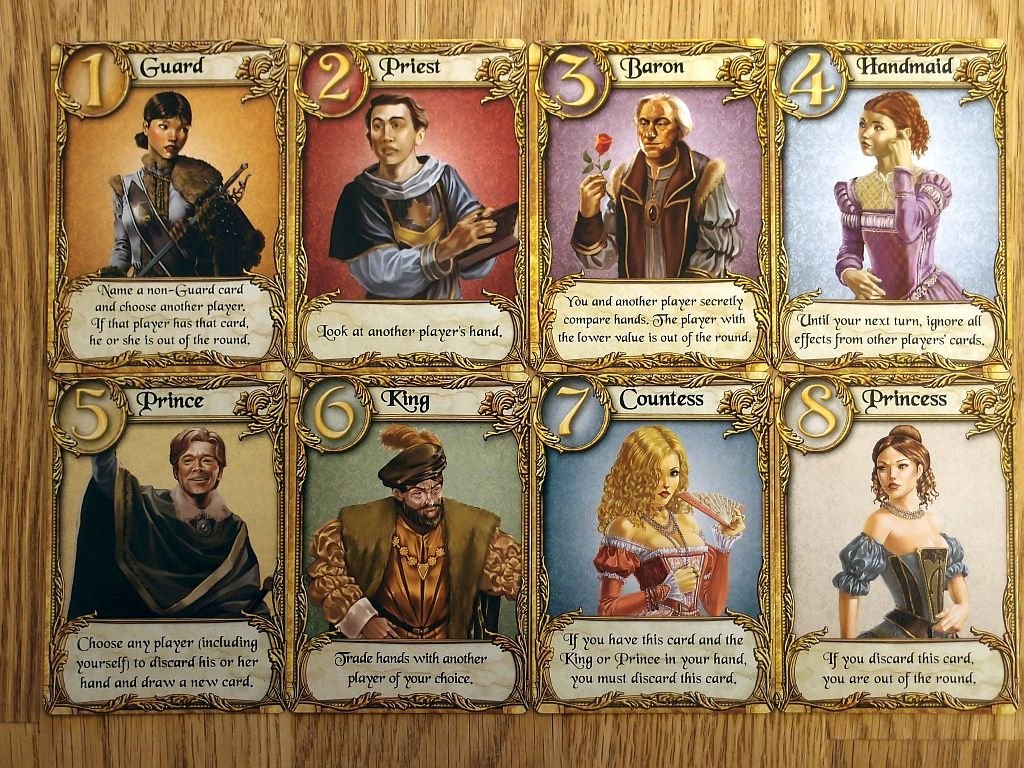
The game is Love Letter. It is a knock-out card game using a set of special cards where, mostly, you try to figure out what cards the other players have. Here are the cards; you can see each has a number in the upper left corner (a level) and a description of its action below the picture:


Each player has only one card in their hand, which they keep secret from the other players. On a turn, the active player draws a card, then chooses which of their two cards to play down, thereby activating that card's action. For example, if a player puts down a guard, they then choose another player and guess what card that player is holding.

There are only 16 cards in the deck: 5 guards, 2 each of Priests, Barons, Handmaids, and Princes, one King, one Countess, and one Princess. If, through game play, all but one player is eliminated, then that player gets a point for the round. If the deck of cards is exhausted first, then the player holding the highest level card wins that round.

Playing today with the two older J's, we simulated the deck with normal playing cards with the following mapping:

  • 4 aces and a joker in place of the Guards
  • two 2s in place of the Priests
  • two 3s for the Barons
  • two 4s for the Handmaids
  • two Jacks for the princes
  • one king for the King
  • one queen for the Princess
For the 6 and 8 year old, it only took one or two rounds for them to pick up the powers of the cards.

Here are some sample deduction scenarios that came up during play and surrounding discussion. I will leave them as exercises to you readers:

  1. You play a Priest against Player A and see she is holding a handmaid. On her next turn, she draws and plays a Guard. What card is she holding at the end of her turn?
  2. You are the first to lead the round, holding a Baron and draw a Guard. What should you play?
  3. What is the implication if a player has the King and Princess at the same time?
  4. Player A puts down the Baron and forces Player B to compare. B losses and puts down the countess, dropping out of the round. What card is player A holding?
  5. With two remaining players, you are holding a King and Guard. Which card should you play?

Overall, the game was a lot of fun, easy to pick up (even using surrogate cards), and led to some fun logic mini-puzzles. It also links readily to concepts around public, private, and asymmetric information which I'm sure we will be exploring as we play the game more.


Friday, August 14, 2015

math games class: 24 game and connect 4 dice

First grade

As a warm-up, the first grade played tic-tac-toe. This was to prepare them for the main game of they day: dice connect 4.

Dice Connect 4
Two players alternate occupying spaces on this grid:

The constraint is that, each turn, the player first throws two dice and then can only select a space in the column that corresponds to the sum. The winner is the first to get four in a row (horizontally, vertically, diagonally.) In our version, the winning spaces need to be a chain of neighbors, in the sense that each space has 8 neighbors.

Second and third grade

In both older grades, we played the 24 game. I saw this mentioned recently on Benjamin Leis's blog about his own math club (maybe just in passing here, I thought he had a more extensive post about the game elsewhere, too).

We played the "war" variation:
players: 4 (when necessary, three players can have a ghost player, or two players can modify each round slightly)
material: deck of playing cards with face cards removed
set-up: deal out all cards to the four players, cards stay in piles face down.
each round: players all turn over the top card in their pile and then race to get as close to 24 using the values of the four cards and standard arithmetic operations. In our version, we allowed addition, subtraction, multiplication, and division, but we didn't insist on using all four cards. When we played, someone would call out a value they could make and the number of cards, say "21 with 3 cards." The other players would then have a minute to try to improve that, either getting closer to 24 or making the same value with more cards.

The player who wins each round collects the four cards and puts them on the bottom of their pile, face down.

Ending the game: when any player runs out of cards, the game is over. The player with the most cards wins. Note: you can also keep going until only one player remains, but this wasn't suited for classroom play.

Playing at home: As mentioned above, you can play the game with 2-4 players. With two players, just have each player turn over their top two cards. With three, we used a dummy/ghost pile of cards to make sure each turn had four open cards. Another variation that is flexible is to keep all cards in one pile, turn over four each round, and then the player who is fastest or has the best result collects them. After the main pile is exhausted, the winner is the player who collected the most cards.

If no one else is available, this can also become a practice or puzzle session. Just turn over 4 cards and see how close you can get to 24. Write down your equations!

Wednesday, June 24, 2015

Deep Tic-Tac-Toe and tangram initials (1-3rd grade math games)

Note: we did 1st and 2nd grades in parallel this week.

First Grade

Warm-up

Our simple warm-up this week was a little before/after game with the days of the week and the months of the year. Starting out, we had a little discussion (debate) about what day it was (Tuesday, at the time). Then, what came immediately before and what came immediately after?

For months, no one was quite sure of the current month, so we talked about that for a moment, then talked about which months would be coming up. We should keep repeating and integrating into some other games so the students can get more comfortable with the sequence of months.

Clap and pat patterns

Moving on from the warm-up, I asked if they could guess some clapping patterns, where I would either clap my hands or pat my lap. Too easy, they both exclaimed. Okay . . .
Pattern 1: I clap 5 times and then ask them what comes next.  More claps! (admittedly, this was easy)
Pattern 2: Alternate clapping and patting (C-P-C-P-C-P) and then what comes next. Again, pretty easy for them to continue C-P-C-P. It was actually a step trickier for them to continue if I ended my sequence on a clap (so their continuation goes P-C-P-C etc)
Pattern 3: Same deal, but pattern is C-P-P- C- P-P etc. At this point, they were clapping and patting along with me to make sense of the patterns.
Pattern 4: C CP CPP CPPP CPPPP CPPPPP etc. Now, here's where it got complicated! We did this one several times.

Next time, we will do these patterns visually as well as aurally.

Tic-tac-toe Game

We played a couple rounds of classic tic-tac-toe (also called X-O here in Thailand). As we played, I asked them questions about what they noticed:

  • how many spaces are there on the game board?
  • how many lines do we draw to get those spaces?
  • What shapes are the spaces?
  • When we draw the board in the usual/lazy way (2 horizontal lines, 2 vertical) do all the spaces have the same number of border edges?
  • If we made more lines, how many spaces would we get?
  • At the end of the game, how many Xs and Os are there? Is it the same number for both?
  • Do they prefer to go first or second?
We had several reasons for playing. The first is to encourage their habits of noticing and wondering. Even in such a simple game, there are a lot of mathematical things they can see and talk about. Our second reason is to prepare for the huge number of tic-tac-toe variations that we can play with number recognition, arithmetic operations, and more involved strategy.

A colorful pattern

We continued our exploration of the 100 board and the bead abacus with a coloring activity. This time, we wanted to color the even numbers (multiples of 2) and not color the odd numbers. For both of the kids, though, they preferred to use different colors for the two types of numbers rather than leave anything entirely plain. As they worked on each new number, they used a 100 bead abacus to figure out whether the number was an even or an odd.

Before beginning the activity, I asked if they had a guess about what pattern would result at the end. There seemed to be a consensus that we would get a checkerboard pattern. After working for a while on the first row, though, one student suddenly had the idea that the evens and odds would be in alternating columns. An interesting conjecture!

I promise pictures of the results next week.

Homework

Play X-O 3 times with a parent or older sibling and finish coloring their 100 boards.

Second and Third Grade

Warm-up

We used a warm-up game similar to last week. When someone has two secret numbers, can we figure out their values if we know the sum and the difference?

Tangram intro

In class, we worked on classic tangram rabbit and fox outlines. This was a really good exercise in paying attention to detail. For most of the class, students would claim to have a solution and we would point out something in their outline that didn't match the target (for example, a horizontal line where it should be on a diagonal or vice versa).

As with tic-tac-toe for the 1st graders, there is a lot to notice and wonder about in the simple tangram puzzles. For example:
  • How many pieces are there? What are the shapes, what are the sizes?
  • If we are using only some of the pieces, can we make the same shape in different ways? Trying to make different types of right isosceles triangles is one version of this.
  • Which edges match exactly?
  • What angles can we match up?

Homework

Make their initials with the 7 piece tangram. As many versions as possible and, if they want, try out other letters/other shapes.

Wednesday, June 17, 2015

Mystery Numbers and a Tricky Pattern (math games grades 1-3)

who: Baan PathomTham grades 1, 2, 3
when: Tuesday morning
where: in school
what did we use: a pack of playing cards, some cube dice

While our second time with the older kids, this was actually our first time with the new 1st grade students since both were out sick last week.

Grade 1

Warm-up
This time, we wanted to play a tricky pattern game involving various ways to write numbers. To start, we all practiced writing the numerals 0-9 using Thai and arabic numbers. To help show the commonality of value, I also included little dot pictures for each. After that, we played a game where I started a sequence, then each child tried to guess and draw a number that would continue our sequence. Here is an example. The guesses that are crossed out are values that don't fit my rule:
This is a re-creation of the actual play. Obviously, the kids have better handwriting than I do


This is a strange game where wrong answers give you more information than correct answers. See if you can figure out what is allowed to come next.

Our friend: The 100 board
We had used 100 boards last week, but I realized that the kids would need a chance to really examine them, notice, and ask questions about what is there. Here are the types of things we discussed:
  • what is the largest number?
  • what is the smallest number?
  • how many spaces are there across the top? what about down the side? what about the long diagonal?
  • when we go down, do the numbers get smaller or larger?
  • when we go to the left, do the numbers get smaller or larger?
Another dice challenge: Race to 20
Armed with our 100 board, we were ready for a new dice game. I think this was my own invention, but I spend so much time reading about games and mathematical activities, that it might come from someone else. If you know who I should credit, please tell me in the comments.
# of players: 2
tools: 2 dice, a 100 board, a small object to mark our position
Game play: first player rolls both dice, chooses one value and adds that to the accumulated sum, moving the marker up to our new position. The next player takes a turn in the same way.
Winning: the first player at or over 20 wins .
Obviously, this gives some adding practice, along with reinforcing the 100 board as a tool for visualizing. After playing a couple of rounds, though, some strategy emerged when we got over 10 as we started to notice that adding smaller values was better than adding larger values. This was a slightly tricky observation since strategic errors don't necessarily lead to a loss, they just increase the probability that the opponent will win.

Most components can be varied: increase the number of dice, use non-cube dice, change the target from 20, increase the number of players. The last one, however, is a bit dangerous as it makes the game even less strategic, though I think that could also be fixed by creating partnerships for a 4 player game.

Homework
Homework this week is to play the Race to 20 (or a higher target) 5 times with a parent or friend and to test their parents with the original pattern rule.

Grades 2 and 3

Warm-up
We started with a couple of mystery number puzzles:

  • Mystery couple 1: two numbers that add to 10 and have a difference of 2.
  • Mystery couple 2: two numbers that add to 12 and have a difference of 4
Several students created their own puzzles to challenge me:

  • Student mystery a: add to 16 and difference of 7. I told them to figure out the product of their two numbers, I would write down the product as well, and they could come back and check me.
  • Student mystery b: add to 20 and difference of 5. Good to see some fractions come into play!
We didn't prescribe any particular way to attack this warm-up challenge. For students who were guessing-and-checking and got a bit stuck, we did help them organize their information into tables to make things clearer.

Challenge Josh: make 31 strategies
From last week's homework, kids came prepared with their variations of the make 31 game. For simplified games with either 1s and 2s or 1s, 2s, and 3s, they got to choose the target value and whether to go first or second. To my delight, there were conflicting views in each class, where kids had the same target value, but disagreed about whether to go first or second. I paired up those groups and we got to test it out. In a couple of cases for each class, I accepted the challenge and played against the kids. The results were mixed, I scored my share of victories, but was defeated twice.

More dotty dice
Remember, this family of games is itself a variation of tic-tac-toe, so we have a 3x3 grid, roll a cube dice, and add that number of spots to a square in our grid.  The first version we played was for each square to be filled when it got 6 dots, then the winner was the first to get 3 filled squares in a row. As an alternative, we tried playing so that the objective was to get a straight line that added up to 20.

This version proved unpopular for two reasons. First, squares would get filled with so many dots that it was hard to tell how many were there. Unsurprisingly, that was exacerbated because not every player was very neat about their dots. Second, it was possible to overfill a row so that it already had more than 20.  This week, we introduced a couple of fixes.

First, instead of using dots, we raised the idea of using tally marks. As far as I can tell, this is the whole point of tally marks, so not a surprise that it comes in handy for this problem.

Second, we changed the objective so that the target was any multiple of five, with the restriction that all squares in the line had to be greater than 0 (none could be empty). This variation proved quite popular, so it became the standard for the rest of the class. When played to win, this provides a lot of practice adding since there are so many lines that need to be checked.

Challenge: what square was last played in the RHS version?


Homework
Play 5 rounds of dotty dice, either with the target being a multiple of 5 or, for a more challenging game, multiple of 6, 7, 8, or 9.

Tuesday, June 9, 2015

We learn to simplify and Dotty Dice (math class 2 Y2)

who: Baan PathomTham grades 1, 2, 3
when: Tuesday morning
where: in school
what did we use: a pack of playing cards, some cube dice

While our second time with the older kids, this was actually our first time with the new 1st grade students since both were out sick last week.

Grade 1

Warm-up
To get started, we did some skip counting by 2 and counting backward from 20. For counting backward, we got a funny reaction when it came time to say 0. At this stage, neither student was willing/able to go below 0, but we did get to talk a little about whether there are numbers below zero. Next time, we will make this a more explicit part of the class.

Dice sums and re-roll game
Our first game is a simple one. All players have 2 dice (regular, 6-sided, for now). Players roll their dice, identify the numbers that are showing and say the addition number sentence. For example, if someone rolls a 2 and 3, they would say "this is 2, this is 3, 2+3 is 5." Next, they choose how many dice to re-roll, either all, one, or none of their dice. Once everyone has re-rolled, they again talk about the numbers showing, the addition fact, and then figure out which player got the largest sum.

We played a sample game to show them how it works and then split up, one student playing with Pooh and another playing with Josh. As we played, we would ask various questions about what they noticed and why they made certain choices. For example:

  • How many sides are on the dice
  • What numbers are on the dice? What is the largest, what is the smallest?
  • What is the largest sum they could get? What is the smallest?
  • What do they think of our choices? Did we play well or badly?

Variation
While we were playing, we noticed there are actually two slightly different versions. In one game (Version A), all players choose which dice to re-roll and then roll at the same time (or, equivalently, in secret). In Version B, players take turns deciding what to re-roll.

We only played as a 2 player game, but there are additional variations if we include more players. Again, they can re-roll simultaneously or in sequence. However, you could also add a points system based on which player has the largest sum, the second largest, etc.

Homework
We asked the students to play this game at home. They should play Version A and Version B at least 5 times (play at least 10 total rounds). Are the games the same or different? Do they use different strategies? Why or why not?

Grades 2 and 3

Warm-ups
As with grade 1, we began the older kids with skip counting warm-ups. We did two things slightly differently that I wanted to note. First, when we said that we would skip count by 7, several of the kids grabbed their notebooks with the times table on it. Instead of starting with 0, though, we started with 2. Second, I sat next to one of the students and had him secretly point to the numbers of the sequence on our 100 board while waiting for his turn. That also made it possible for him to predict what was coming next and to figure out the number he would say, which he thought was really cool.

31 strategy
The homework from last week involved playing a variation of the 31 game and investigating strategy. Almost none of the students ended up playing the original 31 version. Instead they generally played with 1 (ace) through 10 with a target of 71. When we talked about strategy, almost everyone had figured out that there was something interesting happening in the 60s, with several ideas that you wanted to make 60 on your turn, though there were some thinking 61 was an interim target. Everyone acknowledged there was complexity if you had already used up all of a particular number and there were some ideas about explicitly forcing that outcome, mostly looking at using all of the aces or other small values.

No one felt they had a clear strategy and no one was sure whether it was best to be first player or second.

I told them this wasn't surprising because the game is actually pretty complex. One of the ways we can get a better understanding is to make it simpler. We then talked about ways to make the game simpler (use fewer card values, have a smaller target) and then began to investigate.

  • Ace only: the simplest game we wanted to study was to use only 4 aces. What is the largest target we could use? I joked in each class about playing to 1000. For all the reasonable targets (1 to 4) who wins, first player or second player? This was very easy, but I wanted to emphasize that it is great to start with something we really understand well as preparation for jumping into a more complex version.
  • Ace and 2: an obvious next step is to add the next value card. Again, we talked about what the largest reasonable target is and then stepped through strategy for different targets. First player has a winning strategy if we target 1, 2, or 4, while the second player can win targeting 3. Are there any values larger than 3 for which the second player has a winning strategy? We didn't talk through all strategies for all targets, so this is part of the homework.
  • Ace, 2, and 3: stepping up again. This time, we played a couple rounds with a target of 24. I was slightly surprised that this held their interest, even on the second round. Again, we worked a bit on strategies for different targets, but we didn't talk through it completely, so this is part of their homework. One student guessed that 17 might have a different strategy to smaller targets. 

Dotty Six (another dice game)
The basic idea for this game family comes from NRich, so I won't repeat the basic rules. In addition to the dotty six version, we played a dotty ten version where each cell of the board is only filled once it has ten dots (or tally marks) in it.

Homework (grades 2 and 3)

  1. For the Aces+2s variation of 31, find a target larger than 3 for which the second player has a winning strategy.
  2. Prepare to challenge Josh: for the Aces+2s+3s variation of 31, choose a target (larger than 4) and whether you want to be first or second player against Josh.
  3. Keep making observations about the strategy for these games.

Tuesday, June 2, 2015

31 Game (math class 1 year 2)

who: 2nd and 3rd grade at Baan Pathom Tham school
when: Tuesday morning, around snack time
what did we use: regular playing cards

In our class today, we mostly borrowed the game 31 from Dudeney, via Denise at Let's Play Math. You can find the basic rules there, so I will write about slight variations we played and our experience playing with the kids.

Variations
The first modification we made was to start playing as a group instead of head-to-head. Going around in a circle, each student took a turn choosing a card from the grid and adding that value to the running total. This made the game less competitive and involved more people. Because it was less competitive, the kids were willing to choose cards fairly randomly and speed up game play. This was a big advantage for introducing the game, otherwise a couple of the more competitive kids wanted to take a long time thinking through the game to work out their own strategy.

This version also offered natural points where we could ask the kids to look ahead to see who would be able to reach 31, with everyone participating in the question.

After playing this version for a while, we split up and continued this way with half the class. After another couple of rounds, we split into teams and played head-to-head.

Finally, we added cards 7, 8, and 9 to the grid and played to a target of 61.

*Update*: After talking to one of the parents about this game, we came up with another variation. For this, arrange the cards in order 1 to 6, but turn them face-down. Players then alternate turning the cards up and the running total is the sum of the cards showing. Two reasons for considering this version: first, it provides an extra pattern for the kids to consider when they are deciding which card to turn and, second, it is easier for them to recalculate the running total based on the values they can see than the ones they can't see.

Observations
In the basic strategy for the 31 game, the numbers 24, 17, 10, and 3 have special significance. As we were playing, most of the kids recognized the importance of 24. A couple were also able to work back to 17. I didn't see anyone fully work out the associated strategy. Then, it will be fun to see if they can figure out that this isn't a complete strategy for the game.

When playing the game, the kids who just wanted to play randomly were still very interested in questions that hinted at strategy. For example, I would pause the play briefly to ask whether either one had a winning strategy from that point or for someone to explain why they had made a certain play. Generically, these were good conversations.

The kids who wanted to figure out a strategy were generally less fun as playing partners because they were cautious and slower in their play. I'm not sure whether this is a feature or bug.

In second grade, all of the games ended exactly on 31. In third grade, they managed to get a couple of endings where 31 was impossible. I don't think they were yet able to work out exactly what happened to create that result.

Finally, I am looking forward to discussing the targets. Is 31 a good value for the 1-6 game? What would be different if the target were lower or higher? What about the 1-9 game or 1-10 game? What makes a good target anyway?

Homework
Playing either A (value of 1) to 9 or A through 10, play 5 times and record the outcome. Write down your thoughts on strategy for how to win this game.