Showing posts with label 7 year old. Show all posts

Tuesday, February 11, 2020

What is 8?

I've had a chance to spend more time doing math with the kids again and am hoping to write up our activities more consistently.  Let's see how this works out!

Graham Fletcher created a set of  Progressions videos for various elementary school themes. J3 and I recently went back to his page and found he had a new(er than we knew) progression on early number and counting.  Even for this simple topic, the video highlights some points we hadn't considered explicitly, for example distinguishing producers (of a number) and counters. Also, the cardinality point that smaller natural numbers are nested within larger numbers wasn't something we had talked about, but we soon realized it was part of many examples in how we understand numbers.

With that as inspiration, J3 and I decided to search for a range of examples of a single number, we chose 8, in different forms.  There is at least one obvious version we're missing.

Add a comment (with picture, if you can) to show other forms of the number 8!

Marking 8 on the 100 board, an easy place to start:


8 beads on the abacus shows the relationships 3+5 = 8 and 10-2 = 8 (also 100- 92 = 8)

8 can hide in plain sight. Without labeling the three lengths, it would have been hard to recognize the longer one as 8 cm and, for you at home, impossible to know without reference to show the scale.


It happened that, within the precision of our scale, two chocolate wrapped chocolate bars were 8 oz (2x3.5 oz of chocolate + about half an ounce of wrapping for each):

8 cups of water ended up being a lot, so this version unintentionally revealed a relationship 4 + 2 + 2 = 8

Though I'm not sure I can articulate why or show supporting research, I feel it is very valuable to build experience with physical models of numbers to create familiarity and intuition about what they are/mean. In particular, I hope this helped J3 anchor the importance of units of measure and scale in the interpretation of numbers.

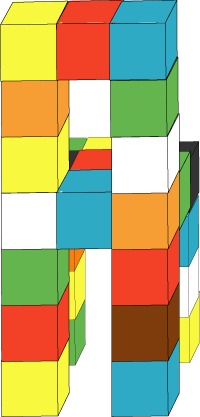
Finally, this construction has nothing to do with the number 8 (or does it???)

Monday, March 6, 2017

Cryptarithmetic puzzles follow-up

I was asked to write a bit about strategies and answers for the puzzles we gave two weeks ago.

BIG + PIG = YUM
Because the digits in YUM are all distinct from BIG and PIG and there are only 7 letters in this puzzle, we should expect there to be many solutions.

The easiest way to get a feel for the puzzle is to start trying values and see what develops. This was part of the idea of using this puzzle as the opening challenge.

As we play with examples, the kids should notice these things that constrain our possible solutions:

  1. B, G, I, M, P, U, Y must all be distinct
  2. We are adding two three digit numbers and the sum is a three digit number
  3. B, P, and Y are all leading digits
  4. The largest sum possible with two numbers 0 to 9 is 18.
Some conclusions:
(a) G is not 0. If it was, then M would also be 0.
(b) B, P, and Y are all not 0. They are leading digits, the rules of our puzzles say they can't be zero.
(c) G + G is at most 18. It may contribute at most one ten to the calculation of U.  That will only happen if G is 5 or larger.
(d) I + I is at most 18. Along with a potential ten from G+G, that means we have at most 19 coming from the tens. That will only happen if I is 5 or larger.
(e) B+G is at most 9. If there is an extra hundred coming from the tens digits, B+ G is at most 8.
(f) If I is 9, G must be less than 5. Can you see why?
(g) If G is less than 5, I cannot be 0

After these observations, I'd suggest picking values of G, then seeing what values of I are allowed, then checking what remains for B and P. Because we aren't allowed to have duplicates, we quickly see that our choices are constrained.

For example, if G is 1 or 2, then I is at least 3 and we get the following possible solutions (B and P can be interchanged):
431 + 531 = 962
341 + 641 = 982
351 + 451 = 802
371 + 571 = 942
381 + 581 = 962

132 + 732 = 864
132 + 832 = 964
152 + 652 = 804
152 + 752 = 904
182 + 582 = 764
192 + 392 = 584
192 + 592 = 784

There are some more advanced ideas that could come out of trying to count or list all of the solutions, so I'd encourage people to explore. Even this simple puzzle can be a lot of fun!

CAT + HAT = BAD
The A in BAD is the key part of this puzzle. We can get two cases:
(a) A is 0 and T is 1, 2, 3 or 4
(b) A is 9 and T is 5, 6, 7 or 8.

Again, while there are a lot of solutions (and counting them would be a fun challenge) they are easiest to build up by choosing A (either 0 or 9), then T, then seeing what flexibility is left for C and H. Here are some examples:

301 + 401 = 702
301 + 501 = 802
301 + 601 = 902
302 + 502 = 804
302 + 602 = 904
103 + 403 = 506
395 + 495 = 890

SAD + MAD + DAD = SORRY
This was a puzzle without a solution. In this case, it isn't too hard to see that SORRY has too many digits. The best explanation was given by one student:
  • The largest three digit number is 999. 
  • If we add three of them, we will at most get 2997. 
  • SORRY has to be bigger than 10,000.
  • This isn't possible
CURRY + RICE = LUNCH
Unfortunately, this also doesn't have a solution, but the reasoning is more subtle than the previous puzzle.

Here, we can reason as follows:
  • R cannot be 0 because it is the leading digit in RICE
  • Because the tens digit of RICE and LUNCH are both C, R must be 9 and we must have Y + E > 10.
  • This also means R + C + 1 = 10 + C.
  • That will mean the 100s digit of RICE must be the same as the 100s digit of the sum.
  • However, the 100s digit of RICE and LUNCH are different.
Too bad, it was such a cute puzzle!

ALAS + LASS + NO + MORE = CASH
This is the most challenging puzzle from this set.

Some things we notice:
  1. There are ten letters (A C E H L M N O R S) and they must all be distinct.
  2. We are adding three 4-digit numbers and a two digit number to produce another 4 digit number.
  3. A, L, N, M and C are leading digits, so they can't be zeros.
  4. The tens and hundreds digits of CASH (S and A) are also involved in the sums for those digits.
Point 4 has a subtle implication, which I'll illustrate with the hundreds digits. Since L + O must be more than 0, but A is the hundreds digit of the sum, we must have some number of thousands carried over. Because A, L and M are all distinct and larger than 0, the smallest their sum can be is 1+2+3. Putting these two observations together, C must be at least 7.

In this case, I find it helpful to put together a table showing possibilities that we have eliminated:
We can see some more restrictions from the fact that A + L + M must be less than 9. That means we have only the following possible triplets (ignoring order):
{1, 2, 3}, {1, 2, 4}, {1, 2, 5}, {1, 3, 4}

One thing we notice is that 1 is in all of these triplets, so either A, L or M must be 1 and none of the other letters can be 1. Another thing we notice is that we don't yet have any way of differentiating A, L, or M, so any ordering of our triplets is possible.  That would mean we have 24 cases to consider.

Let's see how we would work through the cases, starting with A = 1, L = 2, M = 3, the first on our list. Now this, happens to be a stroke of luck, as we'll see.

Starting from the thousands digit, we see that this would make C = 7, if there is a single carry from the hundreds. Indeed, we can see that this must be the value (in the case we are testing), as the carry from there could only come from L + O (plus any carry from the tens digit). Since L is at most 5, L + O is at most 14 and any carry from the tens digit must be less than 6.

Now, in the hundreds digit, we have 2 + O + carry from the tens = 10, so O = 8 - carry from tens.
We know there must be at least one carry from the tens, so O is at most 7. Since 7 is already used by C, let's try 6. That means we need to get 2 hundreds carried over from the tens, so we need
A + N + R + carry from ones = 20, or N + R + carry from ones = 19. Since we have already used 6 and 7, the only way this is possible is if N and R are 8 and 9 (in either order) and we are carrying 2 from the ones.

At this point, the case we've worked through has:
121S + 21SS + 86 + 369E = 71SH

We still have to allocate digits 0, 4, and 5. and we know that S + S + 6 + E = 20 + H. Given our remaining digits, the biggest the left hand can be is if S is 5 and E is 4, making 20. The smallest the right hand can be is if H is 0. Fortunately, this makes the equality hold, so we get our final answer:

1255 + 2155 + 86 + 3694 = 7150

Through the process of checking this case, we learned more about how the carry from lower digits is restricted and it would be faster for us to check through remaining cases.
Let me know how many other solutions you find!

LOL + LOL + LOL + LOL + LOL + LOL + LOL + LOL + LOL + LOL +
LOL + LOL + LOL + LOL + LOL + LOL + LOL + LOL + LOL + LOL + LOL = ROFL

There are 71 LOLs, so this is 71 x LOL = ROFL. While this looks daunting, there are some ideas which take us a long way to the solution.

First, ROFL has 4 digits. If L were 2, 71 x LOL would be more than 14,000, so L must be 1. In fact, ROFL is less than 9861, so LOL is smaller than 9871 / 71 which is 139. We can quickly check
101, 121, and 131 and see that 131 works.

71 x 131 = 9301

Thursday, February 23, 2017

A bit of 3D(ish) geometry

Note: this post started out focused on two recent geometry projects. However, the Desmos Function Carnival, which I originally just included as a miscellaneous item, is also worth your time.

Nets and solids

The most ambitious project recently was led by P (the mom, of course). She found nets for 3-d shapes and supervised J1 and J2 as they created a nice display to take to school.

Here are the nets: SenTeacher Polyhedral nets. They have a collection of other printables, but this collection of nets seems to be the most interesting. Take a look and let me know if you see anything else worthwhile.

Here's the completed board:

A profile picture to show that these are really 3-d:

Solid Shapes and Their Nets (I think Jo Edkins is the author) has a nice discussion of nets and a little puzzle game to distinguish nets that fold into the platonic solids and which don't. Feel free to try to do this for the icosahedron or dodecahedron!

A two dimensional challenge?

J2 asked me about a triangle with two right angles. Of course, we all know that a triangle can't have two 90 degree angles, right? Well, this fits in my list of math lies from this old post: 23 isn't prime.

We talked briefly about triangles on a plane and agreed that two 90 degree angles wouldn't work. If we try by starting with a side and building two right angles on that side, we just get parallel lines. Ok, that's standard.

However, what about this:

We discussed spherical geometry for a bit. Not shown is our first attempt on the other side of the tennis ball that did have two right angles, but the third wasn't. He wanted to see an equiangular triangle on a sphere. This led to further discussion of life on a sphere:

  • what is the largest interior angle sum for a triangle?
  • what is the smallest interior angle sum?
  • are there any parallel lines?
  • are there any squares? are there even any rectangles?
  • is π (the ratio of the circumference to diameter of a circle) a constant?
  • do we have to think like this in real life because the earth is close to a sphere?
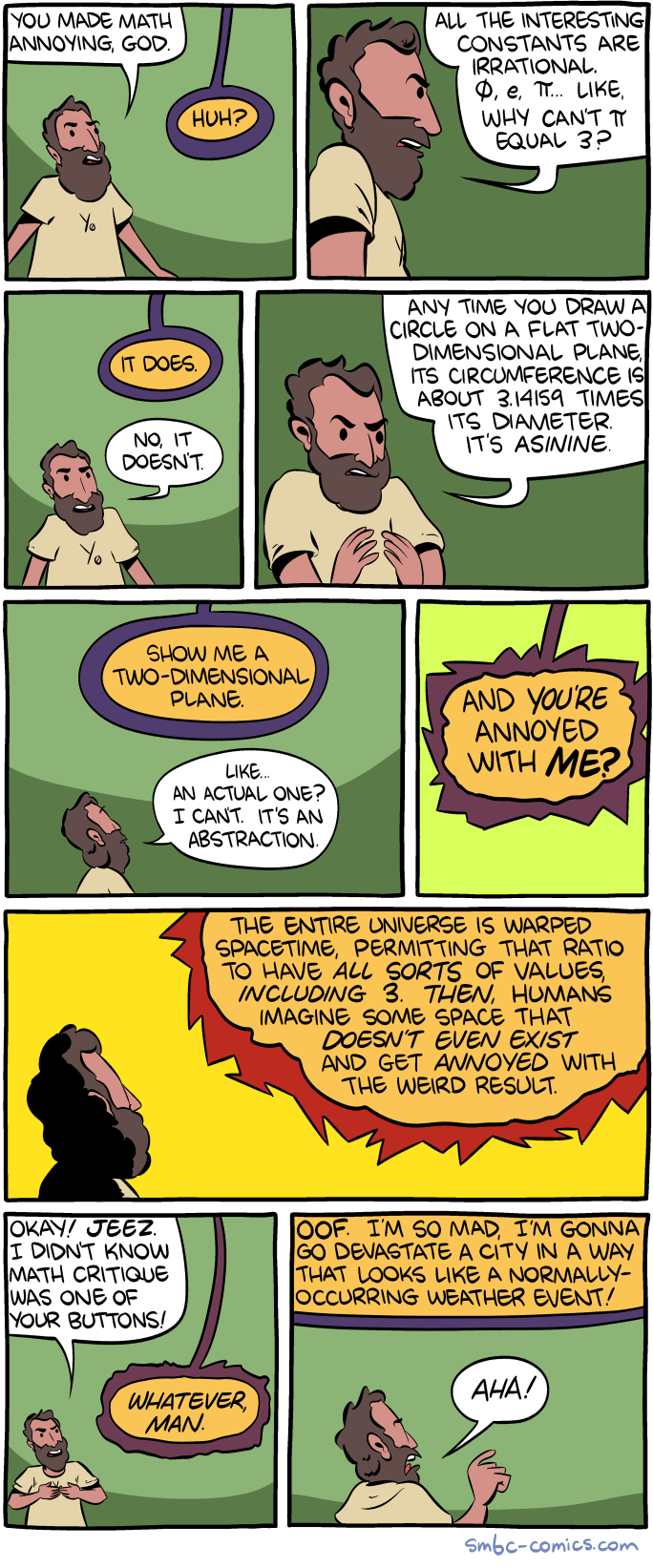
Picking up the point about π, it occurs to me that this is another math lie. This point got a nice treatment recently by SMBC:

I made this pic small so you will go to the site and look at Zach Weinersmith's other awesome work
Some open follow-ups:
  • what is an equiangular quadrilateral on the sphere?
  • what about hyperbolic geometry? I think no triangles with two right angles. If I recall correctly, triangles there have angle sums smaller than 180 degrees (or π radians, ha!)

Other Misc Math

Now for my usual grab bag of other things we've been doing. Some of these are really great activities, so don't skimp on this section!

Desmos Function Carnival
We learned about the Desmos Function Carnival activity from a post by Kent Haines which, in turn, we learned about via Michael Pershan's post. They both were writing about teaching functions to their students and have outlined a really nice sequencing of lessons, if you're into that kind of thing.

In case you are, you might like to know that there is another flavor of Function Carnival available through the Desmos teacher site with 2 other activities. Each version is worth checking out because both of worthwhile activities that aren't in the other. Also, Kent links to this nice graphing activity from the Shell Center which also worked well with J1 and J2.

For our purposes, I was more interested in the mathematical physics (plots of position vs time or velocity vs time) and the fun of creating wacky animations with impossible plots.

If I can figure out how to post the animations, I will update this page, since the animations really enhance the experience. For now, let me give you some screen caps of some of their proposed graphs from the Cannon Man (height) activity:

Have a free-form drawing tool? Make your name!

Note: the vertical stripe doesn't really work with this animation, but the patriotic spirit is there!

Our first attempt at Quantum Field Theory


Here is J2 playing with the function carnival, but J3 (4 years old) enjoyed it just as much:

Different representations
J3 is working on place value and playing with different representations of numbers. Here, she's got the 100 board, an abacus, and foam decimal models. Sometimes I challenge her to make a number, sometimes she challenges me.


Tuesday, February 21, 2017

RSM International Math Contest

Sometime the first week of February, the RSM offers an on-line math competition. For the second year, I had J1 and J2 work through the problems at grade 3 and grade 4 level.  This post is about our thoughts on competition, but I end with a problem from the contest that had us debating.

Compete and win!

To get it out of the way, let me explain my interest in the competition and why I had the kids enter. Above all, I was curious about the problems and expected they would be interesting challenges. We found the puzzles last year interesting, so I was pretty sure this year's collection would also be nice.
While I know that there are tons of excellent activities, I couldn't resist making use of this resource when someone thoughtful had put together a convenient collection in one place.

Second, I am curious about levels and assessments. What types of questions does RSM think 3rd and 4th graders should be able to answer, but find challenging? How difficult would our two little ones find them? Since we are currently operating outside a standard curriculum framework, it is hard for me to judge where they are or what we should expect of them. Admittedly, there are other ways I could form this assessment, but they take more effort.

Notice that I don't really care about how well they perform on the test. It is interesting information for me, but I don't need them to do well.

P has a different view. She was an olympiad kid and sees competitions as the easiest way for our kids to distinguish themselves. You know the anxiety: if they don't win competitions, they won't get into Harvard, they'll end up on the street somewhere.

Perhaps unsurprisingly, the kids are getting a mixed message about the importance and reason for participating in competitions. This year, J1 was particularly sensitive. He was very resistant to doing the RSM test. I spent a lot of time talking with him. Mainly, I wasn't hoping to convince him to do the test, but I wanted to explore other issues related to the expectations he feels on himself, his relationship with J2, and his mindset about his own learning.

I am trying to communicate:

  1. effort and progress are important, starting point and base ability aren't. I know this is debatable, but I'm talking about the differences between my kids where I'm on pretty firm ground.
  2. there are many aspects to math and mathematical ability. Calculating and answering questions quickly are facets, logical reasoning, strategic thinking, spatial reasoning, asking good questions, gathering data, exploring connections, etc, etc are all components, too.
  3. time isn't important. One issue with the RSM test is that it is timed. This goes in the face of our repeated efforts to emphasize that the time it takes to solve something is not a key consideration. To help with this, I screen capped the questions so he could work on them after the official time had expired. Note, however, his recorded performance on the test was based on work within the contest rules. 
  4. Math is not about right answers.
The next section might help illustrate that last point.

Which area do we want?

As mentioned above, one of the questions from grade 4 cause us to argue among ourselves. I'm paraphrasing slightly:
Two tennis ball machines stand on opposite ends of a 25 meter by 10 meter court. The yellow machine shoots yellow balls that stop on the court 2 meters to 16 meters from the yellow machine's side. The green machine shoots green balls that stop on the court 5 meters to 20 meters from the green machine's side. Find the area of the court that has balls of either color on it.
Here are some ideas from our discussion:

  • Option A: we want to find the area of overlap, because that's the only place we could find balls of either color.
  • Option B: we want to find the combined areas, because that's where we could find tennis balls, either color.
  • Option 1: the area with green balls is a rectangle, the area with yellow balls is a rectangle.
  • Option 2: think of the ball machines as single points, shooting balls at various angles and various distances. the target area for each machine is an intersection of of a circular ring and a rectangle. This idea came from J2 when we were looking over the grade 4 questions after time had expired.
To answer the question, choose either A xor B and choose either 1 xor 2. So, what is the right answer?

I think the right answer is to have this discussion, to encourage multiple interpretations (with justification), to see how the answers compare, to think about what other things we could do to make the intended interpretation more clear (a diagram seems the most obvious), to recognize that this is part of the richness of math and it can't be represented by a single numerical answer on a timed test.

Cryptarithmetic Puzzles for Grades 1 to 4

Inspired by a series of puzzles from Manan Shah, I decided to have the kids play with cryptarithmetic puzzles today. In addition to borrowing some of Manan's puzzles, I also used some from this puzzle page: Brain Fun. I've included some more comments below about the Brain Fun puzzles.

My main concern was whether the puzzles were at the right level. In particular, I was afraid that the puzzles would be too hard. In fact, I tried solving a bunch of them yesterday and actually found myself struggling. I'll ascribe some of that to being tired and sick. However, my intuition was to make some simpler puzzles of my own. In particular, I added:
  • puzzles that have many solutions: I figured that many solutions would make it easy to find at least one.
  • a puzzle that "obviously" has no solution. Now, obviously, the word "obviously" is a sneaky one in math, but I was pretty sure the kids could see the problem with this structure.

Grades 1 and 2

For the younger kids, I started with a shape substitution puzzle. This is one our family explored almost 2 years ago: Shape Substitution. I don't recall the original source.

Two reasons why I started with this. First, it has a lot of solutions, but there is an important insight that unlocks those solutions. Second, by using shapes, we can write possible number solutions inside them as we solve or guess-and-check the puzzle. This made it easier for the kids to see the connection that all squares have the same value, etc.


The second puzzle: BIG + PIG = YUM
Really just a warm-up practicing the rules and doing a little bit of checking that we haven't duplicated any numbers.


The third puzzle: CAT + HAT = BAD
Again, lots of solutions, but noticing leads to a good insight.

Fourth puzzle:  SAD + MAD + DAD = SORRY
This is a trick puzzle. The kids know that I like to tease them, so they are aware they need to look out for things like this. We discussed this in class and I suggested they give this puzzle to their parents.

Fifth puzzle: CURRY + RICE = LUNCH
When I translated this to Thai, all the kids laughed. I was sneaking a little bit of English practice into the lesson and then they realized that it was worth trying to read all the puzzles, not just solve them.

Sources: I think I made up all of these puzzles (original authors, please correct me if I'm wrong).

Grades 3 and 4

The older kids already had experience with these puzzles. We did refresh their memory a bit with BIG + PIG = YUM

I asked them to give me the rules and explain why those rules made sense. As with most games, I want to communicate that we're doing things for a reason, but those reasons can be challenged. If they think it makes sense to do it a particular way, we're open to their ideas.

Second puzzle:  SAD + MAD + DAD = SORRY
Same discussion as for the younger kids. When prompted, this was pretty easy for them to spot, but they weren't naturally attuned to think about whether a puzzle had solutions or how many. This led me to take a vote on all the puzzles at the end to see who thought the puzzles would have 0, 1 or many solutions.

Third puzzle: ALAS + LASS + NO + MORE = CASH
A puzzle from Brain Fun. I think this is one of the easier ones on that page. Again, a bit of English practice.

Fourth puzzle: LOL + LOL + LOL + .... + LOL = ROFL (71 LOLs)
This was from Manan. I think it is one of the easier ones in his collection, but it looks daunting. Turns out none of the kids in the class were familiar with (English) texting short-hand, so my attempt to be cool fell flat.

Fifth puzzle: CURRY + RICE = LUNCH
Again, everyone was delighted when I translated this one. We're in Thailand, after all, so at least one puzzle had to be about food.

The key exercise

The final assignment everyone (all four grades) was given was to make up a puzzle for me to solve. I was thinking it would be nice to have one in Thai, but we decided to keep it in English as further language practice.

Manan wrote a nice post about having kids design their own puzzles. If it goes well, this is actually the activity that ties a lot of the learning messages together: they think about structure, they think about what allows multiple or single solutions, they apply their own aesthetic judgment, they use their knowledge of the operations, they are empowered with an open-ended task that cannot be "wrong."

We'll see how it goes. At the very least, I expect a lot of work for myself when their puzzles come in!

An extra sweetener
Two kids asked if we could use other operations than addition. That prompted me to put this on the table (also from Brain Fun):

DOS x DOS = CUATRO

Brain Fun Problems

The first time I'd seen the Brain Fun problems, I added them to a list and called them "basic" (see this page.) When I actually went to solve them, though, they didn't seem so easy.

Big confession time: I actually looked at some of the solutions.  However, I was disturbed to see that the solutions involved extra information that wasn't included as part of the problem statement! For example, in THREE + THREE + FIVE = ELEVEN, the solution assumes that ELEVEN is divisible by 11. This seems to be the case for several of the puzzles involving written out arithmetic:

TWO + TWENTY = TWELVE + TEN (assume 20 divides TWENTY and 12 divides TWELVE, I wasn't clear about whether any divisibility was assumed for TWO and TEN)

I'm not sure if similar assumptions are allowed/required for any of the others.

Maybe I shouldn't complain, since this assumption creates an additional constraint without which there could be further solutions. Perhaps part of the reason it doesn't sit well is aesthetic. In the 3 + 3 + 5 = 11 puzzle, 3 doesn't divide THREE and 5 doesn't divide FIVE.

Lastly, there is a typo in the final puzzle of the Brain Fun page. That puzzle should be
TEN x TEN = FIFTY + FIFTY

Thursday, February 16, 2017

More Man Who Counted (gaps and notes)

As previously mentioned, we have been reading The Man Who Counted. While the story is good and there are nice math puzzles, we've found some of our best conversations have come from errors or weaknesses in the book. Here are three examples:

How old was Diophantus?

In chapter 24, we encounter a puzzle to figure out how old Diophantus was when he died. In summary, the clues are:

  1. he was a child for 1/6 of his life
  2. he was an adolescent for 1/12 of his life. (J1: "what's that?" J0: "a teenager")
  3. childless marriage for 1/7 of his life
  4. Five more years passed, then had a child
  5. The child got to half its father's age, then died.
  6. Diophantus lived for four more years
Perhaps we are wrong about our interpretation of the clues, but we noticed two things:
(a) the answer is not a whole number of years.
(b) the answer given in the book doesn't fit the clues.

For the first part, it seems a natural assumption of these types of puzzles that we are only working with whole number years. Sometimes, this is an interesting assumption to directly challenge.
Here, since the clues involve a second person (Diophantus's child) we felt whole numbers were a strong assumption. Also, the name Diophantus, you know?

Each clue required some discussion for us to agree on the interpretation. The one that seems most open is the fifth clue. In particular, did the child live until its age was half of the age of its father at the time of birth or to the point that, contemporaneously, it was half its father's age?

For completeness, I'd note that neither interpretation matches the book's answer. The first interpretation does allow a whole number answer, but it doesn't give whole numbers for all the listed segments of Diophantus's life.

Just so you can check for yourself, the solution given in the book is 84 years old.

How do you fix it?
We discussed several possible fixes:

  • accept answers that aren't whole numbers or require whole number segments for each clue. This allows us to take the alternative interpretation of the fifth clue (though that still isn't satisfying) or to accept the clues and just take a new answer. This isn't satisfactory because... Diophantus.
  • Change clue 4 or clue 5 to match the book's answer. This approach seemed to fix the puzzle without distorting it or changing the mathematics required to analyze it.
  • Change clue 1, 2, or 3. While possible, these seemed to open the possibility of changing the character of the puzzle. Also, these fractions were plausible based on our own experience of human life spans.
Of course, an even more satisfying answer would be to introduce a further variable and make the puzzle into one that makes heavy(ier) use of the integer restriction.

Clever Suitors

In chapter 31, Beremiz is confronted by a nice logic puzzle. Three suitors are put to a test, each is blindfolded and has disc strapped to his back. The background of the discs: other than color, the discs are all identical, there are five to choose from, 2 black and 3 white.

The first suitor is allowed to see the colors of the discs on the backs of his two competitors, then required to identify the color of his own disc and explain his reasoning. He fails and is dismissed.

The second suitor is allowed to see the disc on the back of the third suitor, then required to identify the color of his own disc and explain his reasoning. He fails and is dismissed.

Finally, the third suitor is required to identify the color of his own disc and explain his reasoning.  He succeeds.

Weakness 1
As a logic puzzle, we enjoyed this. Our problems came from the context in the story. This challenge was set to the three suitors as a way of fairly judging between them by finding the most clever suitor. However, this process was clearly unfair. In fact, it is inherent in the solution that it was impossible for the first and second suitors to determine the color of their own discs.

This led to a nice discussion about who really held the power in this process: the person who structured the problem by deciding what color disc should be on which suitor and what order they would be allowed to give their answers.

Extensions:
  • consider all arrangements of discs. Are there any arrangements where none of the suitors can answer correctly?
  • What is the winning fraction for each suitor? If you were a suitor, would you prefer to answer first, second, or third?

Weakness 2
Our second objection was non-mathematical, but again related to the story context. The fundamental problem wasn't how to choose a suitor. The fundamental problem was how the king could remain peacefully friendly toward all the suitors' home nations through this process.

For this discussion, we went back to the story of Helen of Sparta, which we'd read a long time ago in the D'Aulaire's Book of Greek Myths. Of course, that also led to discussion of the division of the golden apples, another puzzle we all felt surely could have been solved more effectively with some mathematical reasoning...

The Last Matter of Love

The last puzzle of the book is in chapter 33. It is another logic puzzle, again intended to test the merit of a suitor in marriage. The test:

  • there are five people
  • two have black eyes and always tell the truth
  • three have blue eyes and always lie
  • the suitor is permitted to ask three of them, in turn, a "simple" question each.
  • the suitor must determine the eye color of all five people
As a logic puzzle, we readers get some extra information:
  1. The first person is asked: "what are the color of your eyes?" The answer is unintelligible.
  2. The second is asked: "What did the first person say?" The answer is "blue eyes."
  3. The third is asked: "What are the eye colors of the first and second people?" The answers are "the first has black eyes and the second has blue eyes."
Simple questions
Our first objection was the part about asking "simple" questions. Having developed our taste for these types of puzzles through the knights and knaves examples of Raymond Smullyan (RIP, we loved your work!!!), the third question really bothered us. If you're going to go that far, why not ask the third person for the color eyes of all five people?

Personally, I would prefer that the puzzle require us to ask each person a single yes/no question.

As an extension: can you solve the puzzle with that restriction? 

Getting lucky
Again, we felt that this puzzle didn't meet the requirements of the context: to prove the worthiness of the suitor. Putting aside the question of whether this is really an appropriate way to decide whether two people should be allowed to marry, the hero here got lucky.

Extension: what eye color for the third person would have caused the suitor to fail?
Extension: what answer from the third person would have caused the suitor to fail?
Extension: for what arrangement of eye colors would the questions asked by the suitor guarantee success?
Extension: what was the suitors' probability of success, given those were the three questions asked?

Waste
Our final objection was the simple waste in the first question. From a narrative perspective, this is justified and even seems made to serve the purposes of the suitor. However, it opens another idea:
can you solve the puzzle, regardless of eye color arrangement, with only two questions?

Feel free to test this with yes/no questions only or your own suitable definition of a "simple" question.

The power of...

As a final thought, let me say that I think errors and ambiguity in a text are a feature, not a bug. It is another great opportunity for us to emphasize that mathematics is about the power of reasoning, not the power of authority.

Monday, February 13, 2017

NRICH 5 Steps to 50

A quick note about the game we played in first grade today: 5 Steps to 50.

This is an NRICH activity that I've had on my radar for a while. I even made a pencilcode program to explore the activity in reverse. True to their other activities (check them out!!!) 5 steps to 50 requires very little explanation, is accessible to students with limited background, but has depth and richness.

Our lesson outline
I explained the basic activity and did an example at the board. To get my starting value, I had one student roll for the 10s digit and one for the 1s digit. Then we talked through together as we added 10s and 1s.

I then distributed dice and had the kids try 3 rounds. As they worked, I confirmed several rules:

  1. the only operations allowed are +1, -1, +10, -10
  2. we must use exactly five steps (I note that this is ambiguous on the NRICH description, they say "you can then make 5 jumps")
  3. we are allowed to do the operations in any order
  4. we can mix addition and subtraction operations
After everyone had been through 3 rounds, we regrouped to summarize our findings:

  • Which starting numbers can jump to 50?
  • Which starting numbers cannot jump to 50?
We helped the kids resolve disagreements and then posed the following:
  • What is the smallest number that can jump to 50?
  • What is the largest number that can jump to 50?
For those to challenges, we kept the restriction that the numbers must be possible to generate from 2d6.

Basic level
To engage with the activity, some of the kids just started trying operations without much planning. This quickly reinforced the basic points about addition and place-value and commutativity of addition.

For these kids, it was helpful to ask a couple of prompting questions:

  • What do you notice? This is a standard that never gets old!
  • If this path doesn't get to 50, does that mean there is no path to 50?
This second question, particularly, raises the interesting observation that it is easy to show when a number can jump to 50 (just show a path) but to show that no path is possible requires a different type of thinking.

Getting more advanced
The next level of sophistication was really about noticing that the key consideration is the distance to 50. In particular, this identified a symmetry, where n could jump to 50 if 2*50 - n can jump to 50. Of course, the kids didn't phrase this relationship in this way....

The next major step is thinking about a way to systematically write down the paths.

Wednesday, February 1, 2017

Perfect Play for My closest neighbor

Joe Schwartz at Exit10a wrote a fraction comparison post that prompted me to write up more of my experience and thoughts on this game.

Let's find perfect play
This week, I intended to use the game one last time with the 4th graders as an extended warm-up to our class. The challenge I presented:

If we got super lucky and were given perfect cards for each round of the game, what are the best possible plays?

My intention was to spend about 20 minutes on this. Depending on how quickly it went and the kids' reactions, I considered giving them a follow-up for a short homework: what are the best plays if we include all cards A (1) through K (13)?

How did it go?
In the end, the basic activity took the whole class. These comparisons were difficult for the kids, so we spent time talking about each different strategy for comparison:

  1. common denominators
  2. common numerators
  3. distance to 1
  4. relationship to another benchmark number. Like 1/2 in Joe's 4/6 and 8/18 example, a benchmark is a "familiar friend" that should be relatively easy to see it is larger than one and smaller than another. In practice, 1/2 seems to be the most popular benchmark. 

For visualization, drawing on a number line seemed to work best.

I did not assign the full deck challenge as homework. Instead, we gave them some more work with fractions of pies and bars.

What have I learned?
This game is really effective at distinguishing levels of understanding:
(0) some kids are totally at sea. They don't really understand what this a/b thing means, how a and b are related, etc. These kids struggle with the first round of the game when the target is 0, when the idea is to just want to make their fraction as small as possible.

(1) Some kids have got a basic understanding of the meaning of the fraction and can play confidently when the target is 0 or 1. They might still be weak about equivalent fractions. Trying to play some spot-on equivalents when 1/3 and 1/2 are targets is a give-away.

(2) familiar with some frequent friends: kids who can tell readily whether their plays are larger or smaller than the target for 1/3, 1/2, 3/4.

(3) proficient: have at least one consistent strategy they can work through to make a comparison

(4) fraction black-belts: using multiple strategies, already familiar with many of the most common comparisons.

What would I do differently?
Generally, I think it is valuable to spend more time and more models directed at the basic understanding of what fractions mean. The kids who were at or close to stage 4 have, over the years, been seeing diagrams of pies, cakes, chocolate bars, number lines and physical experience with baking measures and fractional inches on measuring tapes and rulers. Oh, and also actual pies (mostly pizza), cakes, cookies, and chocolate bars discussed using fractional language.

More locally, for this game in a class of mixed levels, I would

  • lean toward doing this more as a cooperative puzzle
  • re-order the targets for the rounds as 0, 1, 1/2, 3/4, 1/3, 2 (note: I don't have strong feelings about where 2 fits in this sequence)
  • I also would consider allowing equivalent fractions to the target as winning plays

Tuesday, January 31, 2017

Quadratic Friends (The Man Who Counted)

J1, J2, and I are currently reading The Man Who Counted. Here are some quick thoughts:

Quadratic Friends
The book is a great entry point for mathematical discussions. In fact, it makes it questionable as bedtime reading, since I have to be careful to find a more narrative section to close the evening. Otherwise, we would just continue talking and they'd never get to sleep.

Fortunately, the J's are willing to extend some of these conversations over to the next day, so we're not obligated to wrap up everything in one evening.

Here is an example discussion: in one of the early chapters, the protagonist Beremiz talks about the special relationship between 13 and 16. Namely:
13 * 13 = 169
1 + 6 + 9 = 16
16 * 16 = 256
2 + 5 + 6 = 13
Finding more
We wondered: what other pairs of numbers share this property?

Our first instinct was to gather data, so we started calculating some examples. We began with 0 and worked up, squaring, adding the digits, repeating. We found a couple of cases that flowed into the 13-16 relationship, for example 7. This gives a feeling that 7 is very fond of 13, but 13 only has eyes for 16.  Not the usual way people think about numbers, I guess.

Along the way, we made some interesting observations about this iterative process. I won't spoil the surprise, but would encourage you to explore yourself.

I'd note that J1 did the calculations up to 30 in his head, while I was a bit lazy and wrote a pencilcode program.

An extension
This conversation branched in an interesting way. Squaring is a natural thing to do with numbers, but summing the digits is a bit artificial. It depends on a choice of base. So, a natural follow-up question:
what quadratic friends exist in other bases?  This is an exploration for another day.

Monday, January 23, 2017

Fractions and Farey Addition

Benjamin Leis (who posts at Running a Math Club) flagged this video in response to our recent fractions work: Funny Fractions and Ford Circles (Numberphile). 

Ex ante discussion ideas
The video gave me several ideas for possibly interesting conversations with the kids:
(1) Some basic geometry, particularly for J3. Circles that are tangent, nesting pictures, pictures that have fractal qualities.
(2) Comparing Farey addition and regular addition
(3) Well-defined operations on fractions. I always like to discuss whether the operations gives us the same results regardless of the equivalent form we start with? Farey addition is a good example where the choice of representation is important (indeed, Prof Banahon is careful to keep reminding us that he wants the fractions in lowest terms.)
(4) why do we want the fractions in simplest terms? Possibly relate this to the Cat in Numberland (showing rationals are countable).
(5) what happens if we try Farey addition of three fractions in a row: e.g., (1/5) @ (1/3) @ (1/2)? This is one of the few "naturally occurring" non-associative operations I know.
(6) Since associativity doesn't work, surely distribution of multiplication over Farey addition must not work, right? What about commutativity?
(7) Linking back with our comparison game, if a<b, how do a@c and b@c compare? If a@c < b@c, what can we say about a and b?
(8) what if we allow negative numbers? How should we define Farey addition, then?

How the conversation actually went
J2 was especially taken with the picture of the Ford circles and immediately had two requests: he wanted to draw them and he wanted me to create a pencilcode program to draw them.

The former was a great activity with a lot of figuring and fraction practice. Here he is, hard at work:


Along the way, there was lots of discussion about where to position each fraction on the number line (he scaled with 20 cm as the unit distance from 0 to 1), and how big to make each circle. Tangency condition was a nice check on his work. He would see right away when something was wrong (which did happen several times:


We did talk through some of the ideas on my pre-planned list: is Farey addition well-defined on fractions (no! point 3), does associativity work (no! point 5), could we extend to negative numbers (yes, make the numerator negative seems to work best, point 8).  Other areas are still open for future discussion.


Pencilcode result
I wrote a quick program here: FareyFord. You'll notice that it doesn't actually generate Farey sequences. Instead, it creates generations of fractions, starting from 0 and 1 as the original parents. For each new generation, it uses Farey addition to create a new fraction between each adjacent pair in the previous generation.

Here's a picture of the associated Ford circles:

This method raised an interesting question: what is the largest denominator in each generation? If you don't know, it is cute and worth considering.

More Go (miscellaneous)
Note: this part is unrelated to fractions or farey sequences.

J3 wasn't in the mood to play more capture go with me, but I had an idea. I noticed in one of Nick Sibicky's lectures that one of his students was a young girl, roughly around the age of our three kids. I showed that part of the video to J3 and she made the connection: "this is something girls like me do."

We went and played some silly games on very small boards: 1x1, 2x2, 3x3. In the picture below, we set out a blue-green alternating boundary around a 3x3 board. Then, I asked J3 how many different moves were available. She pointed first to the center, then I asked if there were any other spaces that were the same as the center, if we moved the board around or tipped ourselves upside down.

No, so we made the center red. What other moves? She then chose a side square and figured out that there were three other places that were equivalent. Those became yellow. Finally, we figured out that the four corners were also identical, so that gave us the final picture:


Later, I was playing 9x9 with J2. Instead of go stones, we used Banangram tiles for the white stones. At the end of the game, we tried to make words with the captured tiles from the game. Here was one case where we could (sort of?) make a complete scrabble chain with all the captures:

Tuesday, January 10, 2017

Running, rates, rounding

My running session this morning gave me an idea for a kind of 3-act math discussion with J1 and J2. I will discuss this with them when they come back from camp and see what they think. I expect the last questions will be hard for them and I would like to see how much progress they can make working together.

First Act

Today, I went running and recorded some information on my GPS. For five laps, I ran moderately fast. Here is the data:
Time           Rate         Distance
3:00          12.7 kph         635 m
3:00          12.9 kph         647 m
3:00          12.6 kph         633 m
3:00          12.7 kph         637 m
3:00          12.8 kph         645 m

What do you notice?
What do you wonder?

Second Act

My target was actually to run 12 kph for each of these three minute segments. After the first lap, I knew that I could run more slowly and still hit my target. I wondered, how much less than 635m could I run and still hit my target?
If I compare two laps, both rates and distances, can I figure out the distance I get for each 0.1 kph? Is there another way to calculate the difference in distances for each 0.1 kph?

Third act

For some reason, this made me think about rounding that J1 had recently been studying. He is a bit disturbed about what to do with values that are halfway between the rounded levels, for example whether 15 should round up or down to the nearest ten. Since this investigation of running data involved calculations with measured values and rounding, I though it would be instructive to explore a couple of calculations:

  • I have two distances, rounded to the nearest 10 cm of 20 cm and 10 cm. What is a reasonable range for the difference of those distances?
  • My GPS measured a time of 3 minutes (3:00, rounded to the nearest second) and speed of 12 kph (12.0 kph rounded to the nearest tenth of a kilometer per hour). What distance did I run? What is a reasonable range for that distance?

Tuesday, January 3, 2017

Age puzzles

Some quick puzzles created and discussed with J2 while at lunch today. For all, we made the simplifying assumptions that everyone has their birthday on the same day.

Basics/assumptions
Our friends were discussing their current ages: Jin 9, Jate 7, Panelia 6, Sophia 5, and Jane 4. The first two are boys, the latter three girls. All have their birthday on the same day of the year and are having their birthday today!

Add them up
The boys wondered: will it or has it ever happened that the sum of our ages is the same as the sum of the ages of the girls?

Doubles
A little twist on the previous question: when will the sum of the girls ages be twice that of the boys?

For those that know algebra: can you make sense of the solution?

Halves
The previous puzzle was a bit strange. What if we go the other way: when will (or were) the sum of the ages of the boys twice that of the girls?

Murky waters with products
What is the current product of the boys ages? The product of the girls ages?

Have those products ever been equal? We argued this based on the intermediate value theorem.
When were those products equal? We numerically approximated to the closest half year.

Some other families

J2 asked me to include these, which we'd discussed during a dinner last week.

Bill is five years younger than his sister. In seven years, Bill will be 2/3 his sister's age. How old are they now?

John is ten years older than his brother Joe. In six years, John will be twice as old as Joe. How old is Joe now?

What are your favorites?

If you have any of these types of puzzles, please let us know in the comments!

Sunday, October 2, 2016

Vacation Plan: Emotional Skills

This month is a school vacation period for the three Js. One area of focus this month will be on emotional intelligence skills.

Component Skills

We found a nice overview on Psych Central. We talked through the first four with J1 and J2 to start the month:
  1. Self-awareness: (a) recognize your own emotions and their effects, (b) sureness about your self-worth and capabilities
  2. Self-regulation: using a number of techniques to alleviate negative emotions
  3. Motivation: tools to manage motivation to achieve goals.
  4. Empathy: discerning the feelings behind others’ signals
The article also includes Social Skills as a category, but these seem separate to us.

Around the discussion of empathy, J1 asked how it differs from sympathy. We think that a difference is understanding how other people feel and their perspective (empathy) vs sharing their feeling (sympathy). I admitted that I do not have much sympathy.

A vocabulary list
Underlying many of these skills is a vocabulary of emotions. We found two nice resources for this:
  • Emotions color wheel: this is a great visual for the kids. 
  • Vocabulary list for greater shading: the idea is to move beyond the standards, happy, sad, angry, to get more shading and nuance. Another hope is that, in the moment of analyzing the emotion and comparing with the vocabulary, it will help their self-awareness and provide a point of detachment from the emotion.
Our Focus
J1 chose to focus on skills relating to empathy and sympathy.
J2 chose to focus on skills related to self-regulation.

Daily Schedule

Supporting this skill development and general household organization, we are posted this schedule for the month. You can probably tell that the boys helped write the schedule:

Things to do everyday:

  1. 3 pages of Beast Academy and discussion with J0
  2. 10 minutes of spelling with P
  3. Vocabulary: writing a sentence and 5x words (5 words/ day for J1, 3 words/day for J2) 

07:00 Wake up
          urinate
          put dirty nightclothes in basket
          shower
          get dressed

08:00 prepare breakfast
          eat breakfast
          brush teeth
          poop

12:00 help with lunch
          eat lunch
          clear table from lunch

17:00 help with dinner
          eat dinner
18:30 clear table from dinner
          practice music
          put dirty clothes in basket
          urinate
          bath
          brush teeth

20:00 get in bed
          listen to story
20:30 lights out


Monday, June 20, 2016

Secret Numbers (Addition Boomerang variants)

We have been enjoying Mathpickle activities in our math games classes recently. This week, the 3rd and 4th graders will be playing with some of the more advanced Addition Boomerang variations.

During our planning, we came up with one extra pointer to tie the activity more closely with multiplication. Also, we had ideas for variations and wanted to record our notes so we can use them again in the future.

Tie with multiplication

In Gord's video explanation, he sometimes records in the center of each loop how many times that loop has been used. We emphasize this and write some related equations to help draw out the connection between the repeated additions in this activity and multiplication.

The first way we do this is by making tally marks inside the loop every time that branch is chosen. At any time, you can pause and write down an equation for the current total in a form
AxN + BxM = Total

where A and B are the values of the loops, N and M are the number of times each loop has been used.

Alternatively, we can show a "completed" round of throws by simply writing the number of passes for each loop in the middle and, again, write out an equation showing the total as the sum of two products.

Secret Number Variations

We start with a basic addition boomerang lay-out, either with 2 or 4 branches, both players (or teams) share a common set of addends and take turns adding on to a common running total. In our variants, the players choose and write down a secret number that helps inform their target for the game:

  • Version A: players pick a number between 70 and 100. This is their target for the game and they win if the common total hits that value, whether the target is reached on their turn or their opponents turn.
  • Version B: players pick a number larger than 15. They win if the total hits a multiple of their secret number. For example, if they choose 17 and the running total hits 51 (aka 17 x 3) then they would win. If the total is a multiple of both secret numbers, then the player who chose the larger secret number wins.
  • Version C: players pick any number. They win if the total hits a multiple of their secret number that is larger than 60 (not equal to 60). If the total is a multiple of both secret numbers, then the player who chose the larger secret number wins.

Version B is, I think, the most directly playable.

Possible issues
I'm not sure how to deal with the case where both players choose the same secret number.

For Version A, it will be interesting to see what modification kids can find that will deal with the fact that it is very easy to miss any particular target. In the basic game, once the total is larger than your target, there is no hope of recovery. There are several ways to address this. I would be eager to hear any rule sets that kids create and hear about the experiences.

In Version C, I wonder if choosing 2 as the secret number is too strong a move?

Monday, May 30, 2016

Class summaries

Quick notes on the activities for the classes today.

Grades 1 and 2

Mobius loops
We are splitting up games with other activities. This week, we are introducing several geometry explorations. First up are Mobius strip activities, nicely shown in this Matt Parker second favorite shape:
  1. cylindrical loop: using 2 colored pencils, draw a line along the center of the loop on the inside and the outside. We can see that there are two sides, no big surprise. Cut along one of the lines and the loop splits into two new loops
  2. Mobius strip: give the paper a twist. Now, draw along the middle of the paper and see that there is only one side. Now, cut along this line and see what happens. Repeat this, drawing another line along the center of the new strip. Do you have one side or two? Again, cut along the central line. What do you get?
  3. Two connected loops: tape two,  untwisted loops, together in perpendicular directions. Now cut along the center lines of each loop. What do you get?
  4. Two connected Mobius strips: tape together two mobius strips and cut along their center lines. What results now? Did everyone get the same result?
There are some natural extension explorations:
  • try these with more twists (as per Matt's video)
  • keep cutting the center lines
  • Connect a Mobius strip and an untwisted loop (half-way step between 3 and 4). Now, cut along the center lines. What happens?
  • Inspired by the thinner and thinner loops, kids can explore ways to cut paper so that they get longer and longer strips or loops
Note: these activities can be even more rewarding when something goes wrong. For example, what if there isn't enough tape connected the ends of the loops? These mishaps make everyone pause and consider more carefully what is actually happening.

Also, in the class, we only had time for the first two make-and-cuts, then demonstrated the two connected loops.

Punch (fold and cut)
All this cutting fits nicely with our second exploration: the punch activities from Joel David Hamkins' post punch, fold, and cut from Joel David Hamkins.

Grades 3 and 4

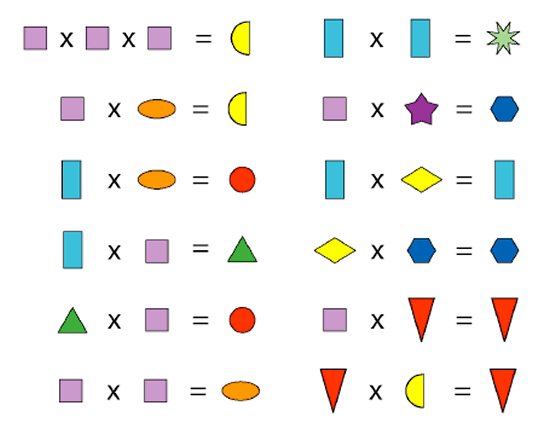
We started with the Shapes x Shapes puzzle from NRICH:
We added a couple of extra questions to this challenge:
  • Before completing the puzzle, which numbers do they think are excluded? Why?
  • Make extra equations that allow us to include those missing numbers. Are they easier to incorporate using multiplication or addition equations? What about equations that combine multiplication and addition?
Observations: 
Once again, this appears to be a very simple activity, but gave us a lot to talk about. In particular, it was very helpful for highlighting a lot of misconceptions and gaps in understanding. Examples:
  • "identity" relationships were still unclear: 1 x n = n, 0 x n = 0
  • Several students thought the first equation would be 4x4x4 = 12 (confusing multiplication and addition) 
 
Division Dice move to Cards
For our core activity, we are extending the Division Dice game. This time, we use playing cards, A through 10, instead of dice rolls to generate the random components of their equations. In this case, the aces are wild and can be any number from 2 to 10. When they form a multi=digit number with a 10, the 10 counts as two digits. For example, 3, 5, 10 could form 105 ÷ 3.

With cards instead of dice, we lack the natural move of flipping the dice to the opposite side which we used to make sure all throws could give us whole number divisions. In this version, we allow division with remainder. However, the twist is that the remainder becomes points for the opponent.
For example, if I draw 3, 3, 5, I can form 53 ÷ 3 to score 17 points for myself, but the opponent gets 2 points.

Question: Are there cases where the best play is not to form the largest possible number divided by the smallest number?

An interesting game variant: swap the scoring so that the active player scores the remainder and their opponent scores the quotient.

Tuesday, May 17, 2016

Build the chair spatial reasoning (Gr 1 and 2)

who: Baan Pathomtham grades 1 and 2
where: in school

Here in Thailand, summer is over and we are back to school! We are kicking off the math games and exploration class today with an activity from NRich (chairs and tables) that has a surprising depth. Also, keep your eyes opened for the hidden reasons why we are starting with this activity.

Build a chair

The starting directive is simple: use unifix cubes to make a chair. Here's an example, from NRich:


To start, we ask the kids to get 15 cubes each. What does 15 mean? How do they know they've got 15? Do they think they will need more or less than 15 to make a chair?

After they have built their chairs, how many did they need? If it was less than 15, how many are left over? If it was more than 15, how many more did they need to add?

Chairs for bears

Once we've all got one chair, can we make two more for the three bears from Goldilocks and the 3 Bears? We need a small one for baby bear, a medium sized one for mama bear, and a large one for papa bear.

As the final construction challenge, we ask them to make a table sized to accompany their original chair.

Homework


  1. Based on the pictures above:  (a) find out how many cubes would be needed to build these shapes, (b) draw a 2d perspective of one of the shapes from one direction.
  2. For those who have construction sets at home, try making chairs of different sizes. What things were similar to using the cubes at school, what was different?

Extension

Building off the three bears activity is a nice extension:

  • What is the smallest chair we could make? How many cubes do you use?
  • How would you make the next larger chair? The next chair larger than that? How many cubes are used for those?
  • What about the tenth chair in this sequence? What would it look like? How many cubes would we use to make it?
  • Same questions for the 100th chair?
  • What is an equation for the number of cubes in the nth chair?
I'd note that these are challenging questions which go well beyond first and second grade. Also, there is no single correct answer, particularly as different students will have different ideas about what is required to be a chair or how the form should grow through the sequence.

Note: these questions follow the thinking of Fawn Nguyen's Visual Patterns.

Friday, April 22, 2016

Ode to a bead string (a non-poem poem)

from The Math Maniac

What is a bead string?
100 beads
Whites and Reds
5+5+5+5+5+
5+5+5+5+5+
5+5+5+5+5+
5+5+5+5+5
From hand and eyes to brain
But also: a caterpillar, a snake,
dog collar and horse bridle
a gun
a gate or a fence
a telephone line
a part of a train
lock for your door
tiny eggs (maybe spiders?)
coins
jewelry (necklace, naturally, or earrings, bracelet, belt)
roller tracks for a made-up truck
beans cooking in a pan
and so much more!


While reviewing Dreambox Learning, I spent some time thinking about physical manipulatives compared to apps. Apps can certainly have nice features, but physical objects own my heart. I'm not even going to talk about the educational value (see this Hand2Mind note for a summary and further references). The thing we really like is the open-ended flexibility about how they can be used, both mathematically and for creative play.

As an example, the bead string is (maybe?) one of the more limited maipulatives because it is linear and one connected piece. We don't even have one. However, the ideas above were immediate ideas coming from observations of how my kids play and a quick brainstorming session with the little ones.
BTW, we find that a 6 to 9 year old can make any object into a gun, in case that idea didn't make sense to you.

Favorite category of math manipulatives: food! In this case, freshly baked chocolate cake.

Returning to math, one of the cool things about this open play with math manipulatives is that it provides a lot of easy entry points into short math chats. These are fun, in themselves, and also reinforce the observation that math is accessible and all around us.

Manipulatives in Apps
While better than nothing, virtual versions of physical manipulatives always seem to fall short, with the following limitations:

  • only one "correct" way to interact with them
  • no possibility of combining
  • can't take them apart
Perhaps there are also some benefits of virtual objects. In particular, they don't need to obey the law of conservation of mass. Can that, or other advantages, be used cleverly to make up for the disadvantages?

Let me know what you think and tell me where you've seen the best use of virtual manipulatives.

Tuesday, February 16, 2016

Dots and Boxes variation

In grades 1, 2, 3, we played this variation of dots & boxes: Mathify the Squares Game.

I'm enthusiastic about this game, but can't resist a quick comment about the "mathification." Dots & boxes is already a mathematical activity, it doesn't need to be "mathified." This term implies confusing arithmetic and calculation with math, something I've written about elsewhere and, I hope, is clearly not implied by our blog.

In any case, I'll use the shorthand MD&B to refer to this dots and boxes variation.

Notes from playing in class


In class, we first introduced the kids to vanilla Dots & Boxes with a pre-printed grid of dots. We knew that it would be too much to play on a lattice covering the whole A4 sheet, but we thought a quarter of the grid would work. That turned out to be too big and the game started to seem monotonous to the kids as there was too much time spent on the opening (playing on squares that don't yet have any filled sides.)

We rectified this problem in 3rd grade and played on much smaller grids, with sizes between 7x7 lattices (which yield 6x6 squares) and 10x10.

After they were comfortable with the vanilla game, we introduced the product version with dice. In our case, we just had the players take turns and didn't give an extra turn when someone completed a square.

Some rule variations
There are some simple variations depending on how you deal with completed squares:

  • no extra turn (this was the version we played in class)
  • player adds another side to a different square with the same value. For example, say the dice are 2 and 4 (product 8) and the player fills a square. They also must add a side to another square with value 8.
  • player rolls the dice and adds a new side (a full extra turn)
  • player adds a side to any square (dice and square values ignored)
Of course, you could also make the extra turn optional instead of compulsory. You might also have some ideas about different ways to handle cases where there are no more free sides on squares with the required number value.

Probability questions

Dice games naturally lead to probability questions. Here were two that I really liked, based on scenarios from a recent game play:

What question are we asking?
What is the chance a player will get both the 20 and 36 boxes:


One great answer was 1/2. The reasoning: we are going to play until all boxes are filled and each of us have an equal chance to fill this box, so 1/2. This is not quite right, since the person who is about to roll has an advantage, but I thought it was an interesting interpretation of the question.

A 2x2 square
In this configuration, what is the probability that the next throw will allow the player to complete a box in the 4-30-25-15 zone?


A bigger D&B family

One of the reasons I thought this D&B variation was so cool is because of our games matrix. Whenever we play games, J1 and I talk about some key characteristics of the game, particularly the amount of randomness and the strategic complexity. These are not entirely independent dimensions, since a larger amount of randomness reduces the number or importance of each player decision, thus the strategic depth.

The mechanics of this game gave us some ideas about how to dial up or down the amount of randomness in this family of games. Here is our list of members of this family, roughly ordered from least random to most random:
  1. vanilla dots and boxes: no random element
  2. mash-up with product game: squares are still labeled, but players control the two factors using selectors (like in the product game) instead of using dice. This can be played with different collections of factors and different size boards (including board variations where a product appears multiple times or only a single time, where values are ordered or randomly distributed).
  3. half-way house: one factor is chosen by players moving a selector, the other is determined by a dice roll (either before or after the "free" factor is selected).
  4. MD&B game: as played in class and described in the first link
  5. MD&B game where each factor appears only once. This is a case of dialing up the randomness by reducing the strategic options of the players. 

Ideas for other games

I'm excited to see what other games we can modify use the underlying idea from the MD&B variation. To be clear: use numbers to label parts of the game and then constrain the players' actions based on a die roll to involve either the pieces with corresponding labels or board positions with those labels.

Three specific examples:
  1. Hackenbush variation where segments of the picture are numbered. This could nicely incorporate probabilities by putting values of the least likely dice rolls closer to the ground.
  2. Ultimate tic-tac-toe meets the product game: from Art of Math. This is an old post, but I just happened to see it when preparing this post.
  3. Dice chess. Here's the wikipedia article. For some reason, I often forget about this variation, even though it is a nice way to reduce the strategic complexity of vanilla chess for beginners and has some nice links with probability.
If you have some favorites, I would love to hear in the comments!

*Update*
Playing through the MD&B version several times, we came up with these rule variations that are worth your consideration:

  1. Game stops as soon as someone rolls a value that can't be played (alternatives are to let that person roll again or have them pass their turn)
  2. Remove some of the randomness: (a) on your turn, you roll and play a side with the required value, but they opponent also plays a side with that value. As we played it, that means moves (without filled boxes) go: A, B, B, A, A, B, B, etc. (b) When a player fills a box, they can choose to re-roll both, either, or none of the dice for their extra turn.
I think our favorite was a combination of all three of these components. Mixing 2a and b, you have to be careful to keep track of whose turn it is, but it lead helped bring out elements of strategy and more thinking about probability.

*Update 2*
Game phases
Above, we talked about how A4 (or even 1/4 of an A4, which I guess is equivalent to A6) is too big for beginning players of Dots & Boxes. They found the game "boring." J1 and I talked about this experience and it led us to considerations around game phases: opening, middle game, and end game. These are terms we first learned in chess, and we found it useful to contrast the two games.
Here were some observations:

  • Opening: a lot of choices, not obvious how most of those choices link with "scoring" or the winning objective of the game. At this stage, there seems to be little interaction between the players (there is enough space that most of their actions either don't bring opposing pieces together or there is a lot of open territory).
  • Middle game: still many playing choices, increasingly direct conflict between players, interim objectives within the game become more clear and there are some chances for plays that either score or more clearly move closer to the overall game objective.
  • End game: significantly fewer choices for each turn than the other phases, either because there are fewer pieces (chess) or most territory has been claimed. At this stage, players are able to focus on the overall game objective, rather than interim objectives.
What we realized is that the larger playing area for D&B significantly increases the length of the opening. Because this phase is the least connected with capturing boxes, it is the hardest for beginning players to see how their choices ultimate lead to scoring and it is the phase with the most available choices on a turn.