Showing posts with label 5 year old. Show all posts

Friday, April 22, 2016

Ode to a bead string (a non-poem poem)

from The Math Maniac

What is a bead string?
100 beads
Whites and Reds
5+5+5+5+5+
5+5+5+5+5+
5+5+5+5+5+
5+5+5+5+5
From hand and eyes to brain
But also: a caterpillar, a snake,
dog collar and horse bridle
a gun
a gate or a fence
a telephone line
a part of a train
lock for your door
tiny eggs (maybe spiders?)
coins
jewelry (necklace, naturally, or earrings, bracelet, belt)
roller tracks for a made-up truck
beans cooking in a pan
and so much more!


While reviewing Dreambox Learning, I spent some time thinking about physical manipulatives compared to apps. Apps can certainly have nice features, but physical objects own my heart. I'm not even going to talk about the educational value (see this Hand2Mind note for a summary and further references). The thing we really like is the open-ended flexibility about how they can be used, both mathematically and for creative play.

As an example, the bead string is (maybe?) one of the more limited maipulatives because it is linear and one connected piece. We don't even have one. However, the ideas above were immediate ideas coming from observations of how my kids play and a quick brainstorming session with the little ones.
BTW, we find that a 6 to 9 year old can make any object into a gun, in case that idea didn't make sense to you.

Favorite category of math manipulatives: food! In this case, freshly baked chocolate cake.

Returning to math, one of the cool things about this open play with math manipulatives is that it provides a lot of easy entry points into short math chats. These are fun, in themselves, and also reinforce the observation that math is accessible and all around us.

Manipulatives in Apps
While better than nothing, virtual versions of physical manipulatives always seem to fall short, with the following limitations:

  • only one "correct" way to interact with them
  • no possibility of combining
  • can't take them apart
Perhaps there are also some benefits of virtual objects. In particular, they don't need to obey the law of conservation of mass. Can that, or other advantages, be used cleverly to make up for the disadvantages?

Let me know what you think and tell me where you've seen the best use of virtual manipulatives.

Friday, December 18, 2015

Modern math competition

Saw this brief exchange and thought it would be a good time to write down some ideas for a new type of math event:
It will be clear below that these are all other people's ideas, I've really just added ideas for how you might score this.

Fold and Cut

Everyone gets a pair of scissors and three pages with a straight-line figure (a shape that has a boundary made up of polygons) in the middle of the page. For each shape, players try to find the smallest number of straight cuts they need to cut out each shape.
One example of a shape to cut out
Another example: cut the house and the tree at once (hard!)

Scoring for each shape:
10 points for least cuts
5 points for second
1 point for all who cut out the shape successfully, regardless of how many cuts it took

Reference: Fold and Cut Theorem.

Estimation

Set up an estimation challenge (number of marbles in a jar, weight of a collection of books, height of a blown-up picture of your favorite mathematicians, etc). All players write down:

  1. Their estimate of the amount
  2. An explanation of their reasoning
  3. A value that they think is too low
  4. A value that they think is too high
Scoring:
Each estimators performance is based on the absolute size of their error (|estimate - actual|) multiplied by the size of their low-to-high range, divided by 2 if the actual value is within their range. The lower the resulting value, the better.

20 points for best performance
10 points for second
5 points for third
1 point for everyone who estimates


Reference: Estimation180 has tons of great prompts for estimation.

Which one Doesn't Belong

Really simple: show players four things, then they figure out reasons why each of the figures could be the one that doesn't belong.

This is just a small sample of the ideas for Which One Doesn't Belong


Scoring:
1 point for every different reason + 5 bonus points if there is a reason given for each of the 4 shapes

Reference: Which One Doesn't Belong has a huge collection of great ideas for shapes, numbers, graphs.

Notice and Wonder

Pick a 3 to 5 math pictures, gifs, or videos to show on a large screen. Players write down the things that they notice ("I notice that ...") and wonder ("I wonder [what, why, when, how many, ...]..?").

From SolveMyMaths


Scoring (similar to WODB):
1 point for every notice or wonder + 3 bonus points for having both a notice and a wonder.

Reference: SolveMyMaths and MathHombre both have really nice collections. Mathematical Etudes has some excellent videos that don't seem to be as widely known among Anglophones. I'm sure there are others

Thursday, July 23, 2015

tmbg inspired primes, perfect, deficient and abundant numbers

A quick conversation summary, inspired by They Might Be Giants kids song: Seven


J1: why is the only way to subtract 7's by using up all the cake?
J0: they are really hungry because they are primes. They only have 2 proper factors.
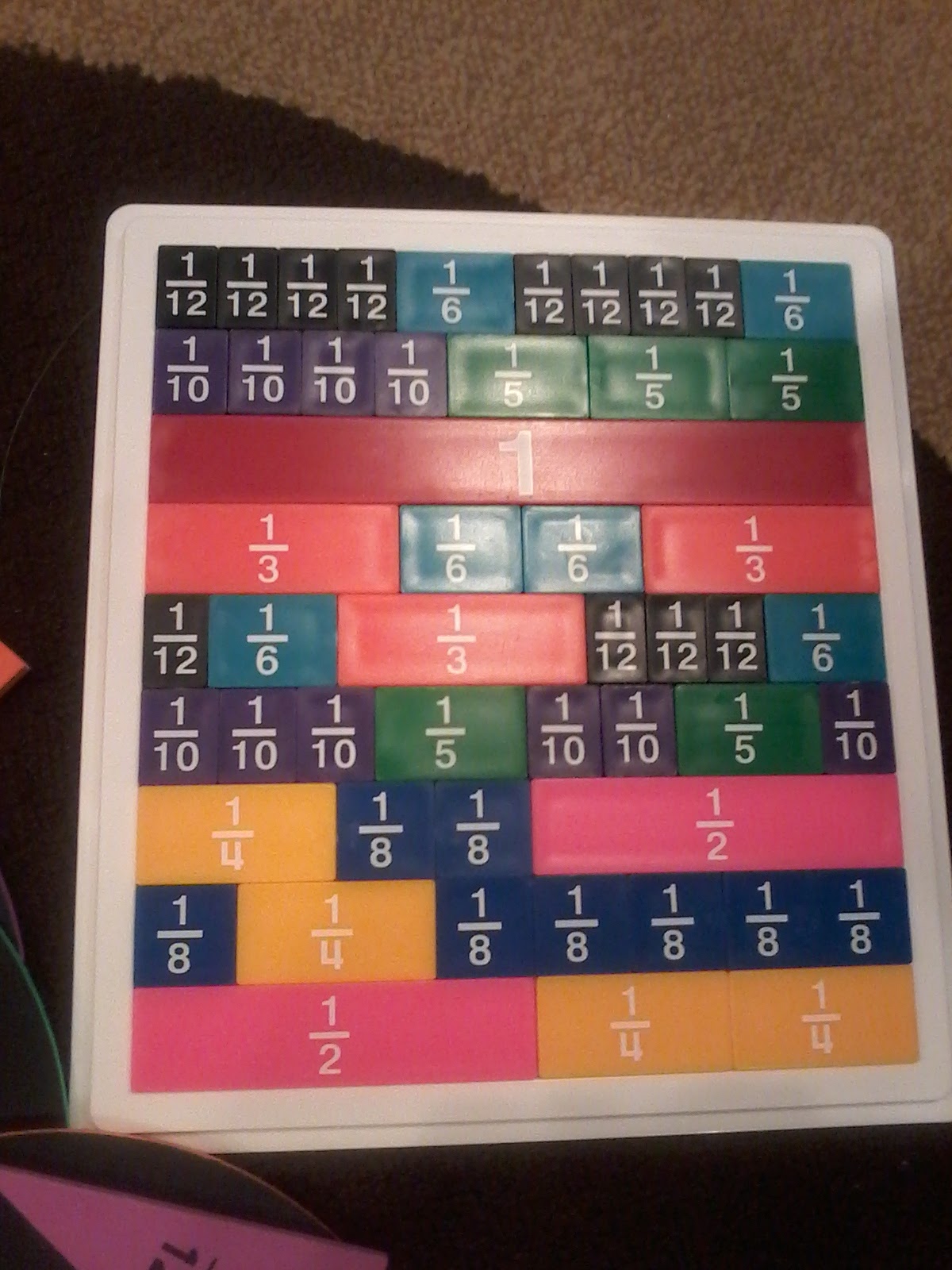
J2: hmm, then what about 6? I guess 6 doesn't like cake?
J1: oh, the other numbers like cake, they just aren't as hungry if they have a lot of factors.
J2: what about 144? 144 must really not need to eat much extra!

Sunday, July 19, 2015

more age chat

who: J1
when: bedtime

J1 wanted to return to our discussion about their three ages. In particular, someone had noticed that, prior to the recent birthday, their whole year ages were all primes: 3, 5, and 7. J1's question this evening: will this ever happen again?

First case

We talked through 2 different cases. The first uses 2 year gaps, so AgeY(J3)+2 = AgeY(J2) and AgeY(J2)+ 2 = AgeY(J1). As we worked through examples, J1 quickly saw that it wouldn't work whenever J3's age was even, so we focused on odds. From 5, 7, 9, he realized that we could skip the cases where J3 was 7 or 9, so we looked at 11 and 17. Along the way, we had identified that J1's age was 9 (3x3), then 15 (3x5), then 21 (3x7).  Seemed to be a pattern of always being a multiple of 3...

Second case

Next, we looked at their current gaps, so AgeY(J3)+2 = AgeY(J2) and AgeY(J2)+ 3 = AgeY(J1)
This one was easier, solved by just looking at the parity of the ages.

So, sad news all around: they will never again have all prime ages!

Fractional ages

Next, we talked about the equation Age(J3) + Age(J2) = Age(J1). This works out now when we use whole year ages (or using the floor function, if you prefer). There had been some chatter earlier about fractional ages, so J1 wanted to check that.  These were the estimates J2 had given earlier for their ages:

  • J3: 3 1/4
  • J2: 5 1/2
  • J1: 8
So, does the equation hold? Unfortunately, it doesn't. J3+J2 is 8 3/4. Will it ever hold in the future and when?

We talked for a while and J1 realized that, as time passes, the sum of the sibling's ages increases twice as fast as his age does. That gave him a clue that it won't happen in the future, but did in the past.  So, when was that?

Keeping in mind the pattern he'd recognized about changes, he guessed it was 3/4 of a year ago. Checking through was a good exercise in fractions and confirmed his conjecture.

From that, he wanted to get more precise about when that date was, 3/4 of a year ago, and then started talking about that having been a really special time for the three of them (unrecognized at the time, of course). When he started getting that precise, though, I offered that J2's estimates were a bit off and substituted J3 = 3 1/6, J2 = 5 5/6, and J1 = 8. This gave an even more satisfying conclusion once he worked out this case.

Thursday, July 16, 2015

Freeform tangrams: an imagination game by J1

Who: J1, J2, and J3 (a late appearance)
When: just before bedtime
What did we use: two sets of tangram pieces

J1 came up with a new game this evening. The rules:

  • number of players: 1 or more
  • playing pieces: 1 or more sets of tangram pieces
  • designer: each round, one player takes the role of the designer, putting the tangram pieces into a configuration. This could be a random arrangement or intentional
  • Taking a turn: in a clockwise order starting with the person to the left of the designer, players say what they think the tangram looks like from their perspective. After everyone has taken a turn, the players shift 90 degrees to their left and repeat the cycle, but this time they are looking at the tangram from a different orientation.
  • Once everyone has had a go from all 4 orientations, the next player becomes the designer
  • Advanced play: once someone has said what they think the tangram looks like from their perspective, the experienced players can add a comment to start building a story based on that object.
  • Winner: everyone!

We played with J1, J2, and J0 taking turns as the designer. To give you a feel for it, here is one of our designs from 3 different orientations:


Here are some of the ideas for what we saw: person jumping out of a box, a wheelbarrow, an army officer, a flower, an 8th note in a mirror, a catapult, a road grader, a knife cutting an apple, the sword in the stone, I was surprised that no one said "poop," which just shows how engaging the two of them found this activity. I doubt it would have been as successful if I introduced these rules and asked them to play!

Our own puzzle book


Wednesday, July 15, 2015

Some comparisons (two tmwyk transcripts and a puzzle)

who: J1
when: just before bedtime

the value of being alive

J1: Daddy, now I've got a question for you
J0: Ok?
J1: if I get a new book every time I write 20 pages in my journal, how valuable is each page?
J1: The books are about 150 baht
J0: How much?
J1: let me check, I think the price is on the back cover . . . 169 baht
J0: if you could tell me what I need to calculate, I'll calculate for you
J1: hmm, so 20 pages is 169 baht, I want to know how much one page is, so I need to divide by 20.
J0: do you think it will be more or less than 10?
J1: less than 10
J0; Are you sure? How do you know?
J1: Well, 10 * 20 is 200 which is more than 169
J0: what about 5 baht per page? Is it more or less than that?
J1: More, 5* 20 is half of 10*20, so 100, which is less than 169.
....
<we figure out that the amount per page is 8.45 baht/page>
....
J1: That's not very much!
J0: How much did you get for your birthday?
J1: [x] from grandma, [x] from grandpa
J0: well, how much is that per day. Is it more or less than 10?
J1: More than 10
J0: how <interrupted>
J1: how do I know? well . . .10 * 365 is ...
<some discussion of whether he was right, various other estimates of the amount of money per day>
J0: How does that compare with each page of your journal?
J1: More...but what if I include the [present a] and [present b]?
...
<he estimates how much different presents cost, figures the total, estimates how much that is per day, etc>
...
J3 (who has been listening all this time): wow, J1, that's a lot of money!

J3 explores bricks

Earlier in the evening, J3 has been building sticks with 1x1x1 TRIO cubes. She made four, all the same length, then handed two to me as drumsticks. I counted the cubes in one (I got 11) and then she counted one of hers (she got 12). I put them side-by-side and we saw they were the same length.

J3: but...daddy, I really counted 12, you are wrong
J0: are you sure they should have the same number.
J3: yes, let's count them again, together
<I point at the cubes and she counts them, 11>
J3: Ok, now I'm going to build a shape and you see if you can make a copy. It will be tricky!

A birthday puzzle

With their current ages expressed as whole years (you know, the way everyone talks about ages, except for mothers of very small children):

  1. What is a number sentence that relates the ages of J1, J2 and J3? Hint, oldest is 8, middle 5, and youngest 3
  2. Will this ever be true again?
  3. Was it ever true in the past?
  4. When/why not?
  5. What about multiplying? Will it ever be the case that AgeY(J1) = AgeY(J2) * AgeY(J3)?
  6. Was this ever true in the past?
  7. When/why not?
Note that there is a complication since they were not all born on the same day, so the difference in their year ages changes depending on the day of the year we are considering.

J2 wanted to investigate more precisely, so he asked to work things out in months. That meant we had to calculate how many months are between them.

Monday, July 13, 2015

We are totally flipping out!

Who: J1, J2, J3
when: dinner time
What did we use: 4 coins

In Sue VanHattum's linkfest post, there was an intriguing puzzle: given four coins in a square, can you call out commands to flip coins so that you are guaranteed to eventually get them all up or down? More precise instructions/rules are in the link.

We saw very quickly that this is an excellent puzzle:
  • complex terminology? Not at all.
  • difficult to find equipment? Nope.
  • low threshold? Yes, Even J3 was able to investigate along with the older ones
  • high ceiling? Yes. Solving the initial puzzle is hard enough, but there are plenty of possible extensions. 
  • Fun and deceptively tricky challenge? YES!
Everyone got to have fun taking a turn as the coin master (following the flipping instructions and rotating the square) and most of us took a turn as the (attempted) solver. Here are our tools:


For most of the conversation, I just listened. The kids naturally focused onidentifying states: what are the possible conditions for the coins, which of these are, for purposes of the puzzle, identical and which are truly different? One other part of the discussion was about moves, again, which are identical and which are different. Of course, the didn't quite use this terminology.

Some extensions

Simplify?
I suggested they try the puzzle with a smaller number of coins. 1 coin, no problem, it always starts solved. 2 coins were pretty easy again. What about 3 coins? Here, there was a little thinking about what the equivalent version would be for 3 coins. In particular, do the coins have this configuration:


and the coin master can only swap the outer two coins, or are they in an equilateral triangle like this,


and rotations are the only transformation?

Well this is math, so there are no right or wrong answers, you just have to try out your different ideas and see what is the most beautiful.

Another simplification we thought about was to eliminate the rotations.

Probabilistic Attack vs Strategic Game
The problem asks for certainty, but let's assume the rotations are done at random. What if  you are happy with a high probability of getting a solved configuration? Is there a different strategy that has a faster expected ending time? Can you say anything about confidence levels (probability of ending at n or fewer moves)?

In contrast, what if the coin master is playing against you, trying to increase the number of moves you take by selecting tricky rotations. Does that alter how you think about the game? How you play, in practice?

See, I told you the ceiling could be pretty high.

Make it bigger
Okay, you've solved the 4 coin puzzle, what about 5 coins? Are there interesting versions for larger numbers of coins?

A humble suggestion

Whatever you do, I encourage you to try the 3 coin triangular version with rotations.

Friday, July 10, 2015

Predestination stories (reading lessons)

who: J1 (guest appearances by J2 and J3)
when: early afternoon
where: in the dining room
what material did we use: pack of sight words, Usborne book of Fairy Tales, Jeffrey Archer collection of short stories.

We have started to be more consistent about the literacy activities we are doing with the kids.

Warm-ups

We have found very quick warm-up activities worked really well in the math classes we teach at school, so we thought we'd do the same for our literacy sessions. We are still in the process of collecting appropriately short and fun activities, but here is a short list of things we've done so far:

  • Sight word sentences: using a pack of sight words, draw 2 and then form a sentence with them. The sillier, the better!
  • Sight word story: take 6 or 8 sight words and form a short story with them. 
  • Crazy Sentences: reading the strange sentences that come out of this program which was inspired by a game from Peggy Kaye (whose site looks like a good source for other qiuck games).
  • Talk about a picture: this is a direct translation of one of our math warm-up activities

Intro to predestination (aka Sleeping Beauty)

For the main event, J1 read (or re-read) the first story in our fairy tale book. As he was reading, I wrote out a couple of questions for us to discuss:

  1. What is the location of the story?
  2. Who are the main characters (2-4)?
  3. What is the conflict in the story?
Of course, these are generic questions we can discuss for almost every story he reads. There were several highlights in our discussion.

What happens with the mean fairy?
In our version, the mean fairy only shows up once, explicitly, in the story, to curse Rose. It is implied in the pictures, that she shows up later to introduce the fated spinning wheel. J1 was strongly drawn to this interpretation based on his own narrative sense of closure and connection. We were a little disappointed that she didn't figure in the ending sequence, but more on that later . . .

Why was Florien successful in rescuing Rose?
Prior to his attempt, several other chaps made an effort and were unsuccessful. J1 said that the reason he was successful seemed to have something to do with Rose drawing Florien's picture earlier in the story and Florien dreaming of Rose. Of course, we don't know how many pictures of princes Rose actually drew, how exact the likeness was to Florien, nor whether the unsuccessful princes had dreamed of Rose or not.

We talked about other stories and came up with these suggestions:

  • Maybe Rose and Florien were partners in a prior life (an idea J1 got from the Thai Ramakien)
  • Maybe Florien did something nice for the mean fairy and she granted him the ability to rescue Rose. J1's favorite version: The mean fairy turned into a squirrel to run through the forest. She accidentally got caught in a hunter's trap. Florein found her and bandaged her wounds.
  • Maybe Florien defeated the mean fairy in battle and won the power to rescue Rose. This version was accompanied by some wild jumping around in a simulated sword (Florien) vs lighting blast (mean fairy) battle.
Predestination vs Free Will
I told J1 about two competing theories: predestination and free will and then we went back to the story to see whether/how each theory was represented. There was a very clear winner, with predestination getting all the points:

  • Rose's story told in advance by the curse/blessings of the fairies.
  • Rose predicts Florien saving her by her drawing
  • Florien predicts saving Rose by his dream
  • The other princes fail to save her "just because" (because they weren't fated to do so)
  • The king acts to prevent the foretold curse by destroying spinning wheels in the land, but the fate is inescapable
The last point flagged up a classic element of predestination stories: even if the characters take action to change their fate, the results still end up the same. Often, the action taken to prevent the fate is somehow critical in causing it to happen.

Appointment with Death
By chance, I had just read this short story in a Jeffrey Archer anthology. I got it out and we read it together, then talked more about predestination vs free will.

Some other tidbits from the chat:
- who is Death? Why do people anthropomorphize death like this?
- why does the story seem to suddenly shift to first person, form Death's perspective? Is the story more or less clear written this way?

Daily Journal

J1 and J2 both have small notebooks for writing a daily journal. They usually write something about what happened that day, but are free to write whatever they want. Sometimes, it becomes a short story or even a never-ending story.
We talk about what they wrote and then make a vocabulary list related to their note. Usually, it is formed from words they mis-spelled, but the vocabulary words could be things they spelled correctly that highlight interesting patterns or a word they didn't use that is related to the topic.

What about the little one?

For J3, we have been working on phonics and letter recognition. Each evening, we have a focus letter or sound that we ask her to find as we read bedtime stories together. Also, we have been singing phonics songs, particularly ones from this collection: Jolly phonics

Thursday, July 9, 2015

A magic trick and magical discussion (part 1)

who: J1 and J2
where: in bed
when: just before going to sleep

Another mystery process trick
I found this post Little Math Magic on JD2718's blog. We did something similar at the beginning of the year with calendars (here) and the kids really liked making a choice, doing some calculations that obscure the choice, then seeing if I can figure out their choice, so I expected that they would enjoy this, too. Computationally, it is a bit more challenging for the kids as it involves squaring 2 digit integers.

14 Squared
talking though 14 squared, J2 asking if we could do 10*10 + 4 *4. We talked about why that doesn't work. In fact, J1 raised the example of 11x 11. Since J2 knew that this is 121, they were able to compare with the other "algorithm" and see that 10x10 + 1x1 isn't right.
J1 said that, instead, we could do 10 * 14 + 4 * 14, which J2 then calculated. When he got to 196, he was delighted, since he did recognize that old friend. Also, he mentioned 169 was another familiar square friend: "13 squared, right?"

From 196, we keep the 6 and then square that, getting 36. We keep the 6 again. Finally, we need to multiply this result by our original number, so 14*6. J2 remembered 4*14 was 56 from an earlier calculation, so he just calculated 14x6 = 14x4 + 14x2= 56 + 28 = 84.

At the time, it felt really good to hear them helping each other work through these calculations, especially their thought process checking the possible algorithm for multiplying 2 digit numbers.

Next time
Well, now that they understand the algorithm, we still have to do it as a trick, where they don't tell me their starting number. After that, let's see if they can figure out how it works?

Thursday, June 25, 2015

A cheating friend (or funny dice)

who: J1 and J2
when: at dinner

The basic puzzle

In class recently, we've been using a warm-up puzzle where we tell the students we have two secret numbers and give them two clues: the sum of the numbers and their difference. The challenge is to find the two secret numbers.

This is a simple algebra problem that can also be attacked easily by guess-and-check (for small values) or by a systematic table of trials. These are the methods being used by the 2nd and 3rd graders, so the puzzles result in a lot of arithmetic practice as well as reinforcing different number bonds.

Our twist

Over dinner, I told the kids that a friend gave me a similar puzzle, but with a slight twist. This friend rolled a 6-sided dice twice and told me the sum and the difference of the values. Sounds the same, but easier, right...?

Unfortunately, our friends are all a bit tricky.
First clues
So, the first clues my friend gave me were that her two numbers sum to 12 and have a difference of 4. The two talked through these clues and found the answer (which I'll leave to you).

But wait: these were supposed to come from dice throws!?

Second clues
I told them that I'd gotten the same conclusion and had challenged my friend. When confronted with this result, the friend said, "oh, there was a mistake. Actually, the difference was 12 and the sum was 4."

After a minute, but before finding a solution, the J2 realized that there was something fishy about this one, two. How can two dice rolls have a difference of 12?!!

Are there two numbers that fit the clues, even if they aren't from dice rolls? Yes, J1 and J2 found them.

Third clues
So, the friend was tricking us again. So what were the actual values? This time, the friend claimed that the sum is 7 and the difference is 2.

At this point, both were highly suspicious, but also very curious to see what would go wrong. This time, they made a table with number bonds of 7 and the differences. It looked something like this:
7+0 = 7        7-0 = 7
6+1 = 76-1 = 5
5+2 = 75-2 = 3
4+3 = 74-3 = 1

At this point, they noticed a troubling pattern in the differences: always odd. J2 suggested adding another line to the table:
7+0 = 7        7-0 = 7
6+1 = 76-1 = 5
5+2 = 75-2 = 3
4+3 = 74-3 = 1
3.5+3.5 = 73.5-3.5 = 0
Ah, now we've got an even value! From there, it took another couple of minutes to find the combination of numbers that add to 7 and have a difference of 2.

Final answer, Final puzzle
Once again, the friend seems to be tricking us: these numbers aren't on a regulation 1 to 6 die either! It was time for the final revelation: actually, all of these were from my friend's dice throws, but they just had very strangely marked dice.

Looking over our work, we saw that we had only come up with 5 different numbers as answers in our puzzles. We confirmed that, yes, the dice was 6 sided, so what was the value of the last side?

This was the last clue from the friend: the average value of the faces on her die is the same as the average value for a regular die.

So, how are the sides of my friend's die marked?

Sunday, June 21, 2015

Triangles and Angles: a proof for 5 year olds

who: J2 (also P and J0)
what did we use: polydrons, polydron protractor

J2 and I were playing with polydrons and he got interested in measuring the various angles. Since there are three different triangles in the set, he got to test each of them and found that the angle sum was always 180 degrees. We went on to examine squares and pentagons to see what he could make of those.

In the evening, P and I were talking about about this investigation and I mentioned this proof that the interior angles of a polygon sum to $180 \times (n-2)$:


P was surprised and said that she likes this proof more:
In this version, you have to subtract the middle 360 degrees.

I was a bit surprised that I hadn't ever thought of this version or seen it elsewhere, but quickly realized we could repurpose it to finding the interior angles of a triangle itself.  Here's the picture:

Now, the argument:
  1. Angles of the large triangle are equal to the sum of the angles of the smaller triangles - 360
  2. Let x be the sum of interior angles of a triangle.
  3. Based on 1, we have x = 3x - 360
  4. Rearranging, we get x = 180.

Where we get stuck: a challenge for you

Here's the thing: the sum of interior angle measures of a triangle isn't 180 degrees. That is, it doesn't have to be if you are working in non-euclidean geometry. Here's a nice picture (not mine) of a triangle with angle sum of 270 degrees:

Comes from MathStackExchange


However, our proof doesn't seem to use any fancy postulates. Your challenge, why doesn't it work on a sphere? What extra postulate did we secretly use?

A side point about measurement

When my son was measuring the angles for an isosceles right triangle, he read 46 degrees off the protractor. I was too focused on getting to the punchline about all triangles having the same angle sum and I "corrected" the measurement to 45 degrees. He still said some things and we had a conversation about ideal mathematics and real measurement, but I felt it was a missed opportunity.

Seasonal math and dice, dice, dice

who: J1, J2, J3
what did we use: mangosteen(!), dice, a checkers set.

Queen of mathematical fruits

My condolences to everyone outside of Thailand, you are current missing some delicious pre-school math: Mangosteen!

The mathematical secrete is on the bottom of the fruit. The flower shape on the bottom has petals that correspond to sections of the fruit inside. This one will have 7 sections


Just to trick you, this is a view from a different one, with 6 fruit sections.

J3 has been having a lot of fun counting the "flower" petals, opening the fruit, then counting the segments to check.

J2 has been using these to practice subitizing (recognizing number groups without counting them). J1 has just been gobbling down the mangosteen.

Dice Games

A dotty dice puzzle
In school for the 2nd and 3rd grades, we introduced a tic-tac-toe variation using dice where the winner is the first player to make a straight line that is a multiple of 5 (more notes here). For homework, the kids played this game with other multiples, in our case 6. During one game with J1, there was an interesting scenario that I saved to discuss with J2. The board has the numbers as marked and the player has just rolled a 4. Where should you play (you can add 4 to any cell of the grid, remember that you don't want your opponent to be able to make a multiple of 6 on their turn):


Race to 20
For J3, we modified one of the games that we had played in the 1st grade class last week. In this game, two players race to be the first to 20 on a 100 board. In this version, both player has a token/marker of their own. For each move, the players roll 2 dice and choose which value to move, then count up their position on the board. First player to 20 or more wins.

The strategy here is very simple, but it was a good game for J3 to start learning about dice and the 100 board. Once she got the point of the strategy, though, she had her own idea:"I'm going to add both dice together and move that amount!"

Snakes and Ladders experiment
J1 and I tried an experiment with snakes and ladders: a race between two different teams.
Team 1: a single marker that has to move according to the roll of one hexahedral die.
Team 2: two markers, the player can choose which one to move on each turn.
The winner is the player who gets a marker to 100.

Which team has an advantage? How big is that advantage? What if you play so that the winning marker has to land exactly on 100 (otherwise bounces back)?

Knights Move

SolveMyMaths recently tweeted about Knights Move (aka Razzle Dazzle.) Since we are always looking out for more/new games to play, it sounded interesting. Also, we could repurpose existing material to play. The game is a cross between chess and basketball. Below, see J1's set-up:


Yes, we are using icosahedral dice as the balls. Also, the chess pieces on the side are spectators, they aren't part of the action (since this is played on a 7x8 board).

One of the most interesting parts was our ability to experiment with rules. Since we didn't have a definitive version, we felt free to try slight modifications. In particular, we experimented with:

  • Passing: allowing multiple (chain) passes or just a single pass on a turn.
  • Defense: moving into the 8 squares around the ball holder forces them to pass on their turn
  • back-and-forth passes: player who passed the ball has to move again before they can receive the ball (we turned the checkers upside down to indicate they couldn't receive a pass). 


Saturday, June 20, 2015

Crazy Tangles and the order of the months

who: J1, J2, J3
when; a couple of minutes scattered through the day, 5 minutes at dinner
what did we use: two colored pieces of string (shoelace weight)

Playing with string

2 years ago, Fawn Nguyen wrote a note about Conway's Rational Tangles. It was a great activity for her algebra class (so go read her note) and I thought our little ones might enjoy it. While getting a soldering iron to fix a toothbrush robot (another upcoming post?) I found two blue and red string that looked really perfect for this investigation.

There are two moves, twist and rotate. Since Fawn does such a fantastic job of showing these moves, I won't even bother trying to describe them. For us, we made it into a two person activity where we hold different strings in each hand. I introduced the ideas in the following sequence:

  1. told J1 that there were two moves and showed him. 
  2. Then we did a bunch of twists and I counted one each time. 
  3. After that, I told him a twist counts as +1. 
  4. We did a sequence (3 twists, rotate, one twist, rotate, two twists, rotate, two twists)
  5. at that point, he insisted on leading the moves, so he was in charge
J2 had been watching and basically understood the pattern, but we did something similar later as his turn.

J3 had her turn as well and basically just wanted to get tangled up in the string

Reactions
J1 got very excited about making conjectures about what the rotation operation does. His first guess was multiply by -1. We tested with twist, rotate, twist and found that we were back to state 0. However, when we did 2 twists, rotate, then 2 more twists definitely didn't get us to state 0.
Next conjecture was that rotate subtracts 2, but that also is disproven by the fact that TTRTT(0) is not 0. He is still working on it.

For J2, he liked to get complicated and started out with 10 twists and then a rotate. From that point, he let me call the moves (TRTTRTTRTTRTTRTTRTTRTTRTTRTT) and was totally delighted to see us get untangled back at state 0 after all of that.

J3 got a lot of mileage out of disrupting other people's tangles. This was certainly fun for her, but a bit frustrating for the older two.

Which month is first?

At dinner, I asked the kids which is first, January or February? J1 and J2 quickly said "January."
Next question, which is first, January or March? January again.
Next, January or April? Again, quick answer of January. P interjects, is that going to last?
January or May? J2 again says "January" quickly, J1 is starting to hesitate.
January or July? January again from J2, July from J1.

Why?
J2 is pretty clear; "January is the first month of the year, so it always comes first."
J1 has a different idea. It is June now, so our next July will come before the next January. Thus, July is first.

Next question, which comes first, January or December?
J2 again says "January, it is the first month of the year, so it has to come first."

What month comes immediately before January?
J2 says "December."

Note :J3 doesn't really know the months yet, so she wasn't very proactive, but she did enjoy repeating the others' answers.

This question occurred to me when reading Who's the Oldest over at Musings of a Mathematical Mom.

Tuesday, June 16, 2015

Is John a liar? and other good puzzles

who: J1 and J2
what did we use: Smullyan's Alice in Puzzle Land and some online games
when: after dinner

This post is basically a thank-you to all the people who create wonderful books, puzzles, and games. Also, thanks to the people who spread the message by telling us about these resources. In this case, we're directly indebted to A O Fradkin, Annie at the Math Forum, Mike Lawler for these specific activities.

Alice in Puzzle Land

The title of this post comes from one of the opening puzzles in Smullyan's book of logic puzzles: Alice in Puzzle Land. Here's how it goes:
John, and his brother, have the peculiar characteristic that one always tells the truth and the other always lies. Unfortunately, we don't know which one tells the truth and we don't know which one is John. Gosh, we don't even know John's brother's name! What single yes/no question can you ask one of the brothers to figure out which is John? 
What if we want to figure out whether John always tells the truth or always lies, what single yes/no question can we ask one of the brothers to determine this?
To be honest, I didn't get the answer, but J2 managed to figure it out after they posed a bunch of questions and we worked through the possibilities together, example "what if the one we are asking is John and he tells the truth?"

The Js (mostly J1 and J2) have had a lot of fun discussing this particular challenge and have also really enjoyed the tart-ingredient thieves series. They are currently working on the "very complicated logic puzzle" at the end of the first chapter to determine whether the Gryphon or the Mock Turtle was the tart thief.

SolveMe Mobiles

Since we started teaching the math games class at school last year, I have had a strong bias away from on-line games and puzzles. Part of this is simply that we wouldn't be able to use these puzzles in the class, but also because I wanted to help parents see that they don't need any special tools to help their kids have deep mathematical experiences.

Anyway, the SolveMe Mobiles and Game About Squares (below)  helped me recognize and reject this bias!

The mobile puzzles are from EDC, a group with which I am not affiliated, but which I hold in high regard. Each puzzle gives you a balanced mobile that, secretly, codes equations to solve for the weights of the various shapes. J2 (5yrs old) has especially enjoyed this and has just finished puzzle 51:

Even J3 (3yrs old) has gotten something out of this puzzle. She was looking at the screen and we (J0, J1, J2) asked: what do you see, what do you notice, what do you wonder (not all at once.) She talked about shapes, she talked about how many, she asked questions about what different things meant, she tested putting numbers into the blanks.

Game About Squares

Another cool puzzle: Game About Squares. I don't know who to thank for creating this and making it freely available, but it was part of a really nice Notice and Wonder post by Annie which is, itself, great and you should go read it. In the spirit of the game, I'm not really going to tell you much about it, just go play!


Monday, June 15, 2015

Bath-time math

Who: J3
When: bath before bedtime
Where: bathtub (of course)

A simple, but classic bath-time investigation: which container holds more water? We've got three, and it is easy to see that the white cup holds less than the other two. However, comparing the silver and blue isn't so easy. Are they the same size? If not, which is larger?


J3 started with the basic technique filling one with water and then using that to try to fill the other. Then, she moved on to usin a common measure, counting how many white cups were required to fill each of the larger containers. Her technique was very splashy, so I wouldn't say every cup of water was equally full or that every drop successfully made the transition from cup to bucket. At this stage, the play was about the spirit of the investigation, the joy of counting, and the fun of splashing water around the bathroom.

More math around the house

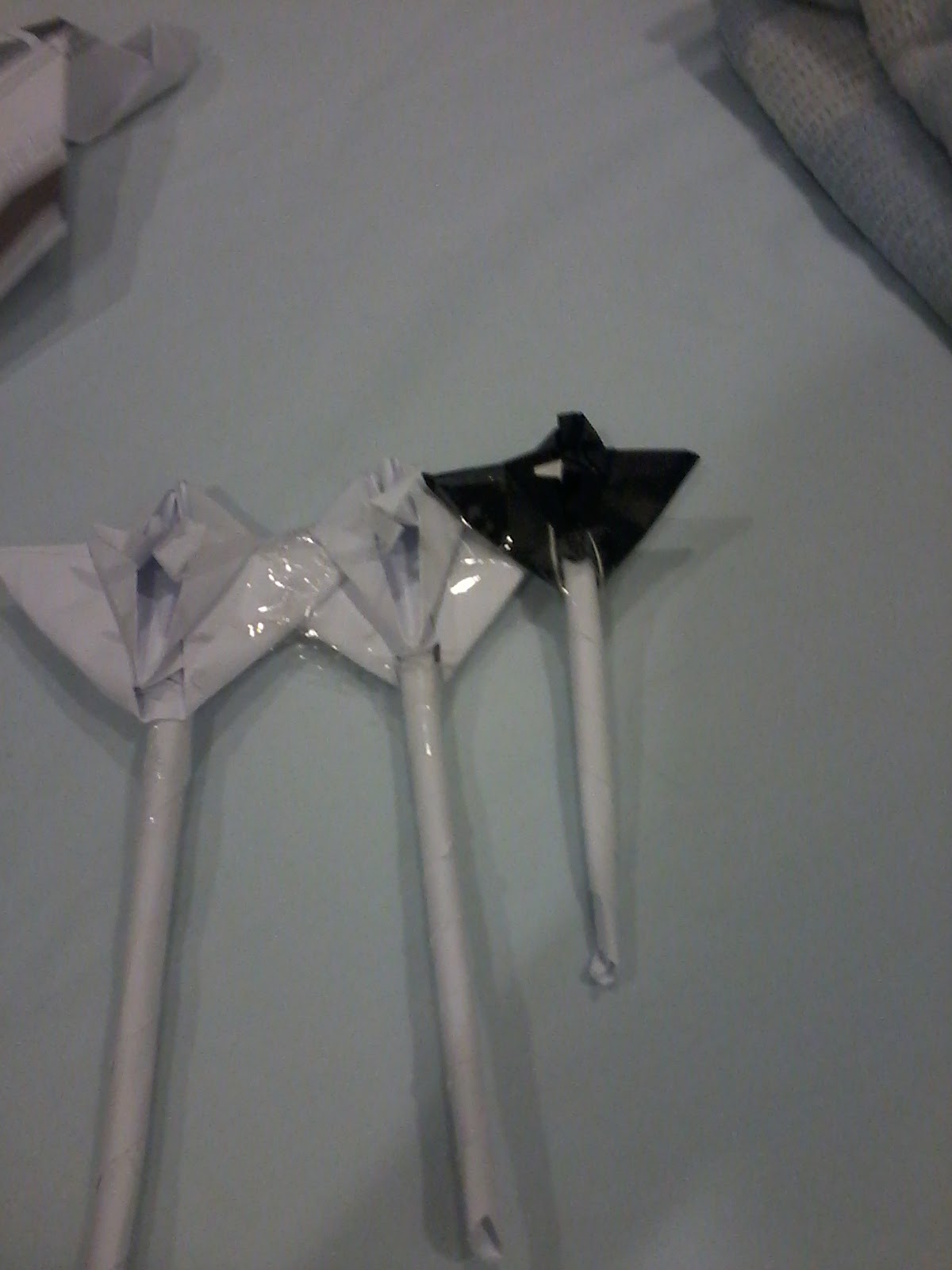
Triplet of decorative paper airplanes (courtesy of J1)

A mathematical pizza (courtsey of J2 who made the dough and J1 who snapped the picture)

What's mathematical about pizza? Measuring ingredients, tracking the time to mix the dough, talking different shapes for the base (circle and rectangle are never quite achieved, of course), temperature of the oven, time to cook, ways of cutting, probability that any will be left for mommy or daddy to taste....

Monday, June 8, 2015

Math is all around (proof without words)

Ok, I can't resist writing a little explanation. These are pictures of activities from the last 2 months that never quite made it into blog posts or, if they did, I just like the pictures and wanted to show them again.


A fractal tree made from rummy king tiles (part of our Natural Math/Moebius Noodles Multiplication explorers course):

Another fractal tree:

Is it an alien or a self-similar bug? How many body segments would we need to draw for the next smaller level?

Family Tree fractal:

I think this was a substitution fractal, again, Multiplication Explorers:

Halving sequence, another activity from the Multiplication Explorers course:

This little piece was 1/16536th of the starting square (2-14)

How many animal hybrids can we make?

Many ways to make a whole. How many ...?

Even in the round:

A version of Pascal's triangle made into a puzzle. I think we made all the cells mod 10. Hand cut!


Some pictures we saw at an exhibit in one of the halls at NASA in Houston. We did our own calculations and didn't agree with their claims about how many stamps or how many coins were used.


Finally, a couple of nice magic squares, fraternal twins or identical? I can't take credit for this, but don't remember where I saw it (prob on twitter):

Sunday, May 31, 2015

Twist on an old puzzle and our number scavenger hunt

who: J1, J2, J3
when: after lunch, before violin lessons
what did we use: mini-white board and things around our neighborhood

Digit Substitution

You've seen these puzzles before: there are triangles, squares, and circles that represent digits in an arithmetic equation and you need to figure out which digit is represented by each shape. During a recent RightStart Math session, J1 got a couple of these. The puzzles were fun, but standard, each with a unique answer. We decided to add two twists.

How many answers?
The first twist was to find how many answers there are to this puzzle. You can see us mid-work, having already identified two choices for the circle and several options for the other two shapes.
The point is that it invites the kids to think carefully about the abstract relationships between the values that the shapes can have.


Build your own
I always love reversing a puzzle and having the kids build their own puzzles. I opened with the challenge to see if they could create a puzzle with no solutions. Initially, they draw the shapes at random and assume there's no solution. However, once we worked through a couple, they started to notice patterns and to carefully plot their strategies for making the puzzles impossible. Also, it led to discussions about what should be allowed as a solution: can a number have a leading zero, is it ok if two shapes represent the same digit, can we allow a shape to represent a negative number or a number larger than 9, etc.  Really cool thoughts that transcend the specific puzzles we suggested to each other.

Our number scavenger hunt

J3 went looking for numbers around our neighbourhood the other day. This was suggested long ago on Kids Quadrant last September, but I didn't really appreciate how good it would be for us until we started. Here are pictures J3 took of our finds from 1 to 4.

One swimming pool (that is soo big)

Two black metal pieces to open the door

Three plastic bottles (prior to us doing a civic duty and helping clean up)

Four light switches

Except the first, all pictures were taken by J3. We also found an office chair that has 5 wheels, but the picture didn't quite capture it.

Playing this game, J3 was really excited to count everything in sight. I was a bit surprised that she seemed to have very little prior expectation about whether any particular group would meet the target we were seeking, so we will make sure to play this again soon.