Showing posts with label number theory. Show all posts

Sunday, July 3, 2022

Perfect numbers: Lichtman's Theorem (Part 1)

This summer, we are working through Jared Lichtman's recent proof that the primes achieve the maximal Erdős sum over primitive subsets of the natural numbers.

Quanta Magazine had a very nice article describing the theorem (formerly a conjecture of Erdős) which is the inspiration for this project. The article is here.

I will be posting notes on our conversations. The most important thing to understand: this project is about the journey and not the destination. We may not (probably won't!) get all the way through the paper. Along the way, we will take plenty of detours and excursions.

Tuesday, February 21, 2017

Cryptarithmetic Puzzles for Grades 1 to 4

Inspired by a series of puzzles from Manan Shah, I decided to have the kids play with cryptarithmetic puzzles today. In addition to borrowing some of Manan's puzzles, I also used some from this puzzle page: Brain Fun. I've included some more comments below about the Brain Fun puzzles.

My main concern was whether the puzzles were at the right level. In particular, I was afraid that the puzzles would be too hard. In fact, I tried solving a bunch of them yesterday and actually found myself struggling. I'll ascribe some of that to being tired and sick. However, my intuition was to make some simpler puzzles of my own. In particular, I added:
  • puzzles that have many solutions: I figured that many solutions would make it easy to find at least one.
  • a puzzle that "obviously" has no solution. Now, obviously, the word "obviously" is a sneaky one in math, but I was pretty sure the kids could see the problem with this structure.

Grades 1 and 2

For the younger kids, I started with a shape substitution puzzle. This is one our family explored almost 2 years ago: Shape Substitution. I don't recall the original source.

Two reasons why I started with this. First, it has a lot of solutions, but there is an important insight that unlocks those solutions. Second, by using shapes, we can write possible number solutions inside them as we solve or guess-and-check the puzzle. This made it easier for the kids to see the connection that all squares have the same value, etc.


The second puzzle: BIG + PIG = YUM
Really just a warm-up practicing the rules and doing a little bit of checking that we haven't duplicated any numbers.


The third puzzle: CAT + HAT = BAD
Again, lots of solutions, but noticing leads to a good insight.

Fourth puzzle:  SAD + MAD + DAD = SORRY
This is a trick puzzle. The kids know that I like to tease them, so they are aware they need to look out for things like this. We discussed this in class and I suggested they give this puzzle to their parents.

Fifth puzzle: CURRY + RICE = LUNCH
When I translated this to Thai, all the kids laughed. I was sneaking a little bit of English practice into the lesson and then they realized that it was worth trying to read all the puzzles, not just solve them.

Sources: I think I made up all of these puzzles (original authors, please correct me if I'm wrong).

Grades 3 and 4

The older kids already had experience with these puzzles. We did refresh their memory a bit with BIG + PIG = YUM

I asked them to give me the rules and explain why those rules made sense. As with most games, I want to communicate that we're doing things for a reason, but those reasons can be challenged. If they think it makes sense to do it a particular way, we're open to their ideas.

Second puzzle:  SAD + MAD + DAD = SORRY
Same discussion as for the younger kids. When prompted, this was pretty easy for them to spot, but they weren't naturally attuned to think about whether a puzzle had solutions or how many. This led me to take a vote on all the puzzles at the end to see who thought the puzzles would have 0, 1 or many solutions.

Third puzzle: ALAS + LASS + NO + MORE = CASH
A puzzle from Brain Fun. I think this is one of the easier ones on that page. Again, a bit of English practice.

Fourth puzzle: LOL + LOL + LOL + .... + LOL = ROFL (71 LOLs)
This was from Manan. I think it is one of the easier ones in his collection, but it looks daunting. Turns out none of the kids in the class were familiar with (English) texting short-hand, so my attempt to be cool fell flat.

Fifth puzzle: CURRY + RICE = LUNCH
Again, everyone was delighted when I translated this one. We're in Thailand, after all, so at least one puzzle had to be about food.

The key exercise

The final assignment everyone (all four grades) was given was to make up a puzzle for me to solve. I was thinking it would be nice to have one in Thai, but we decided to keep it in English as further language practice.

Manan wrote a nice post about having kids design their own puzzles. If it goes well, this is actually the activity that ties a lot of the learning messages together: they think about structure, they think about what allows multiple or single solutions, they apply their own aesthetic judgment, they use their knowledge of the operations, they are empowered with an open-ended task that cannot be "wrong."

We'll see how it goes. At the very least, I expect a lot of work for myself when their puzzles come in!

An extra sweetener
Two kids asked if we could use other operations than addition. That prompted me to put this on the table (also from Brain Fun):

DOS x DOS = CUATRO

Brain Fun Problems

The first time I'd seen the Brain Fun problems, I added them to a list and called them "basic" (see this page.) When I actually went to solve them, though, they didn't seem so easy.

Big confession time: I actually looked at some of the solutions.  However, I was disturbed to see that the solutions involved extra information that wasn't included as part of the problem statement! For example, in THREE + THREE + FIVE = ELEVEN, the solution assumes that ELEVEN is divisible by 11. This seems to be the case for several of the puzzles involving written out arithmetic:

TWO + TWENTY = TWELVE + TEN (assume 20 divides TWENTY and 12 divides TWELVE, I wasn't clear about whether any divisibility was assumed for TWO and TEN)

I'm not sure if similar assumptions are allowed/required for any of the others.

Maybe I shouldn't complain, since this assumption creates an additional constraint without which there could be further solutions. Perhaps part of the reason it doesn't sit well is aesthetic. In the 3 + 3 + 5 = 11 puzzle, 3 doesn't divide THREE and 5 doesn't divide FIVE.

Lastly, there is a typo in the final puzzle of the Brain Fun page. That puzzle should be
TEN x TEN = FIFTY + FIFTY

Thursday, February 16, 2017

More Man Who Counted (gaps and notes)

As previously mentioned, we have been reading The Man Who Counted. While the story is good and there are nice math puzzles, we've found some of our best conversations have come from errors or weaknesses in the book. Here are three examples:

How old was Diophantus?

In chapter 24, we encounter a puzzle to figure out how old Diophantus was when he died. In summary, the clues are:

  1. he was a child for 1/6 of his life
  2. he was an adolescent for 1/12 of his life. (J1: "what's that?" J0: "a teenager")
  3. childless marriage for 1/7 of his life
  4. Five more years passed, then had a child
  5. The child got to half its father's age, then died.
  6. Diophantus lived for four more years
Perhaps we are wrong about our interpretation of the clues, but we noticed two things:
(a) the answer is not a whole number of years.
(b) the answer given in the book doesn't fit the clues.

For the first part, it seems a natural assumption of these types of puzzles that we are only working with whole number years. Sometimes, this is an interesting assumption to directly challenge.
Here, since the clues involve a second person (Diophantus's child) we felt whole numbers were a strong assumption. Also, the name Diophantus, you know?

Each clue required some discussion for us to agree on the interpretation. The one that seems most open is the fifth clue. In particular, did the child live until its age was half of the age of its father at the time of birth or to the point that, contemporaneously, it was half its father's age?

For completeness, I'd note that neither interpretation matches the book's answer. The first interpretation does allow a whole number answer, but it doesn't give whole numbers for all the listed segments of Diophantus's life.

Just so you can check for yourself, the solution given in the book is 84 years old.

How do you fix it?
We discussed several possible fixes:

  • accept answers that aren't whole numbers or require whole number segments for each clue. This allows us to take the alternative interpretation of the fifth clue (though that still isn't satisfying) or to accept the clues and just take a new answer. This isn't satisfactory because... Diophantus.
  • Change clue 4 or clue 5 to match the book's answer. This approach seemed to fix the puzzle without distorting it or changing the mathematics required to analyze it.
  • Change clue 1, 2, or 3. While possible, these seemed to open the possibility of changing the character of the puzzle. Also, these fractions were plausible based on our own experience of human life spans.
Of course, an even more satisfying answer would be to introduce a further variable and make the puzzle into one that makes heavy(ier) use of the integer restriction.

Clever Suitors

In chapter 31, Beremiz is confronted by a nice logic puzzle. Three suitors are put to a test, each is blindfolded and has disc strapped to his back. The background of the discs: other than color, the discs are all identical, there are five to choose from, 2 black and 3 white.

The first suitor is allowed to see the colors of the discs on the backs of his two competitors, then required to identify the color of his own disc and explain his reasoning. He fails and is dismissed.

The second suitor is allowed to see the disc on the back of the third suitor, then required to identify the color of his own disc and explain his reasoning. He fails and is dismissed.

Finally, the third suitor is required to identify the color of his own disc and explain his reasoning.  He succeeds.

Weakness 1
As a logic puzzle, we enjoyed this. Our problems came from the context in the story. This challenge was set to the three suitors as a way of fairly judging between them by finding the most clever suitor. However, this process was clearly unfair. In fact, it is inherent in the solution that it was impossible for the first and second suitors to determine the color of their own discs.

This led to a nice discussion about who really held the power in this process: the person who structured the problem by deciding what color disc should be on which suitor and what order they would be allowed to give their answers.

Extensions:
  • consider all arrangements of discs. Are there any arrangements where none of the suitors can answer correctly?
  • What is the winning fraction for each suitor? If you were a suitor, would you prefer to answer first, second, or third?

Weakness 2
Our second objection was non-mathematical, but again related to the story context. The fundamental problem wasn't how to choose a suitor. The fundamental problem was how the king could remain peacefully friendly toward all the suitors' home nations through this process.

For this discussion, we went back to the story of Helen of Sparta, which we'd read a long time ago in the D'Aulaire's Book of Greek Myths. Of course, that also led to discussion of the division of the golden apples, another puzzle we all felt surely could have been solved more effectively with some mathematical reasoning...

The Last Matter of Love

The last puzzle of the book is in chapter 33. It is another logic puzzle, again intended to test the merit of a suitor in marriage. The test:

  • there are five people
  • two have black eyes and always tell the truth
  • three have blue eyes and always lie
  • the suitor is permitted to ask three of them, in turn, a "simple" question each.
  • the suitor must determine the eye color of all five people
As a logic puzzle, we readers get some extra information:
  1. The first person is asked: "what are the color of your eyes?" The answer is unintelligible.
  2. The second is asked: "What did the first person say?" The answer is "blue eyes."
  3. The third is asked: "What are the eye colors of the first and second people?" The answers are "the first has black eyes and the second has blue eyes."
Simple questions
Our first objection was the part about asking "simple" questions. Having developed our taste for these types of puzzles through the knights and knaves examples of Raymond Smullyan (RIP, we loved your work!!!), the third question really bothered us. If you're going to go that far, why not ask the third person for the color eyes of all five people?

Personally, I would prefer that the puzzle require us to ask each person a single yes/no question.

As an extension: can you solve the puzzle with that restriction? 

Getting lucky
Again, we felt that this puzzle didn't meet the requirements of the context: to prove the worthiness of the suitor. Putting aside the question of whether this is really an appropriate way to decide whether two people should be allowed to marry, the hero here got lucky.

Extension: what eye color for the third person would have caused the suitor to fail?
Extension: what answer from the third person would have caused the suitor to fail?
Extension: for what arrangement of eye colors would the questions asked by the suitor guarantee success?
Extension: what was the suitors' probability of success, given those were the three questions asked?

Waste
Our final objection was the simple waste in the first question. From a narrative perspective, this is justified and even seems made to serve the purposes of the suitor. However, it opens another idea:
can you solve the puzzle, regardless of eye color arrangement, with only two questions?

Feel free to test this with yes/no questions only or your own suitable definition of a "simple" question.

The power of...

As a final thought, let me say that I think errors and ambiguity in a text are a feature, not a bug. It is another great opportunity for us to emphasize that mathematics is about the power of reasoning, not the power of authority.

Tuesday, January 31, 2017

Quadratic Friends (The Man Who Counted)

J1, J2, and I are currently reading The Man Who Counted. Here are some quick thoughts:

Quadratic Friends
The book is a great entry point for mathematical discussions. In fact, it makes it questionable as bedtime reading, since I have to be careful to find a more narrative section to close the evening. Otherwise, we would just continue talking and they'd never get to sleep.

Fortunately, the J's are willing to extend some of these conversations over to the next day, so we're not obligated to wrap up everything in one evening.

Here is an example discussion: in one of the early chapters, the protagonist Beremiz talks about the special relationship between 13 and 16. Namely:
13 * 13 = 169
1 + 6 + 9 = 16
16 * 16 = 256
2 + 5 + 6 = 13
Finding more
We wondered: what other pairs of numbers share this property?

Our first instinct was to gather data, so we started calculating some examples. We began with 0 and worked up, squaring, adding the digits, repeating. We found a couple of cases that flowed into the 13-16 relationship, for example 7. This gives a feeling that 7 is very fond of 13, but 13 only has eyes for 16.  Not the usual way people think about numbers, I guess.

Along the way, we made some interesting observations about this iterative process. I won't spoil the surprise, but would encourage you to explore yourself.

I'd note that J1 did the calculations up to 30 in his head, while I was a bit lazy and wrote a pencilcode program.

An extension
This conversation branched in an interesting way. Squaring is a natural thing to do with numbers, but summing the digits is a bit artificial. It depends on a choice of base. So, a natural follow-up question:
what quadratic friends exist in other bases?  This is an exploration for another day.

Thursday, December 8, 2016

Solving contest problems (challenge from Mike Lawler)

These are my notes working through problems posted by Mike Lawler on his blog. You'll have to go there to see the problem statements.

The intended value of this write-up is to show examples of the actual problem solving thought process someone has followed, not just a polished solution.

Problem 19
Since the circle has area 156 π the radius squared is 156, which is 4 * 3* 13. That seems like a strange number, I'm curious to see where it will make calculations come out nicely, later in the problem.

We're told OA has length 4 sqrt(3). Squaring that only gives 48, so A is well within the circle. That means triangle ABC has vertex pointing toward O along the perpendicular bisector of side BC.

This lets me set up a picture of a right triangle with legs length $x$ (half the side of the equilateral triangle), $x$ sqrt(3) + 4 sqrt(3) (the altitude of the equilateral triangle plus OA) and hypotenuse r (2 sqrt(3*13)).

Applying the pythagorean theorem and simplifying along the way:

$$x^2 + 3(x+4)^2 = 156$$
$$4x^2 + 24x + 48 - 156 = 0$$
$$x^2 + 6x - 27 = 0$$

Visually factoring gets me $x$ is either -9 or 3.  3 is much more reasonable for half the length of the side of a triangle, so my answer is 6.

Note: If this weren't a contest problem, I might try to think about the -9 root a little more carefully.

Equiangular hexagon
I had already solved this problem from a recent tweet of Mikes, so I can't fully recreate my thought process.  Here were some of the highlights:
  • wonder why 70%
  • draw a picture: fail to notice that triangle ACE is equilateral
  • Split the hexagon into two trapezoids by line CF
  • Calculate the area of those two trapezoids
  • Calculate the length from C the intersection with AE and segment CF.
  • Calculate the area of ACE based on the two subtriangles split by CF.
  • Obtain the quadratic equation for r based on the formulae for the two areas and the given 70% parameter.
School Competition
Let's call Andrea's rank $m$ for median. Since she is the unique median, there must be $2m - 1$ total contestants. We also know:
  • $m \leq 36$ because Andrea scored higher than Beth who was ranked 37th
  • $64 \leq 2m -1 $ because Carla ranked 64th, so there were at least that many competitors
  • $3 \mid (2m - 1)$ since every school sent three competitors
The first two inequalities tell us that $33 \leq m \leq 36$. Because $2m -1$ is a multiple of three, $m$ can't be a multiple of 3, so it has to be 34 or 35. Calculating mod 3, we can quickly check both and see that $m$ has to be 35.

That means the competition had 69 competitors from 23 schools.

Using multiple choice
After putting together these notes, I saw a commenter on Mike's blog use "solution by multiple choice." When I was doing timed tests/contests, I would make use of the options as part of my strategy. However, I don't do that now, since I'm much more interested in exploring the mathematics of the problems than getting the final answer.

Monday, July 4, 2016

Evens/odds and a quick update

Early years math seems to put a strange emphasis on even and odd numbers. Recently, a friend asked whether there was a point to this. Maybe it is just one of those little bits of terminology that we are asked to memorize for no reason?

By chance, this was something I had started considering about a month ago. It did seem strange that we spend so much time on this simple way of splitting integers. I wondered if it was worth the attention. From that point, my awareness was raised and I started noticing where it occurs and ways it links with more advanced concepts and future learning. My conclusion is that even/odd is surprisingly deep.

First, it is a simple version of concepts that will be developed further. For example, the alternating (starting with 0) even, odd, even,odd, even... is an illustration of a pattern. They will soon see other alternating patterns, then more complicated patterns and 2d or 3d patterns.

For another example, evens are multiples of 2, odds are numbers with a non-zero remainder when dividing by 2. This leads to understanding other multiple families, division, and division with remainder.

Second, the even/odd distinction is helpful for improved understanding of different calculations. For example, the observations that even+even = even, while odd + odd = even, etc. These can be used to help self-check their calculation and also will form early experiences with algebra. Similarly,
even x odd vs odd x odd reinforce understanding of multiplication. Again, this gets broadened for multiples of 3, 4, 5, etc.

Third, there are a lot of more advanced results that are easiest to prove by parity arguments. Sometimes we are working with a set of things that are even and the key observation is we can pair them up. Other times, we have a set that is odd and the key insight is that, when we pair them, one must be left over.

Recently, with the J1 and J2, we were looking at some constrained ways to put the numbers 1 to 25 on a 5x5 checkerboard. They were able to prove that some versions were impossible simply because 25 is odd, so there are more odd integers in 1 to 25 than even integers.

Lastly, there are techniques in computer science that involve even vs odd. This comes up pretty naturally because of the essential use of binary.

Some games

Recently, J1 and J2 have gotten hooked on some classic card games. In particular, we've been playing a lot of 3-handed cribbage. It is a nice way to do some simple addition practice and build intuition about probability. Probability is now getting even more share of mind: in the last couple of days we started playing poker together. This was actually inspired by some of our reading together.

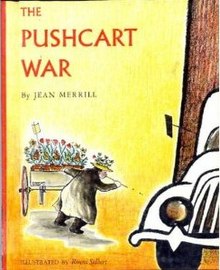
We are reading the Pushcart War.


In one scene, there is a poker game. Of course, the J's insisted that I explain the game and were eager to try it out. J3 was the huge winner tonight, while I busted out. Oh well.

Monday, June 20, 2016

Secret Numbers (Addition Boomerang variants)

We have been enjoying Mathpickle activities in our math games classes recently. This week, the 3rd and 4th graders will be playing with some of the more advanced Addition Boomerang variations.

During our planning, we came up with one extra pointer to tie the activity more closely with multiplication. Also, we had ideas for variations and wanted to record our notes so we can use them again in the future.

Tie with multiplication

In Gord's video explanation, he sometimes records in the center of each loop how many times that loop has been used. We emphasize this and write some related equations to help draw out the connection between the repeated additions in this activity and multiplication.

The first way we do this is by making tally marks inside the loop every time that branch is chosen. At any time, you can pause and write down an equation for the current total in a form
AxN + BxM = Total

where A and B are the values of the loops, N and M are the number of times each loop has been used.

Alternatively, we can show a "completed" round of throws by simply writing the number of passes for each loop in the middle and, again, write out an equation showing the total as the sum of two products.

Secret Number Variations

We start with a basic addition boomerang lay-out, either with 2 or 4 branches, both players (or teams) share a common set of addends and take turns adding on to a common running total. In our variants, the players choose and write down a secret number that helps inform their target for the game:

  • Version A: players pick a number between 70 and 100. This is their target for the game and they win if the common total hits that value, whether the target is reached on their turn or their opponents turn.
  • Version B: players pick a number larger than 15. They win if the total hits a multiple of their secret number. For example, if they choose 17 and the running total hits 51 (aka 17 x 3) then they would win. If the total is a multiple of both secret numbers, then the player who chose the larger secret number wins.
  • Version C: players pick any number. They win if the total hits a multiple of their secret number that is larger than 60 (not equal to 60). If the total is a multiple of both secret numbers, then the player who chose the larger secret number wins.

Version B is, I think, the most directly playable.

Possible issues
I'm not sure how to deal with the case where both players choose the same secret number.

For Version A, it will be interesting to see what modification kids can find that will deal with the fact that it is very easy to miss any particular target. In the basic game, once the total is larger than your target, there is no hope of recovery. There are several ways to address this. I would be eager to hear any rule sets that kids create and hear about the experiences.

In Version C, I wonder if choosing 2 as the secret number is too strong a move?

Monday, May 30, 2016

Improv Math and Division Dice follow-up

We had a really good experience playing Division Dice, the game that we introduced a couple of posts ago.  Mainly, I want to illustrate something fun that came out of really listening and paying attention to what the kids are doing and saying. I like to think of this as "improv math," as a way to credit my improv comedy experiences for heightening my awareness of how important this is.

Division Dice for number sense

I was really pleased about the quality of thinking stimulated by the game. We played with the most loose rules (1s are wild, the components of the 2 digit value can be flipped to their 7s complement). That gave a lot of opportunity for the kids to think through options to (a) make whole number divisions and (b) maximize values.

For example, rolling 3, 4, 6:
  • what are the allowed groupings that give a whole number division? Remember, in the 2 digit number, we can use any of the values 1, 3, 4, 6, and it is possible for us to use two 3s or two 4s in our calculation.
  • What is the highest scoring choice?

Division Dice for arithmetic exercises

As a way to create virtual worksheets, this game is mediocre. The basic structure means that students are never dividing by a divisor larger than 6. This leave out a lot of fact families. However, because the kids are trying to maximize their scores, they quickly realize that they can almost always get away with division by 2, occasionally must divide by 3, and rarely get stuck dividing by 4 or 5. I haven't yet seen a case in a live game where division by 6 was necessary.

Fun exploration: what scenarios will require division by 6?

Using playing cards or other dice shapes allows us to extend the possible values and reduce the likelihood of dividing by 2 or 3. However, it also increases the number of cases that don't have a whole number division relationship. We are thinking about ways to incorporate division with remainder and will try out a variant tomorrow.

Improv Extension

Playing at home, the 3, 4, 6, case led J1 to consider: how do 63 ÷ 3 and 64 ÷ 4 compare?
As he contemplated that, I realized that we had a nice sequence of multiples, meaning all of these are whole numbers:


There were several cool things for J1 to observe here:

  • 4 of the 6 quotients end in 1
  • The quotients are all decreasing
  • The drops between successive quotients are themselves decreasing
  • the dividends are equal to the divisors + 60

We pursued this in two ways:
Extension 1: what if we add something else to the dividends?
We tried three versions.

  1. starting with 60 and adding 6 at each step
  2. Starting with 60 and adding 60 at each step.
  3. starting wit 1 and adding 7 at each step

You can see our notes mid-discussion below:


Later, when J2 was also involved, I offered them another sequence: starting with 66 and adding 6 for each increment:
66 ÷ 1
 72 ÷ 2 
78 ÷ 3
84 ÷ 4
90 ÷ 5
96 ÷ 6
120 ÷ 10
132 ÷ 12
150 ÷ 15
180 ÷ 20
240 ÷ 30
420 ÷ 60
3660 ÷ 600
36060 ÷ 6000
We're breaking the rule about the dividends being multiples of the divisors, but the last two calculations are still easy and nicely illustrate the limiting behavior.

Extension 2: can we find other chains of whole number division equations?
We started this by thinking more simply: for chains shorter than 6. For example, what are the smallest K, L, M, N larger than 1 such that all of the following are whole numbers:

K ÷ 1
 (K+1) ÷ 2 

L ÷ 1
(L+1) ÷ 2
(L+2) ÷ 3

M ÷ 1
(M+1) ÷ 2
(M+2) ÷ 3
(M+3) ÷ 4

N ÷ 1
(N+1) ÷ 2
(N+2) ÷ 3
(N+3) ÷ 4
(N+4) ÷ 5

After getting the shorter cases under our belt, we then went for a chain of length 7. J2 worked by himself for a while, then came back and announced that no chain with dividends smaller than 100 would work.  He went away and then came back quickly with the idea that maybe we could add 7! to each divisor.


Tuesday, May 24, 2016

Logic Puzzle collection and Dropping Phones

Recently, Mathbabe put out a request for riddles. There are some good links in the comments:
We've played with puzzles from almost all of these sources in the past, but this was a good opportunity to put together a nice list.

The one that stood out to me was on FiveThirtyEight. That's a site I read frequently, especially during this US election season ... and I was totally unaware of The Riddler feature. We kicked off with the oldest puzzle from their archive: Best way to drop a smartphone.

Breaking stuff

Right away, J1 and J2 loved the theme and were into questions about whether they could somehow keep the phones, if they weren't broken, or utterly destroy them, if they were broken. We talked about setting an upper bound with a very simple strategy of starting on the 1st floor and working up each floor. That's not a great answer, but it got them into modifications and improving strategies.

Through the conversation, it was interesting to see them start with the idea that the drops for one of the phones would be de minimis and could be ignored, but then start to pay attention to that aspect. Also, they had to grapple with the idea of balancing the number of drops that would be required in different cases.

While we didn't get to the optimal strategy, but the kids managed to get a version that, at worst, would take 19 drops for the 100 story building. Their intuition was based around taking the square root of 100. They could see that this probably wasn't the best answer, since there were still cases that, at worst, would take 10 drops and others that, at worst, would take 19.

Can you do better?

Smaller before bigger

The puzzle page poses the same challenge for a 1000 story building. However, we found something interesting when working on the version for a 10 story building: there is  strategy where all worst cases take the same number of drops, but it is not the optimal strategy!

It is a little hard to write about this without disclosing the strategy, but here's a hint:

  • 4 + 3 + 2 + 1 = 10 and 5 + 4 = 9
  • We are always allowed to assume that the phones will break if dropped from the top floor of the building

This led to another extension: what size buildings will have the same issues as for a 10 story building?

Probability comes in

Another extension is to think about the expected number of drops required and strategies that minimize this. Crucially, this extension introduces the idea about our prior beliefs about the sturdiness of the phones: where do we think the phones are likely to break, what is our confidence?

We didn't pursue this extension very far, but it did lead to some interesting conversations about terminal velocities. For those who want to follow that thread, this (other) stack exchange thread might suit you: How to figure out height to achieve terminal velocity.

Monday, February 1, 2016

All your base are belong to us (cryptarithm extension)

If you don't know Futility Closet, I suggest you take a look. It is a fun and quirky combination of math puzzles, chess puzzles, and historical anecdotes

This recent post had a nice puzzle, Hidden sum, that led to a fun conversation with J2 and J1.
This was a fun puzzle on its own that I knew would appeal to J2, since one of his familiar number friends, 111, is lurking in the solution.

The base

Before I got a chance to discuss with J2, however, I spent some time considering a small clause in the question: "in base 10." Strangely, if this clause hadn't been included, I probably would never have thought to investigate in other bases. This restriction, though, seemed like an invitation to go exploring in other bases. Since the older J's had recently done some work in non-decimal bases, I thought they would enjoy this extra exploration.

I told J2 this puzzle. First, he worked through the base 10 version, including seeing an old friend (and familiar factorization) along the way, I asked what he thought about doing it in other bases. He was interested, so we started with binary. Luckily, his first idea was to consider possibilities for TTT. In binary, the only three digit TTT is 111, aka 7 in decimal. He saw that was prime, so couldn't be factored into two 2-digit factors. That proved to be the first key insight of the exploration.

We moved on to base 3, 4, 5, 6, 7, 8, 9, 10, and 11. At some point, J1 joined the game. Along the way, they made the following observations and conjectures:

  1. if 111 is prime, there is no solution. This is because TTT will have to have a 3 digit factor.
  2. If 111 is not prime, it will have one 1-digit and one 2-digit factor (why?)
  3. If 111 is not prime, neither factor will end with a 0 in the ones place (why?)
  4. Given a 2-digit number (ME) with a non-zero ones digit in the ones place (E not 0), and a (non-zero) one digit number X, there is a single digit value T such that multiple of T x X is of the form YE (a 2-digit number sharing the earlier value in the ones place). 

For the first three conjectures, "(why?" means that most of you should be able to prove these. For the fourth, this conjecture isn't true! However, there is something extra that happens in the scenario for the puzzle that gives extra information and makes it true when ME x X = 111

The sum

One other point is lingering for me: why does the original puzzle ask for the sum of E, M, T, and Y? Sometimes, this form of question is a clue that there is some interesting relationship that allows us to calculate the answer without finding values for all the variables. Though it is common, I still get a kick out of this, probably because there is such a strong instinct to solve for all the variables.

In this case, I really don't see a way to get the sum directly, without finding values for E, M, T, and Y. Any ideas?

If there isn't a direct path, why did they phrase the question this way? Without seeing the exam, my guess is that this is an information reduction operation that allows this to be a multiple choice question.

Sunday, January 17, 2016

Bitter pills (some unfortunate math)

During a hike in the south, J1 tripped and cut his forehead badly. This incident lead to the following conversation snippets and math observations about taking medicine.

How many ways

J1 has to take three different pills, a white one, an orange one, and a cream one. How many ways can he take them? 6, of course, 3 choices for the first, 2 for the second, and then whatever is left at the end. Follow-up: why do we multiple the choices instead of adding them?

However, our answer is 12. The twist is that one pill is broken into two halves because it is so big. That means we have 4 pieces, so 4! ways of arranging, but two pieces are identical, so 4!/2 distinct ways of ordering the pieces.

For those who are more advanced: what if we allow taking more than one pill at a time?

Cut in half and comparisons

As noted above, the white pill is pretty large, 375 mg. We break it in half, so how large is each half?
The next largest pill, the orange one is 25mg. How many times larger is the white compared with the orange?

The smallest, the cream one, is 5mg. How many times larger is the orange? How many times larger is the white?

Some pictures

Sorry to disappoint you, if you are looking for pictures of the wound. It really is too gruesome to spring on the math lovers of the internet.

Not our favorite ten frames:


Which sequences of pattern blocks close up?


Peg Board Fun


Primes and Powers

Saw this tweet and did a short investigation with J2.


His immediate reaction was a great one: "Let's try 2 and 3."
For uniqueness, we verbally talked through 5 and 3, but I guided him to recognize that these would both be odd. That led him to recognize that the only possibilities were an odd prime and 2, so we worked through some more cases and came up with a related conjecture:


Sunday, December 20, 2015

Just in time for christmas: some valentines math

Note: The point of this post is that you should go take a look at the CSMP storybooks and read them with your (elementary age) kids. They are hard to find, but I've done that work for you: CSMP at the Wayback Machine

You might call us hopelessly out of sync with the rest of the world: we haven't seen the new Star Wars and we are reading math stories bout Valentine's Day instead of Christmas. Oh well, at least we manage to link in at least one New Year's tradition.

The Story

In the world of numbers, everyone sends just one Valentine card. However, they arrange it so that everyone receives ten. The fact that they can do this and their technique are explained in the old (old, old) CSMP storybook: Valentine Mystery.

Just look at those dandelions!


I grew up on the CSMP workbooks and storybooks and they still have a large place in my heart. Now, they are hard to track down; this link is via the internet archive: Wayback Machine.

Our investigations

J3 read the story to me and then we talked together about what was going on. He really liked that the diagrams created multiplicative fractals. We had seen these before, in May when we did activities from Natural Math's Multiplication Explorers, but he didn't remember until I showed some old pictures.

It seemed that he understood the story well enough. What we wondered: what will the numbers do for New Years? I suggested that they would play a game where each number would give one red envelope (filled with cash, of course) but that every number would receive two. Was that possible?

Well, he wasn't so enthusiastic because: "that means every number will just get one envelope." Meaning that, net, they will send out one envelope and get one back. Not so exciting.

His suggestion: In the valentine's mystery, basically the numbers drop their one's digit to figure out who will receive their valentine. Maybe now, they should drop two digits, their ones and tens. Thinking for a bit, he realized this was great: now all the numbers will get 100 ang bao.

Why stop there? Can we get everyone to receive 1000 red envelopes? What about one million? Or more?

Conclusion:  the whole numbers are the ultimate Ponzi scheme!

Detour via 5

After realizing that we could get the numbers to receive an arbitrarily large number, we went back to the formulation in the book. Namely:
25 = 2 x 10 + 5, so 25 sends a note to 2
306 = 30 x 10 + 6, so 306 sends a note to 30
So, J3 wondered, what if we used 5 instead of 10? Okay, we did a little exploration where he would call out numbers, I would expand the division relationship, then we'd conclude who would send a present to whom:
368 = 73 x 5 + 3, so 368 sends a present to 73
306 = 61 x 5 + 1, so 306 sends a present to 61
5 = 1 x 5 + 0, so 5 sends a present to 1
0 = 0 x 5 + 0, so 0 sends a present to itself
So, how many presents does each number receive?

A little binary

Not giving up on the idea of receiving 2, I asked J3 if he knew about binary. "No, but I've heard of it." These are our notes (his handwriting is now almost the same as mine!):


For our table of decimal and binary versions, he would try to figure out the next number. For the first couple of guesses, I would decompose the number and he would figure out the decimal version. After a couple, he did the decomposition himself. Finally, he caught on and understood some of the patterns of how to count up in binary.

We still haven't gotten to the punchline for our New Year's story, but it seems close.

Some snaps

Famly fun working on Find the Factors puzzles together

Traditional Xmas party activities

Wednesday, July 29, 2015

ABCs of logic puzzles

who: J1
when: while on holiday from school

After a long gap, I had a chance to look at Tanya Khovanova's math blog again recently. She has a nice mix of questions/puzzles, some of which are beyond our kids right now while others are perfect. Yesterday, we talked about a pair of problems involving a trio of puzzling characters: Alice, Bob, and Carl.

My hidden number
In the first puzzle, Carl has a secret number and gives out some clues. This puzzle shares characteristics with the (recently) famous Cheryl's Birthday puzzle. In particular:

  1. There is some common information
  2. There is some private information that the characters in the story have, but we don't have
  3. The characters make comments about whether someone else can solve the puzzle
  4. Being told something you already seem to have known (e.g., "You don't know the answer") actually gives the character enough additional information

I like Tanya's puzzle more than CBP because it is more self-contained and also invites us to a bunch of (elementary) number theory observations in addition to working through the logic.

Here are some highlights of the discussion:

  • Realizing that there are some numbers where it is sufficient to see either the 10s or the 1s digit to reconstruct the whole number (given multiple of 7, less than 100, etc)
  • Realizing that there are some numbers where one person could know the answer, but the other doesn't and that it could be either the person with the tens or the ones digit.
  • Thinking about what it meant to Bob when Alice said that he didn't know the number.
  • Identifying related clusters of multiples of 7 (like {14, 84}, {21, 28, 91, 98}) that helps us see some (slightly) more subtle relationships between numbers we don't normally associate

Where's the party
In the prior puzzle, we could trust everything that Alice, Bob, and Carl said as being true. In our second challenge, where's the party, we now confront a problem where there is always something distorted in their comments.

Once again, we felt there were some parallels with some of the scenario's from Smullyan's Alice in Puzzle Land. You have to play with the statements you are given to extract the useful information.

The key issue in our discussion of this puzzle was the process of going back and forth between "true" numbers and numbers spoken by the characters. This led us to talk about functions, like Alice(t) is the number Alice will say when she is talking about true number t and the inverse functions. J1 called the function inverse operator Undo, so Undo(Bob)(Bob(t))=t and Bob(Undo(Bob)(s)) = s.

Suddenly, J1 had so many questions about these new objects, Alice(), Bob(), Carl(), and their Undo relatives:

  • When are they the same, i.e., Alice(t) = Bob(t)?
  • Which one is larger, for a given true number t?
  • Do we ever have Alice(t) = Undo(Alice)(t)?
  • etc, etc

This was an invitation to make some pictures, a simple graph of the three functions. Here is J1's and then the one we made together:


The pictures then gave us some new things to notice. For example:

  • Carl only says the largest number for a bounded region of true numbers
  • For any true number, Carl never says the smallest number

A call for puzzle extensions/mash-ups 
J1 asked something I wouldn't have considered on my own: are these the same Alice, Bob, and Carl in the two puzzles? If so, does something interesting happen if we combine the distortions of the second puzzle with the basic set-up from the first puzzle? What if Alice and Bob don't know Carl's constant?

Please go forth and consider this version, as well as create new ones of your own. If you need further inspiration, consider this mash-up Cheryl's sweets, from the fantastic Aperiodical crew.

Monday, July 27, 2015

a physical feeling for densities

who: J1
when: after lunch
where: our stairs

Thanks to Mom, our stair number line recently got a (partial) refresh with some snazzy new number posters. This stimulated a new exploration by J1 to study how dense different groups of numbers are. Well, that wasn't how he phrased it . . .


J1's dialogue as he played on the stairs:
Hmm, what if I walk up the multiples of 2? <walks up skipping stairs, no problem here>
Oh, that's pretty easy, but J3 might find it tricky.

What about squares? 1, 4, what's next ...?
Ooh, 9, that's hard. <finds a cheat by wedging his feet against the sides of the stairs so that he isn't touching the stairs in between>
What's next? 16, oh no! <seeing that it is too far to get by himself>

What about primes?
2 <easy>
3 <very easy>
5, 7 <not to bad>
9? No!
11... daddy, please help! <I help lever him up onto 11>
13, easy!
15, no... 17 <slips as he tries a couple of tricks to get to the 17th step>

Okay, now let's try multiples of 4
<etc>

Thursday, July 23, 2015

tmbg inspired primes, perfect, deficient and abundant numbers

A quick conversation summary, inspired by They Might Be Giants kids song: Seven


J1: why is the only way to subtract 7's by using up all the cake?
J0: they are really hungry because they are primes. They only have 2 proper factors.
J2: hmm, then what about 6? I guess 6 doesn't like cake?
J1: oh, the other numbers like cake, they just aren't as hungry if they have a lot of factors.
J2: what about 144? 144 must really not need to eat much extra!

Sunday, July 19, 2015

more age chat

who: J1
when: bedtime

J1 wanted to return to our discussion about their three ages. In particular, someone had noticed that, prior to the recent birthday, their whole year ages were all primes: 3, 5, and 7. J1's question this evening: will this ever happen again?

First case

We talked through 2 different cases. The first uses 2 year gaps, so AgeY(J3)+2 = AgeY(J2) and AgeY(J2)+ 2 = AgeY(J1). As we worked through examples, J1 quickly saw that it wouldn't work whenever J3's age was even, so we focused on odds. From 5, 7, 9, he realized that we could skip the cases where J3 was 7 or 9, so we looked at 11 and 17. Along the way, we had identified that J1's age was 9 (3x3), then 15 (3x5), then 21 (3x7).  Seemed to be a pattern of always being a multiple of 3...

Second case

Next, we looked at their current gaps, so AgeY(J3)+2 = AgeY(J2) and AgeY(J2)+ 3 = AgeY(J1)
This one was easier, solved by just looking at the parity of the ages.

So, sad news all around: they will never again have all prime ages!

Fractional ages

Next, we talked about the equation Age(J3) + Age(J2) = Age(J1). This works out now when we use whole year ages (or using the floor function, if you prefer). There had been some chatter earlier about fractional ages, so J1 wanted to check that.  These were the estimates J2 had given earlier for their ages:

  • J3: 3 1/4
  • J2: 5 1/2
  • J1: 8
So, does the equation hold? Unfortunately, it doesn't. J3+J2 is 8 3/4. Will it ever hold in the future and when?

We talked for a while and J1 realized that, as time passes, the sum of the sibling's ages increases twice as fast as his age does. That gave him a clue that it won't happen in the future, but did in the past.  So, when was that?

Keeping in mind the pattern he'd recognized about changes, he guessed it was 3/4 of a year ago. Checking through was a good exercise in fractions and confirmed his conjecture.

From that, he wanted to get more precise about when that date was, 3/4 of a year ago, and then started talking about that having been a really special time for the three of them (unrecognized at the time, of course). When he started getting that precise, though, I offered that J2's estimates were a bit off and substituted J3 = 3 1/6, J2 = 5 5/6, and J1 = 8. This gave an even more satisfying conclusion once he worked out this case.

Thursday, July 9, 2015

A magic trick and magical discussion (part 1)

who: J1 and J2
where: in bed
when: just before going to sleep

Another mystery process trick
I found this post Little Math Magic on JD2718's blog. We did something similar at the beginning of the year with calendars (here) and the kids really liked making a choice, doing some calculations that obscure the choice, then seeing if I can figure out their choice, so I expected that they would enjoy this, too. Computationally, it is a bit more challenging for the kids as it involves squaring 2 digit integers.

14 Squared
talking though 14 squared, J2 asking if we could do 10*10 + 4 *4. We talked about why that doesn't work. In fact, J1 raised the example of 11x 11. Since J2 knew that this is 121, they were able to compare with the other "algorithm" and see that 10x10 + 1x1 isn't right.
J1 said that, instead, we could do 10 * 14 + 4 * 14, which J2 then calculated. When he got to 196, he was delighted, since he did recognize that old friend. Also, he mentioned 169 was another familiar square friend: "13 squared, right?"

From 196, we keep the 6 and then square that, getting 36. We keep the 6 again. Finally, we need to multiply this result by our original number, so 14*6. J2 remembered 4*14 was 56 from an earlier calculation, so he just calculated 14x6 = 14x4 + 14x2= 56 + 28 = 84.

At the time, it felt really good to hear them helping each other work through these calculations, especially their thought process checking the possible algorithm for multiplying 2 digit numbers.

Next time
Well, now that they understand the algorithm, we still have to do it as a trick, where they don't tell me their starting number. After that, let's see if they can figure out how it works?

Tuesday, March 31, 2015

Apologies to the avocado and sums of cubes

Who: J3 and J2
Where: side of the house
When: this afternoon

Sums of Cubes

Cathy O'Neil (THE Mathbabe) flagged a proof-by-picture of Nichomachus's theorem yesterday and suggested it would be a fun discussion with kids. J2 and I started exploring it today. My current favourite introduction is to say: "a friend thought you might be interested to explore ..." In this case, to explore patterns from adding up perfect cubes.

From past conversations, his natural inclination was to start with 13, then 13+23, etc and look for patterns. Initially, he confused 23 and 24, so we clarified that and he embarked on a bunch of calculating. I kept notes for him. To give an easy extra term for his pattern seeking, I started with zero cubed.

First conjecture
We built our table to this level:
03=0
03+13=1
03+13+23=9
03+13+23+33=36

At that point, J2 noticed we had squares and guessed that we were going to get every other square. Two nice conjectures, one of which already wasn't quite true, but that was more obviously clear with the next term:
03=0
03+13=1
03+13+23=9
03+13+23+33=36
03+13+23+33+43=100
03+13+23+33+43+53=225

J0: so, are we still getting squares?
J2: ... yes. That's 15 squared
J0: hmm, shall we write that down?
J2: yes, daddy. write down 0 = 02, 1 = 12, 9 = 3 (etc)
J0: ok, so:
03=0=02
03+13=1=12
03+13+23=9 =32
03+13+23+33=36=62
03+13+23+33+43=100=102
03+13+23+33+43+53=225=152
J2: hey, those are triangular numbers!

More testing
For the rest of the conversation, he talked about what he expected the next terms would be, then he did the calculations to check. He didn't remember 6 cubed or 7 cubed, so we had diversions to talk about strategies to calculate them. At the end, he was very excited to see that the conjecture was still working, our cubes were adding up to squares of triangular numbers.

To be continued
Frankly, I think it will be a while before he can attack the wallet proof on his own (or with my minimal guidance). In the next couple of weeks, if we have access to some blocks construction sets, though, I'm hoping we can work together to actually do these transformations, rearranging the cubes into squared triangular numbers and vice versa. I expect even this will be a bit difficult, but it should be fun!

The avocado

Our original avocado project was supposed to run for a whole year, with the kids making observations periodically and tracking the progress. The plant (and kids) have grown well during the last several months. Unfortunately, I am pessimistic about the future prospects of our plant as we enter the hot season. We'll see at the next update.

How tall is it? Shoulder height

Key observation: these new leaves are very shiny

Wednesday, March 25, 2015

The high chair for learning inequalities (also, a broken calculator)

who: J2 and J3
when: at lunch
where: local Japanese restaurant

Who is taller

While eating lunch today, we found a good excuse to talk about (mathematical) inequality. Next to our table were two spare chairs, a kid high chair and a standard adult chair. The natural questions:

  • if J2 sits in the high chair and J3 in the adult chair, who will be higher? 
  • Are you sure and why do you think so? 
  • What if you switch with J2 in the high chair and J3 in the adult chair? 
  • How confident are you of the answer now?

In the course of the conversation, they talked about who is taller standing (J2) and which chair has a higher seat. It made intuitive sense to them that the taller person in the higher seat would end up higher. Still, it was good to test:


For the question about switching seats, they weren't sure, but thought J2 would still be taller (he was). Finally, I asked J2 if this would always be the case: if he sat on a lower seat, would he still be taller? After a minute's reflection, he said it could be either of them. Could they happen to end up the same height?  Also, yes!

With these simple props, it ended up being a surprisingly good conversation.

A broken calculator

After reading Mike Lawler's post about of Dan Finkel's Broken Calculator puzzle, I had to share it with J2. He was asleep at the time, so I made my own in pencilcode (a souped up version here). This morning, after breakfast, I showed it to J2, gave him the back story. We briefly talked about square roots to remind him, and then he was hooked.

You can see his current progress here, working toward finding a way to get every integer from 0 to 109:


Mike's post and videos are very good, so I only want to make a couple points to complement his discussion:

  1. Playing with the calculator first made the problem much more accessible. For J2, it helped him see that the +5 and +7 buttons could only make the value larger. It also helped him recognize that he needed square numbers for his square root and to strategize about how to make them. Finally, it led him to discover the trick for making 1.
  2. Making other numbers than 2 became a very natural extension that he asked on his own. At first, he started recording (or having me record) the numbers he had made on a paper, then I added the table to our program to keep track automatically.
  3. He had fun the rest of the day asking other people, mostly his mother, if they could figure out how to make 2.
  4. It was also very easy to extend this by asking about other combinations than +5 and +7. We played with a +6 and +7 version that is, conceptually the same, but practically much more difficult since you lose the ones-digit preservation.
For anyone who wants to sneak in some calculation practice, this served that purpose, too. Why, you might ask? Even though he could always see an answer by pressing the button, there was a cost if he pressed the wrong one because then he would have to go through his sequence again. As a result, he would pre-calculate each operation to make sure it was taking him along the right path.

Finally, this same framework could be used easily with other operations. In particular, for kids who aren't yet ready for square roots, the reduction button could be division (e.g., divide by 4) or even subtraction (e.g., subtract 19).

Saturday, February 28, 2015

23 still isn't prime (sometimes)

who: J1 and J2
where: walking around the neighborhood
when: after lunch on a saturday

In response to our earlier discussion that 23 is prime in the integers but not in the rationals, someone on Google Plus (either Curious Cheetah or Paul Hatzer) mentioned that 23 isn't prime in base 9. That led to another good discussion with the kids.

We went through a bunch of bases larger than 3 and discussed whether 23 was prime in that base. A different way of seeing this is that we were looking for primes in the arithmetic series 2b+3:

BasePrime?
4Yes
5Yes
6No
7Yes
8Yes
9No
10Yes

They were really excited to feel that they had found a prime-making machine. At this point it seemed that a clear pattern had emerged: all primes except when the base is a multiple of 3. I asked if they had any ideas why and they quickly identified that, when the base is a multiple of three, then 3 will divide 2b+3. We went back to some lower bases for which 23 wouldn't be sensible, but we saw that our prime/non-prime pattern still held:

"Base"Prime?
1Yes
2Yes
3No
4Yes
5Yes
6No
7Yes
8Yes
9No
10Yes

Finally, of course, we had to see the bad news: this sequence doesn't hit primes on every base that isn't a multiple of 3 and, in fact, our earlier exploration had stopped just short of the first counter example:
"Base"Prime?
1Yes
2Yes
3No
4Yes
5Yes
6No
7Yes
8Yes
9No
10Yes
11No (boo hoo)
12No
13Yes