Showing posts with label money. Show all posts

Wednesday, July 15, 2015

Some comparisons (two tmwyk transcripts and a puzzle)

who: J1
when: just before bedtime

the value of being alive

J1: Daddy, now I've got a question for you
J0: Ok?
J1: if I get a new book every time I write 20 pages in my journal, how valuable is each page?
J1: The books are about 150 baht
J0: How much?
J1: let me check, I think the price is on the back cover . . . 169 baht
J0: if you could tell me what I need to calculate, I'll calculate for you
J1: hmm, so 20 pages is 169 baht, I want to know how much one page is, so I need to divide by 20.
J0: do you think it will be more or less than 10?
J1: less than 10
J0; Are you sure? How do you know?
J1: Well, 10 * 20 is 200 which is more than 169
J0: what about 5 baht per page? Is it more or less than that?
J1: More, 5* 20 is half of 10*20, so 100, which is less than 169.
....
<we figure out that the amount per page is 8.45 baht/page>
....
J1: That's not very much!
J0: How much did you get for your birthday?
J1: [x] from grandma, [x] from grandpa
J0: well, how much is that per day. Is it more or less than 10?
J1: More than 10
J0: how <interrupted>
J1: how do I know? well . . .10 * 365 is ...
<some discussion of whether he was right, various other estimates of the amount of money per day>
J0: How does that compare with each page of your journal?
J1: More...but what if I include the [present a] and [present b]?
...
<he estimates how much different presents cost, figures the total, estimates how much that is per day, etc>
...
J3 (who has been listening all this time): wow, J1, that's a lot of money!

J3 explores bricks

Earlier in the evening, J3 has been building sticks with 1x1x1 TRIO cubes. She made four, all the same length, then handed two to me as drumsticks. I counted the cubes in one (I got 11) and then she counted one of hers (she got 12). I put them side-by-side and we saw they were the same length.

J3: but...daddy, I really counted 12, you are wrong
J0: are you sure they should have the same number.
J3: yes, let's count them again, together
<I point at the cubes and she counts them, 11>
J3: Ok, now I'm going to build a shape and you see if you can make a copy. It will be tricky!

A birthday puzzle

With their current ages expressed as whole years (you know, the way everyone talks about ages, except for mothers of very small children):

  1. What is a number sentence that relates the ages of J1, J2 and J3? Hint, oldest is 8, middle 5, and youngest 3
  2. Will this ever be true again?
  3. Was it ever true in the past?
  4. When/why not?
  5. What about multiplying? Will it ever be the case that AgeY(J1) = AgeY(J2) * AgeY(J3)?
  6. Was this ever true in the past?
  7. When/why not?
Note that there is a complication since they were not all born on the same day, so the difference in their year ages changes depending on the day of the year we are considering.

J2 wanted to investigate more precisely, so he asked to work things out in months. That meant we had to calculate how many months are between them.

Friday, May 22, 2015

Tangrams and math at the market

who: J2 and J1
when: all day (sick kids at home)
what did we use: tangrams

A quick-start activity and conversation from our kids' recent home-sick days.

Tangrams

(Note: people like pictures, but I don't like spoilers. I've included some of our tangram pictures at the bottom of this post)

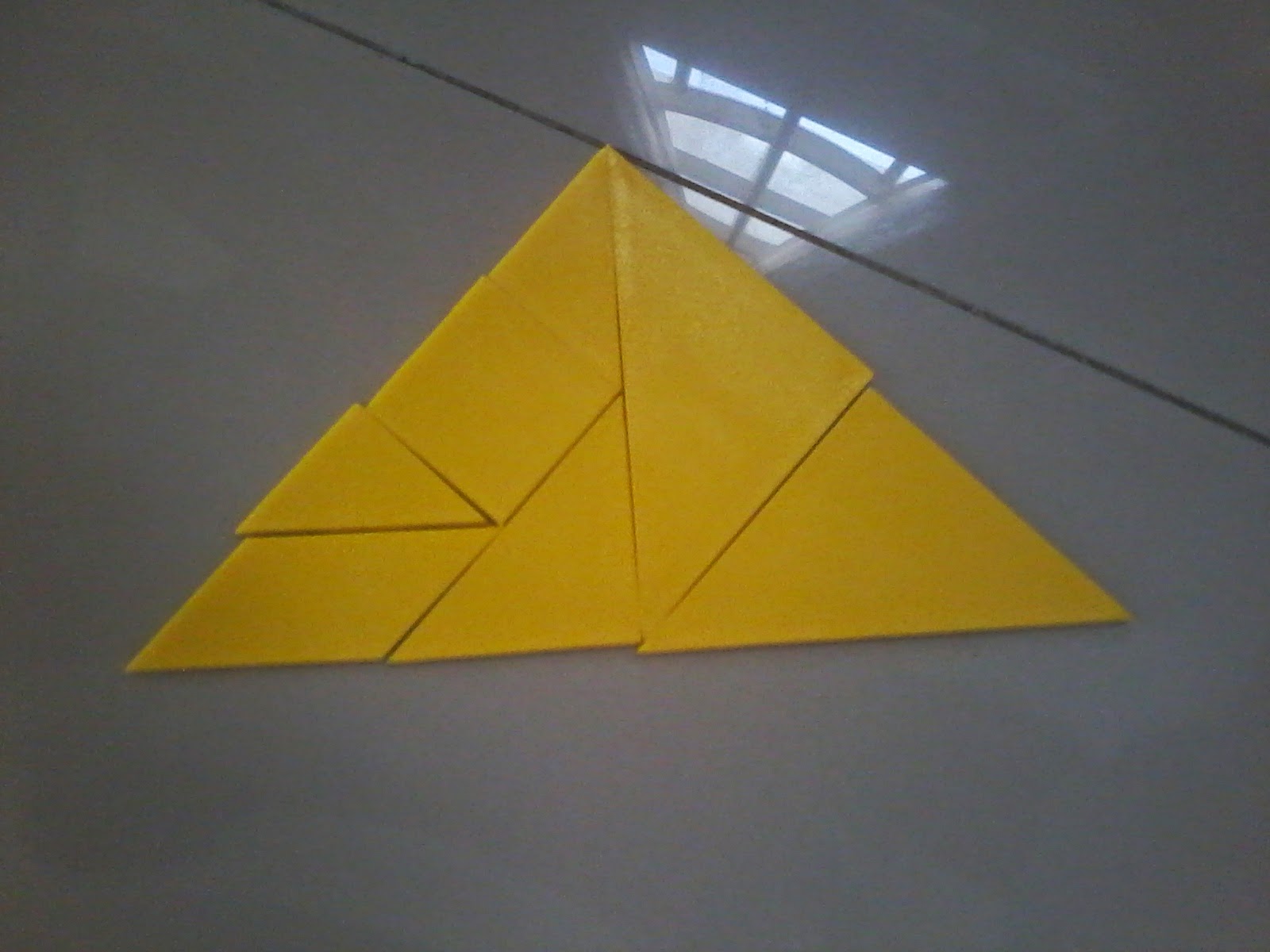
We got a book of tangram puzzles from the grandparents when we were visiting. It was a good catalyst for getting out the nice tangram set that came with our RightStart math kit. While the book gave us some good ideas, the best one was a simple progression we (J2 and I) came up with on our own: make isosceles right triangles with 1, 2, 3, 4, 5, 6, and 7 pieces.

When we did attempt puzzles from the book, we quickly noticed that we never came up with the same solution that the book had. Admittedly, we only did about half a dozen puzzles, but this led to the natural question of how many solutions we could find for our triangle progression. That naturally opens a really interesting discussion about when you should consider two solutions to be the same (rotations, reflections)?

Another path to follow is related to dissections: we had a sense that some solutions are more satisfying than others because they can't be broken into "typical" sub-shapes. Making this idea more precise is difficult, but worth pursuing.

One last path for the triangle progression is to see what solutions are possible simultaneously. There are several ways to specify this, but here is a specific challenge for you:
Let P be a set of positive integers summing to 7. Using the 7 traditional tangram pieces at one time, make isosceles right triangles so that, for each p in P, there is exactly one triangle with p pieces.
Can you find a set P that works?

Math at the market

Someone was nice enough to buy me a bag of passion fruit. For some reason, the price came up: 80 baht for 1 kg (we weighed it, just to confirm). I recalled another market where I had purchased 800 grams for 100 baht. Of course, that leads to instant discussion:

  • Which seller has a cheaper price? How do you know?
  • How much cheaper is one price than the other? What are sensible ways to compare?
  • Why might the prices be different? Different place and time are obvious ones.
  • If the two sellers were next to each other in the market at the same time, would people only buy from the cheaper source? Why/why not? What factors complicate this?
Also, if you were paying attention, you will realize that, yes, this is how I thank someone for giving me a gift: lead them along a mathematical conversation!

Some pictures

Avoid this section if you don't want hints about some tangram configurations.

We thought our approach to making a letter "L" shape was better than the one suggested by the book. Both have an annoying triangle tip poking out. Our version otherwise has a common and consistent width on the two legs which the book didn't have.


Simple rectangle. This is an example of something that comes quickly once you figure out the classic 7-piece square.


One of the members of our triangle family and a cousin of the class square. This gives away solutions for 1, 2, 5, and 7 piece triangles, so sorry about that.

Friday, February 20, 2015

Chinese New Year math game

Who: J1 and J2
Where: dining room floor
When: after lunch

I've been asked to write about a new game designed by two of the J's.

Number of players: 2
Material required: stacks of banknotes with different denominations. We play with Thai notes, which come in 20, 50, 100, 500, and 1000 flavours.
Game play:
  • one player closes her eyes
  • the other player swaps several stacks of notes. when that player is ready, he slaps the ground to signal the non-looking player.
  • the non-looking player slaps a stack of banknotes. they get points equal to the denomination of the notes in the pile they slapped.
  • These points are added to a running total
Winning condition: unclear

Is it fun?
I think it depends on two factors: (a) did you invent the game and (b) how much do you like mixing, sorting, and counting stacks of money? If you answered "yes" to (a) or "very much" to (b), then you are in business.

Other ideas for Chinese New Year

Frankly, I was underwhelmed when I did a google search for math activities around Chinese New Year. Feel free to use these prompts to come up with your own:
  • 12 animals in the zodiac that serve as mascots for each year
  • properties of the lunar calendar
  • differences between the lunar and Gregorian calendars
  • puzzles involving envelopes with different amounts of money in them (or maybe empty!)
  • game theory analysis of how much to put in your envelopes for relatives, including whether to mark your (giver's) name on the envelope.
If you come up with anything you enjoyed, add it to the comments and we'll have something good for next year!

Wednesday, January 14, 2015

Simple splits: sharing money

Who: J1 and J2
When: just after dinner
Where: dining room floor

Taking the skytrain (BTS) yesterday, I ended up with interesting change: 48 Baht comprised of four 10s, one 5, and three 1s. Why is this interesting change, you ask? While 48 has a lot of factors, this set of coins makes it impossible to evenly divide into any smaller amount!

Just chop it right here!


This gave me an idea for a sharing discussion with the kids. Here's the intro to our conversation:
  • J0: Hey, I just realized I have 48 baht
  • J1: Can I have it?
  • J0: Not yet, I want to ask you a couple of questions. If you were going to split it equally with J2, how much would you each have?
  • J1: 24. Can I have it now?
  • J0: (I write down 48 split for J1 and J2 means 24 for each). What if you were going to split it with your sister, too?
  • J1: still 24
  • J0: Oh, I mean you split with J2 and J3. All three of you get the same amount
  • J1: (losing interest, the coins don't seem closer to his grasp) Uhh, I don't know. Let's do something else.
  • (proceeds to wander around the room for a bit, does some other activity for a while. I have a guess he is thinking about the question and avoid pressing)
  • J1: 16, we each get 16 baht!
  • J0: Good! How did you figure it out?
  • J1: I divided 48 by 3. Can I have the money now?
  • J0: Yes. Here are the coins. Can you show me how you would split it like we said? Show me how to share it with J2.
He played for a while until he realized that it couldn't be split evenly. We talked about why (easiest path to seeing this was to realize a split means making 24 baht and that isn't possible with those coins). Then we talked about whether it would be possible to split them fairly in some other way. Here were ideas, mostly his, but this was a collaborative conversation:
  1. split them as close as possible and randomly decide who gets which pile
  2. split them as close as possible and then J1 gets more because he is older
  3. J1 splits them as close as possible, gets more and gives the rest to J2. This is considered fair because every child ends up with more money than they had at the start, so they should be happy. This is a version of the ultimatum game and I was really surprised that J1 came up with this reasoning on his own.
  4. Split evenly what we can and give the rest back to daddy.
  5. Ask for change for the 5 baht coin and then split evenly.
  6. Just cut some of the coins in half (physically cut them)
  7. Buy something with the money that we both want and can split evenly (ice cream, yogurt drinks, etc)
  8. Split 25/23 and J1 gives J2 something of value to balance
Do you have any other ideas for how to tackle this sharing problem?

Determining value

Point 7 led to a mini-conversation about how much value the extra item should have: 2 baht or 1 baht. J1 gave a bunch of examples (used toys, some services) and asked me if they had the right value, and I explained it would really depend on whether they both agreed because there wasn't a separate way to determine the value.

The conversation propagates

J1 had so much fun with this conversation that he then got J2: "hey, i want to show you something. How can you split 48 baht into two?" He didn't completely recreate the discussion, but the two got a lot of the same ideas out together and it was great fun to watch.

Important Lessons

  • When they don't seem to be focusing on a question or challenge, (sometimes) they still are thinking about it.  Let them have space and don't force it.
  • Even mundane items and observations can be gateways to deep ideas

Saturday, January 10, 2015

Money game and some cute little challenges

Who: J1
When: after breakfast (no school today!)
Where: dining room table
What you need: playing cards with images of money on them

Played a cute game called '51' from RightStart Math using their US coins card deck. It was an ok game that led to a surprisingly interesting discussion.

The game in brief:
  • The US coin cards show the obverse image from pennies, nickels, dimes, quarters, and Kennedy half dollars. One side of each card has two copies (two total images) of the coin, the other sides are a common pattern (so you don't know the coin when the card is turned down).
  • Players are each given 3 cards
  • On each turn, a player plays a card to an open stack making a total less than 52 cents, collects the stack if they have made exactly 51 cents, or plays a card to create a new stack if their coin would cause the existing stacks to overrun 51.
  • At the end of the game, compare who has collected the most cards
An ok game with some strategy and some calculation practice (particularly reinforces the strategy of regrouping and number facts related to coin denominations).

Here was the fun part:

Challenge 1

At the end of one game, we had 90 cents unclaimed on the table.


I was initially surprised, thought for a moment, then realized what had happened. Questions I posed to J1 that I offer to you:
  1. Why was I surprised?
  2. How much did we usually have remaining on the table at the end of play?

Challenge 2

How many dollars are represented by coins in our card deck? Hint: it is an integer.

Challenge 3

What is the maximum amount that could be stranded at the end of the game? Does this depend on the number of each denomination in the pack?

Sunday, September 28, 2014

Monopoly arithmetic

who: J1
when: at bedtime (we were supposed to go to sleep, but stayed up to play)
where: bedroom

We have recently had an outbreak of Monopoly.

Apologies for blurriness; my shutter speed isn't fast
enough to catch the lightening action of this game
J1 and I have been playing a lot of City Monopoly.  Basic play is similar to the classic version, but on every turn the player uses a little randomization device (not a dice!) to determine how many enhancements they can build on their properties (1-3 building blocks or a railroad). This device can also be used a minute timer for auctions and an hour timer for the overall game. I guess these extra functions justify why they didn't just use a tetrahedron dice.

Monopoly games have been known to last for a very long time, but we aren't allowed to keep a partially-completed game lying around the house.  Instead, we play for about 40 minutes and then tally up the assets to see who has won. One of J1's interesting observations: we usually end up with less money than when we started the game.

Where's the math?
There is a ton of thinly veiled arithmetic in this game as every action requires some type of calculation. This ranges from 2 dice addition when moving the pieces to simple multiplication when calculating the cost of building several blocks to 3 digit subtraction when making change.

There are slightly more subtle points around deciding where to build property enhancements based on which properties give a greater return on capital.  J1 is starting to build an intuitive sense and has made some good observations when comparing between properties.  The most sophisticated analysis he started was looking at the first ten squares and talking about which ones are "easy" to hit.  For example, the very first property can't be hit until players have gone all the way around the board and he was excited to realize that..

Where's the game?
Strategically, there doesn't seem much depth.  The only frequent choice on each turn is where to build the enhancements, including railroads.  Occasionally, there is also a choice about where to build a hazard or a bonus structure.

I said that we usually end up with less money than at the start.  Actually, we have played 10 times and always lost money.  Seems that the winning strategy is just to avoid taking action.  For us, that mostly means not building enhancements, except for the very rare times when they immediately increase the properties rental value as much as the enhancement cost.

Wednesday, August 13, 2014

Currency conversion and 1001 nights

who: J1 (and a bit of J2)
where: bedroom
when: bedtime (particularly after lights out)
what materials: internet connection (not really necessary)

This is another Talking Math With Your Kids -style conversation.


  • J1: Daddy, what's 100 pounds (British pounds) in Baht (Thai currency)?
some discussion about which way he wanted to convert as I hadn't really been listening
  • D: Well, there are about 50 baht per pound.
  • J1: So, I need 50 groups of .  . .can you use the computer to calculate it?
  • D: Yes, I can, but we don't need to.  First, though, we need to figure out what calculation to do. You said you have 100 pounds and there are about 50 baht per pound
some mumbling, not really getting anywhere; I'm tempted to comment and guide, but hold back.
  • J1: I have 100 groups of 50.  What's that?
  • D: What about 10 pounds in baht?
  • J1: (pause) that's 500
  • D: how did you calculate that?
I was assuming some strategy for directly calculating 10 x 50, either just adding a zero or building from 10 x 5 (which he would calculate as 10-20-30-40-50), or 50-100-150-200-250-300-350-400-450-500.
  • J1: well, I know 20 pounds is 1000 baht.  Then 10 is half of 20 and 500 is half of 1000.
  • D: Interesting.  How many 20s are in 100?
  • J1: (thinking) 5000 baht in 1000 pounds!
some conversation about what  you can buy with 5000 baht.
  • D: what about 15,000 baht.  How many 5,000s are in 15,000?
  • J1: 3, so 300 pounds.  Wow, that's a lot


Why did I find this so interesting?
First, I was really surprised by the strategy to calculate 10 x 50.  This reinforces the magical phrase "how did you think of that?" Sometimes my own preferred approach seems so obvious that I feel there won't be anything interesting gained by hearing the child's approach and, in this case, asking the question was just because I wanted to build a good habit.  I was so surprised by the answer that I forgot to tell him about an alternative strategy.

Second, there had been several other times earlier in the day when I tried to lead him into a mathematical conversation and he wasn't taking the bait. I guess I should relax and see where chances arise instead of controlling it.

Ok, but 1001 Arabian Nights?
We've started reading the Project Gutenberg version of 1001 nights. Nice mathematical title, no? Well, tonight we started The Story of the Husband and the Parrot. What you need to know is:

I am reading the story of Sheherezade to J1 and J2.  In this story . . .
. . . Sheherezade is telling King Shahriar The story of the Fisherman, in which . . .
. . .the fisherman is telling a genie The Story of the Greek King and the Physician Douban, in which . . .
. . .the King tells his Vizir about a story told by another vizir to King Sinbad, in which . . .
. . . we get The story of the Husband and the Parrot (which involves the Parrot telling the Husband a short story).

Counted generously, that's 6 stories-within-a-story.  And now I've told you, so that's 7 layers.