Showing posts with label investigation. Show all posts

Friday, May 22, 2015

Tangrams and math at the market

who: J2 and J1
when: all day (sick kids at home)
what did we use: tangrams

A quick-start activity and conversation from our kids' recent home-sick days.

Tangrams

(Note: people like pictures, but I don't like spoilers. I've included some of our tangram pictures at the bottom of this post)

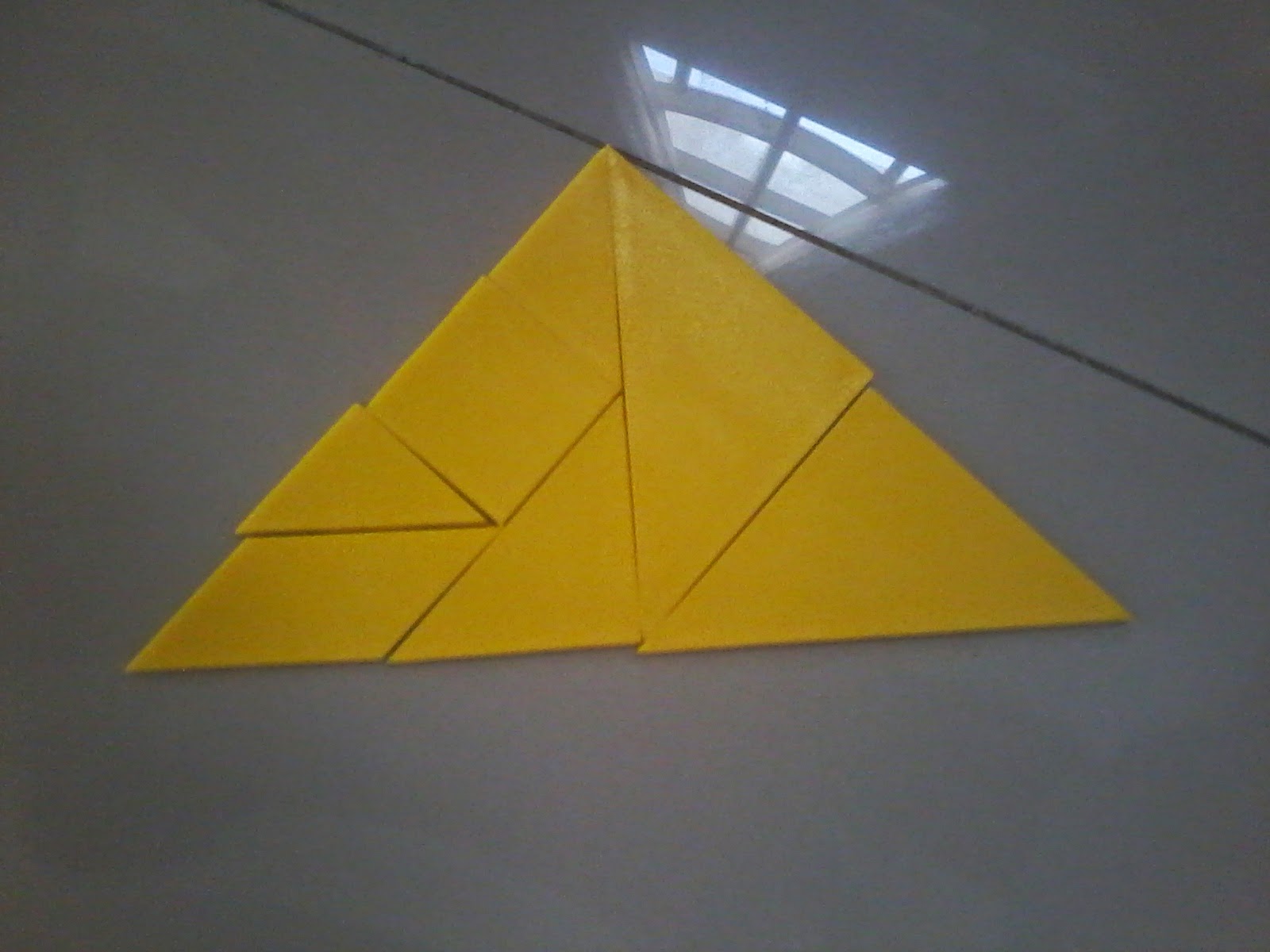
We got a book of tangram puzzles from the grandparents when we were visiting. It was a good catalyst for getting out the nice tangram set that came with our RightStart math kit. While the book gave us some good ideas, the best one was a simple progression we (J2 and I) came up with on our own: make isosceles right triangles with 1, 2, 3, 4, 5, 6, and 7 pieces.

When we did attempt puzzles from the book, we quickly noticed that we never came up with the same solution that the book had. Admittedly, we only did about half a dozen puzzles, but this led to the natural question of how many solutions we could find for our triangle progression. That naturally opens a really interesting discussion about when you should consider two solutions to be the same (rotations, reflections)?

Another path to follow is related to dissections: we had a sense that some solutions are more satisfying than others because they can't be broken into "typical" sub-shapes. Making this idea more precise is difficult, but worth pursuing.

One last path for the triangle progression is to see what solutions are possible simultaneously. There are several ways to specify this, but here is a specific challenge for you:
Let P be a set of positive integers summing to 7. Using the 7 traditional tangram pieces at one time, make isosceles right triangles so that, for each p in P, there is exactly one triangle with p pieces.
Can you find a set P that works?

Math at the market

Someone was nice enough to buy me a bag of passion fruit. For some reason, the price came up: 80 baht for 1 kg (we weighed it, just to confirm). I recalled another market where I had purchased 800 grams for 100 baht. Of course, that leads to instant discussion:

  • Which seller has a cheaper price? How do you know?
  • How much cheaper is one price than the other? What are sensible ways to compare?
  • Why might the prices be different? Different place and time are obvious ones.
  • If the two sellers were next to each other in the market at the same time, would people only buy from the cheaper source? Why/why not? What factors complicate this?
Also, if you were paying attention, you will realize that, yes, this is how I thank someone for giving me a gift: lead them along a mathematical conversation!

Some pictures

Avoid this section if you don't want hints about some tangram configurations.

We thought our approach to making a letter "L" shape was better than the one suggested by the book. Both have an annoying triangle tip poking out. Our version otherwise has a common and consistent width on the two legs which the book didn't have.


Simple rectangle. This is an example of something that comes quickly once you figure out the classic 7-piece square.


One of the members of our triangle family and a cousin of the class square. This gives away solutions for 1, 2, 5, and 7 piece triangles, so sorry about that.
Wednesday, January 14, 2015

Simple splits: sharing money

Who: J1 and J2
When: just after dinner
Where: dining room floor

Taking the skytrain (BTS) yesterday, I ended up with interesting change: 48 Baht comprised of four 10s, one 5, and three 1s. Why is this interesting change, you ask? While 48 has a lot of factors, this set of coins makes it impossible to evenly divide into any smaller amount!

Just chop it right here!


This gave me an idea for a sharing discussion with the kids. Here's the intro to our conversation:
  • J0: Hey, I just realized I have 48 baht
  • J1: Can I have it?
  • J0: Not yet, I want to ask you a couple of questions. If you were going to split it equally with J2, how much would you each have?
  • J1: 24. Can I have it now?
  • J0: (I write down 48 split for J1 and J2 means 24 for each). What if you were going to split it with your sister, too?
  • J1: still 24
  • J0: Oh, I mean you split with J2 and J3. All three of you get the same amount
  • J1: (losing interest, the coins don't seem closer to his grasp) Uhh, I don't know. Let's do something else.
  • (proceeds to wander around the room for a bit, does some other activity for a while. I have a guess he is thinking about the question and avoid pressing)
  • J1: 16, we each get 16 baht!
  • J0: Good! How did you figure it out?
  • J1: I divided 48 by 3. Can I have the money now?
  • J0: Yes. Here are the coins. Can you show me how you would split it like we said? Show me how to share it with J2.
He played for a while until he realized that it couldn't be split evenly. We talked about why (easiest path to seeing this was to realize a split means making 24 baht and that isn't possible with those coins). Then we talked about whether it would be possible to split them fairly in some other way. Here were ideas, mostly his, but this was a collaborative conversation:
  1. split them as close as possible and randomly decide who gets which pile
  2. split them as close as possible and then J1 gets more because he is older
  3. J1 splits them as close as possible, gets more and gives the rest to J2. This is considered fair because every child ends up with more money than they had at the start, so they should be happy. This is a version of the ultimatum game and I was really surprised that J1 came up with this reasoning on his own.
  4. Split evenly what we can and give the rest back to daddy.
  5. Ask for change for the 5 baht coin and then split evenly.
  6. Just cut some of the coins in half (physically cut them)
  7. Buy something with the money that we both want and can split evenly (ice cream, yogurt drinks, etc)
  8. Split 25/23 and J1 gives J2 something of value to balance
Do you have any other ideas for how to tackle this sharing problem?

Determining value

Point 7 led to a mini-conversation about how much value the extra item should have: 2 baht or 1 baht. J1 gave a bunch of examples (used toys, some services) and asked me if they had the right value, and I explained it would really depend on whether they both agreed because there wasn't a separate way to determine the value.

The conversation propagates

J1 had so much fun with this conversation that he then got J2: "hey, i want to show you something. How can you split 48 baht into two?" He didn't completely recreate the discussion, but the two got a lot of the same ideas out together and it was great fun to watch.

Important Lessons

  • When they don't seem to be focusing on a question or challenge, (sometimes) they still are thinking about it.  Let them have space and don't force it.
  • Even mundane items and observations can be gateways to deep ideas