Showing posts with label fractions. Show all posts

Sunday, March 2, 2025

Mathish-ish

 Read Jo Boaler's Math-ish and thought it would be useful to pull out the valuable points and provide an overview of the rest.

Encourage Metacognition Through Eight Mathematical Strategies

This is from page 39-45. I'd note that this set of ideas is somewhat typical for the book: though described as methods to encourage "metacognition," these are closer to problem solving strategies.

This list is populated with ideas that will be familiar from other standard sources, like Polya's How to Solve It or Cuoco's Mathematical Habits of Mind. Nonetheless, these are still solid cues for a teacher/tutor to either help with the problem solving process (1, 2, 3, 5, 8) or to move beyond simply finding a right answer (3, 4, 6, 7.)
  1. Take a step back
  2. Draw the problem
  3. Find a new approach
  4. Reflect on "why?"
  5. Simplify
  6. Conjecture
  7. Become a skeptic
  8. Try a smaller case

Reflection cues

From page 48, a quasi-infographic with seven cues that are actually directed toward metacognition. 
  1. What mathematical concepts did you learn today?
  2. How is the idea you learned today related to others you have learned?
  3. What opportunities did you get to struggle? How did that feel?
  4. How could you use the mathematical concept in your life?
  5. What different strategies or approaches to the problem were helpful to you?
  6. Are there areas that you do not understand and would like more opportunities to learn?
  7. Can you write your own problem for someone else to try to solve?
Boaler suggests asking students to answer one of these questions, of their choice, in place of standard homework problems. From my personal experience, it takes consistent effort to get students to take these reflection questions seriously.

Group work

Initially, I noted two blocks in this section (pages 52 and 53): a set of 5 roles during group work and 8 "mathematical ways of working." On returning to this discussion, I was more struck by the things that Boaler does not cover related to group work. In particular:
  1. The critical importance of finding activities that truly require group engagement and cooperation.
  2. The typical level of frustration that most students associate with their prior group work experiences.
For example, of the 8 "participation quiz" behaviors, only two of them somewhat depend on the group (underlined and bold):
  • Recognizing and describing patterns
  • Justifying thinking using multiple representations
  • Making connections between different approaches and representations
  • Using words, arrows, numbers, and color coding to communicate ideas clearly
  • Explaining ideas clearly to team members and the teacher
  • Asking questions to understand the thinking of other team members
  • Asking questions that push the group to go deeper
  • Organizing a presentation so that people outside [the group] can understand your [group's] thinking

Struggly

Boaler advertises a website, Struggly, that seemed worth investigating. It maybe hard to get a full sense from the demo activities, but I didn't see anything either bad or special here. If other people have used it, please let me know what is unique about Struggly (in comparison with ST Math, for example.)

Integrating math history

Boaler cites (page 86) several aspects in the history of Fermat's Last Theorem and Andrew Wiles' proof:
  1. The vast amount of valuable ideas that emerged in the course of attempts to prove FLT
  2. The fact that Wiles' initially announced proof had a gap
  3. The way that professional mathematicians persistent through their work over extended periods of time
Personally, I do find it tempting to incorporate biographical and historical information in math classes, but I don't think I have found a way to do this that fully resonates with students or has the effect that I want.

What matters in pre-college mathematics

I'm on board with the idea that only a small number of key concepts from pre-college mathematics are really critical for students and a sharp distillation is helpful. Starting on page 95, Boaler identifies three candidates. For what it is worth, the source is David Coleman, the CEO of the College Board. In general, the College Board doesn't seem a force for good in education, but these three candidates seem plausible.

Number sense/arithmetic

An ability to calculate with basic arithmetic operations, an understanding of fractions, and a sense of estimation. Here is where Boaler really hits her "ish" concept, an acknowledgement that almost all real-world incarnations of mathematical concepts are approximate, rather than exact.  I would prefer to broaden this a bit and say that strong number sense should include an ability to switch between the approximate and precise and a recognition of the differences between them.

Data literacy/Data analysis and problem-solving

In this section, Boaler rehashes the (now) obvious point that data is abundant and students/citizens should have some facility to interpret and analyze data.  Some nice visualizations are included:
  • Stephen Curry's 2015-2016 shot performance (page 124)
  • NCAA Women's Soccer PSxG for penalty shots (page 125
  • Examples from dear-data.com
  • Student data representation from the student's life (page 127)
The youcubed data science course: https://hsdatascience.youcubed.org/curriculum/
I will try to find time to review that specifically.

Linear Equations

This section does not really justify why linear equations have a distinguished place in the top 3 concepts.  I may return to this to back-fill potential reasons, but most of what is cited (pages 129-131) is spurious, rather than real linear relationships.

Fractions

Visual representations of 1 ÷ (2/3):
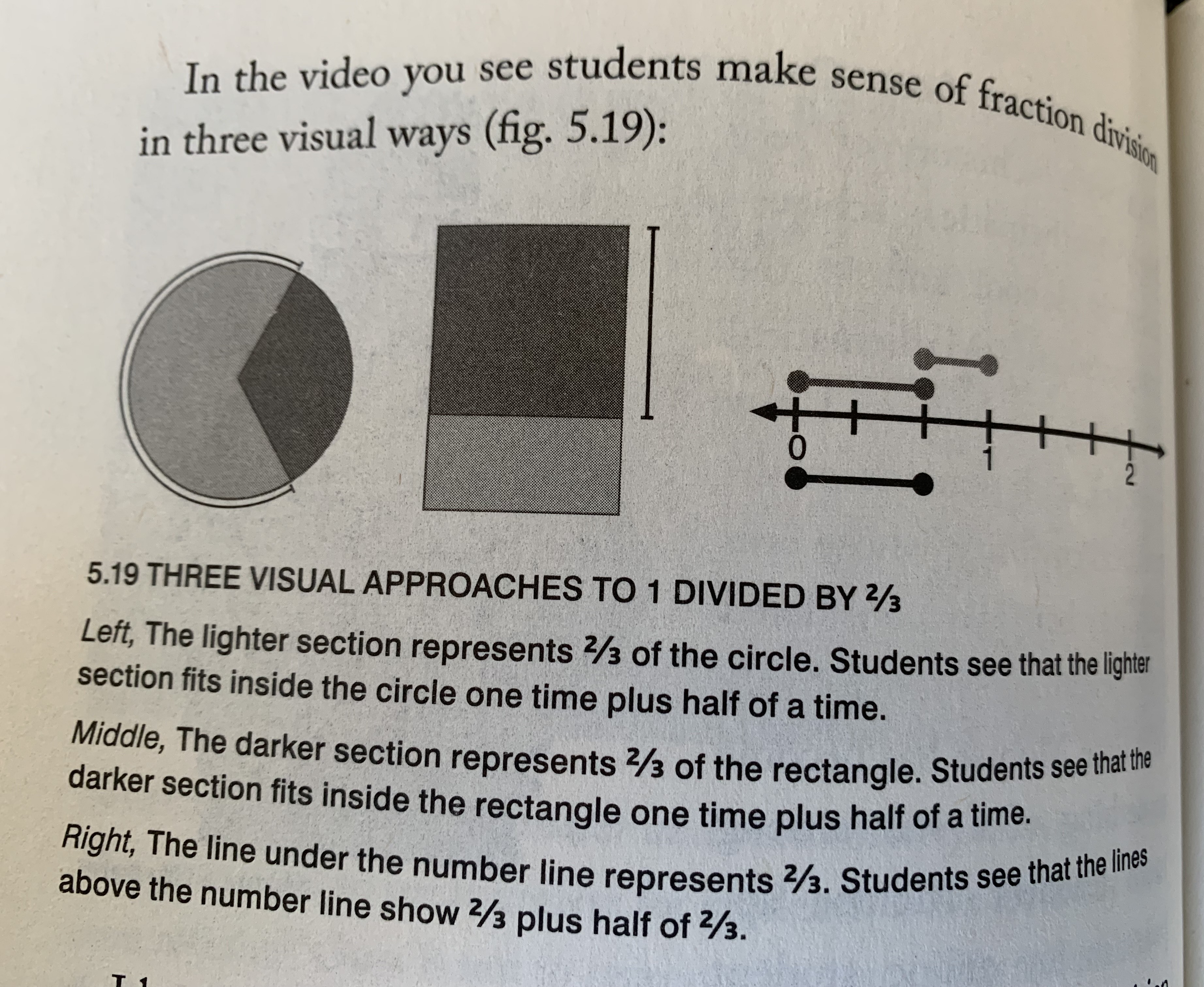
In several parts of Math-ish, Boaler emphasizes the importance of understanding fractions, in contrast to a rote/algorithmic approach to calculating with them.  I think these visual representations are the best thing she offers as a step toward ways of understanding.

Wednesday, February 1, 2017

Perfect Play for My closest neighbor

Joe Schwartz at Exit10a wrote a fraction comparison post that prompted me to write up more of my experience and thoughts on this game.

Let's find perfect play
This week, I intended to use the game one last time with the 4th graders as an extended warm-up to our class. The challenge I presented:

If we got super lucky and were given perfect cards for each round of the game, what are the best possible plays?

My intention was to spend about 20 minutes on this. Depending on how quickly it went and the kids' reactions, I considered giving them a follow-up for a short homework: what are the best plays if we include all cards A (1) through K (13)?

How did it go?
In the end, the basic activity took the whole class. These comparisons were difficult for the kids, so we spent time talking about each different strategy for comparison:

  1. common denominators
  2. common numerators
  3. distance to 1
  4. relationship to another benchmark number. Like 1/2 in Joe's 4/6 and 8/18 example, a benchmark is a "familiar friend" that should be relatively easy to see it is larger than one and smaller than another. In practice, 1/2 seems to be the most popular benchmark. 

For visualization, drawing on a number line seemed to work best.

I did not assign the full deck challenge as homework. Instead, we gave them some more work with fractions of pies and bars.

What have I learned?
This game is really effective at distinguishing levels of understanding:
(0) some kids are totally at sea. They don't really understand what this a/b thing means, how a and b are related, etc. These kids struggle with the first round of the game when the target is 0, when the idea is to just want to make their fraction as small as possible.

(1) Some kids have got a basic understanding of the meaning of the fraction and can play confidently when the target is 0 or 1. They might still be weak about equivalent fractions. Trying to play some spot-on equivalents when 1/3 and 1/2 are targets is a give-away.

(2) familiar with some frequent friends: kids who can tell readily whether their plays are larger or smaller than the target for 1/3, 1/2, 3/4.

(3) proficient: have at least one consistent strategy they can work through to make a comparison

(4) fraction black-belts: using multiple strategies, already familiar with many of the most common comparisons.

What would I do differently?
Generally, I think it is valuable to spend more time and more models directed at the basic understanding of what fractions mean. The kids who were at or close to stage 4 have, over the years, been seeing diagrams of pies, cakes, chocolate bars, number lines and physical experience with baking measures and fractional inches on measuring tapes and rulers. Oh, and also actual pies (mostly pizza), cakes, cookies, and chocolate bars discussed using fractional language.

More locally, for this game in a class of mixed levels, I would

  • lean toward doing this more as a cooperative puzzle
  • re-order the targets for the rounds as 0, 1, 1/2, 3/4, 1/3, 2 (note: I don't have strong feelings about where 2 fits in this sequence)
  • I also would consider allowing equivalent fractions to the target as winning plays

Monday, January 23, 2017

Fractions and Farey Addition

Benjamin Leis (who posts at Running a Math Club) flagged this video in response to our recent fractions work: Funny Fractions and Ford Circles (Numberphile). 

Ex ante discussion ideas
The video gave me several ideas for possibly interesting conversations with the kids:
(1) Some basic geometry, particularly for J3. Circles that are tangent, nesting pictures, pictures that have fractal qualities.
(2) Comparing Farey addition and regular addition
(3) Well-defined operations on fractions. I always like to discuss whether the operations gives us the same results regardless of the equivalent form we start with? Farey addition is a good example where the choice of representation is important (indeed, Prof Banahon is careful to keep reminding us that he wants the fractions in lowest terms.)
(4) why do we want the fractions in simplest terms? Possibly relate this to the Cat in Numberland (showing rationals are countable).
(5) what happens if we try Farey addition of three fractions in a row: e.g., (1/5) @ (1/3) @ (1/2)? This is one of the few "naturally occurring" non-associative operations I know.
(6) Since associativity doesn't work, surely distribution of multiplication over Farey addition must not work, right? What about commutativity?
(7) Linking back with our comparison game, if a<b, how do a@c and b@c compare? If a@c < b@c, what can we say about a and b?
(8) what if we allow negative numbers? How should we define Farey addition, then?

How the conversation actually went
J2 was especially taken with the picture of the Ford circles and immediately had two requests: he wanted to draw them and he wanted me to create a pencilcode program to draw them.

The former was a great activity with a lot of figuring and fraction practice. Here he is, hard at work:


Along the way, there was lots of discussion about where to position each fraction on the number line (he scaled with 20 cm as the unit distance from 0 to 1), and how big to make each circle. Tangency condition was a nice check on his work. He would see right away when something was wrong (which did happen several times:


We did talk through some of the ideas on my pre-planned list: is Farey addition well-defined on fractions (no! point 3), does associativity work (no! point 5), could we extend to negative numbers (yes, make the numerator negative seems to work best, point 8).  Other areas are still open for future discussion.


Pencilcode result
I wrote a quick program here: FareyFord. You'll notice that it doesn't actually generate Farey sequences. Instead, it creates generations of fractions, starting from 0 and 1 as the original parents. For each new generation, it uses Farey addition to create a new fraction between each adjacent pair in the previous generation.

Here's a picture of the associated Ford circles:

This method raised an interesting question: what is the largest denominator in each generation? If you don't know, it is cute and worth considering.

More Go (miscellaneous)
Note: this part is unrelated to fractions or farey sequences.

J3 wasn't in the mood to play more capture go with me, but I had an idea. I noticed in one of Nick Sibicky's lectures that one of his students was a young girl, roughly around the age of our three kids. I showed that part of the video to J3 and she made the connection: "this is something girls like me do."

We went and played some silly games on very small boards: 1x1, 2x2, 3x3. In the picture below, we set out a blue-green alternating boundary around a 3x3 board. Then, I asked J3 how many different moves were available. She pointed first to the center, then I asked if there were any other spaces that were the same as the center, if we moved the board around or tipped ourselves upside down.

No, so we made the center red. What other moves? She then chose a side square and figured out that there were three other places that were equivalent. Those became yellow. Finally, we figured out that the four corners were also identical, so that gave us the final picture:


Later, I was playing 9x9 with J2. Instead of go stones, we used Banangram tiles for the white stones. At the end of the game, we tried to make words with the captured tiles from the game. Here was one case where we could (sort of?) make a complete scrabble chain with all the captures:

Wednesday, January 18, 2017

Closest neighbor one-on-one

In my last post, I wrote about playing Denise Gaskins' closest neighbor fraction game with our 4th grade class. Yesterday, I spent time with J2 and used the game as a semi-cooperative puzzle.

This activity worked really well and the experience gave me some additional ideas about how to use the core ideas again with the 4th grade class.

Puzzle or game?
First, there were only two of us, one a kid and another an adult, so that background naturally makes the activity very different. As the key modification for play, we played all of our hands open and helped each other find the fraction in each of our hands that was closest to the target for that round. Then, we worked together to determine which of those two "champions" was closest overall.

Some of the consequences:
  • the activity was not really competitive (see below)
  • J2 had to do a lot more fraction work.
Let me explain the second point here. Because we were looking for the best play, J2 had to consider all of the combinations in his hand (20 choices). Some of those can be rejected quickly with simple analytical strategies depending on the target. Even this is good number sense thinking. Also, some combinations are close competitors and need to be analyzed more carefully.

If we were playing with closed hands, he could choose two cards, play a fraction based on them, and I wouldn't be able to say anything about whether those were his best options or not.

Second, while I write that "we worked together," as a sneaky dad, that means that I pretended to do work, while actually getting J2 to analyze my hand as well as his. Really, the only thing I offered was an alternative comparison strategy, once he had already worked through his own approach.

An example of some strategies
We found that some of the comparisons that arise naturally in this game are quite tricky, even for me. For example, quickly tell me which is closer to 1/3: 1/5 or 4/9?

We found that placing the fractions on a number line was a really helpful strategy for many of the comparisons. We also made very heavy use of the two strategies involving common numerators or common denominators.

Finally, you can see in this example that J2 is comfortable mixing decimals and fractions, for example converting to 1/2 to 3.5/7 to aid some comparison:


Our grid
Through our play, we filled out this grid, taking turns putting in our best results and congratulating each other when our hand was the ultimate champion for that round:


Competition and Strategic thinking
I was particularly pleased by one comment J2 made about this overall game: "this is mostly luck, how well we can play depends on the cards we get." This comment came after one round where he had several duplicate cards in his hand, reducing the number of distinct values he could play. We've discussed elsewhere my goals of helping the kids think about game structure, so I always love it when they bring those ideas up themselves.

Some thoughts about competition. While we played this game non-competitively, I'm not opposed to competition nor do I think that this game always needs to be played non-competitively. Ultimately, my litmus test is how to play in a way that is the most fun. If I were a more serious educator, I suppose I would also consider which way is the most educational, too.

It won't always be obvious what is the best way to play each game. In this case, I got to benefit from the prior experience with the class and my close knowledge of J2. Many times, I'll tell the kids that there are several ways to play and we'll try them out together, then review the experience.

Among other things, this is why I love handicap games like Go. By adjusting the starting advantages, we can create scenarios where it is very competitive and very fun, even though the players have very different levels of experience and current strength in the game. And also, there are things we can do together when we want a non-competitive activity.

Ideas for going back to class
From this time with J2, here are my ideas about taking the game back to the 4th grade class are:
  1. Spend a lot of time on fraction comparison strategies before we play
  2. Reduce the number of cards dealt to each player
  3. play as teams
  4. convert to open hands with a lot of talk about why we chose particular plays

An actual puzzle

As a reward for reading down this far, here's an actual puzzle related to the closest neighbors fraction game:

During the round where the target is 1/2, Jay plays 6/6 = 1. Was that her best play? How do we know?


Tuesday, January 17, 2017

My Closest Neighbor Fraction game

Denise Gaskins recently flagged a post about a good fraction game: My Closest Neighbor. I tried this out in class today.

A pre-test
First, I wasn't sure whether the level of the game would be right for the kids. I was considering it for the 3rd and 4th graders, but had some alternative activities planned in case. To start, I posed the following questions:
  • Which is closest to one-half: 1/3 or 2/5? The third graders really struggled with this, so I left it alone and went to my plan B games. The fourth graders were all confident on this one.
  • Which is closest to 3/4: 5/11 or 11/12?  This was a challenge for the fourth graders, but I thought it would be ok to play the game.
In our discussion of the second question, we explored two strategies:
  1. making a common denominator
  2. comparing with reference numbers
The common denominator is a bit of a pain, since 11 is prime, though at least we have the fact that 4 is a factor of 12. One student soldiered through this approach, but it was difficult for the other kids to follow.

For the second strategy, we made use of some observations that were more elementary for the kids:
(a) 5/11 < 5/10 = 1/2
(b) 3/4 is halfway between 1/2 and 1
(c) 11/12 < 1

Combining these, it was easy for us to draw a rough number line, place 5/11, 1/2, 3/4, 11/12, 1 and see that 11/12 must be closer.

The game
We played three rounds: target 0, target 1/3 and target 1/2. I think this game was very challenging for the kids.  Everyone had to work to figure out the best play from their hand and didn't always make the right (local) choice. For example, whether to choose 5/8 or 5/9 for a 1/2 target.

Once everyone had played, the challenge was still just starting. They had to figure out who was closest. I structured the discussion by helping them figure out which plays were lower than the target and which were higher. For the ones that were lower, they could put them in order and only needed to consider the highest. Then, we worked on the ones higher than the target and got the lowest of those.

In the course of this discussion, we added a third strategy to the ones listed above:

  • making a common numerator
Summary thoughts
Fraction comparison like this was still too difficult for the kids to make an engaging game. If I were to do it again, I would change to make it more of a puzzling exercise, removing competition and any sense of time pressure.

Once the kids gain a bit more experience, though, I think this game has some nice features. It is particularly good for practicing fraction sense, and the multiple rounds allow some scope for strategic play.

Sunday, February 7, 2016

Surreal numbers and whole body integers

Two unrelated activities to note:
(1) Exploring checker stacks and surreal numbers with J1 and J2
(2) A whole body numbers game with J3

Surreal Numbers and Kids

If, like me from one month ago, you don't know about surreal numbers, I think you'll find they can be a really engaging exploration with kids. The main attraction is the appearance of infinities and infinitesimals, both of which really seem to resonate with young mathematicians. In addition, there's fantastic icing on this cake, too: you can explore by playing a simple (to learn) game with a lot of depth.

Credits: this exploration is strongly inspired by Mike Lawler's recent posts about surreal numbers and the Jim Propp post that inspired him. If you are interested in doing this type of exploration with your kids, I strongly suggest going through all of their posts on the subject.

Note: since we used black and red checkers, while the convention in the other posts is blue and red, I will abbreviate B and R so you can naturally substitute your own preferred color scheme.

How we got started
Using a set of regular, stackable, checkers (black and red), I showed each of the older J's the position RB + BR (a stack with red on the bottom, black on the top and a stack with black on the bottom, red on top) and explained that the basic moves.

This was a good initial example because it let us talk about each of the major scenarios:

  • We will investigate cases where B moves first and others where R moves first
  • Each one can only take stacks above one of their own color checkers
  • If the colors allow, they can take a top checker and leave the rest of a stack undisturbed
  • If their color is the bottom of a stack, they can remove the whole stack
  • Usually, they will have choices about which stacks to remove
Then, I explained the losing condition: if you don't have any more moves, you lose. They quickly realized this was the same as when they no longer had any checkers of their own color on the board.

Next, we quickly played a set of simple games:
  1. Single B checker
  2. Single R checker
  3. B + R
  4. RB + BR
  5. RB + B
  6. B+B+B+B +R+R (and similar)
  7. BBB+R+R (and similar)
Connecting with numbers
I told them that one amazing thing is that we can give each game position a value. Then went through:
  1. Single B checker is +1
  2. What do they guess a single R checker is? explain -1
  3. What about B+R? eventually get to 0
  4. Explain the fundamental trichotomy: positive value means winning strategy for B exists, negative for R, what about 0?
Powers of 1/2
The first really juicy bit came when I asked what they thought the value of a BR stack would be. This established a common sequence of investigations:
  1. If alone, can we see a winning strategy for either B or R? In this case, obviously B. Thus, the value is positive
  2. Compare with 1 by playing the game BR + R. They were really fast about seeing this link, for others this is worth writing out and spending some time discussing. In this case, they saw BR + R must be negative, so the value of BR is between 0 and 1.
  3. Guess a value; they've got enough experience to think that often the answers are "nice," so 1/2 was a natural guess.
  4. Test. In this case, it meant checking BR + BR + R
Next stop was RB. I wanted to make sure negatives weren't left out and to reinforce the symmetry in the colors, so would ask them to swap the colors and get a value as a quick follow-up.

Next, I asked them to see if they could find a configuration with value 1/4. This took a long time and there were lots of false starts. I didn't think this would be easy and didn't help them shortcut the exploration.

Once they got 1/4, though, they had a fast guess about 1/8. We checked it and then they made a conjecture about further powers of 1/2.

Deep blue and red
Seeing powers of 2 in some form is always fun, but both knew that they had been promised infinity and wanted to see it. Using our plastic dinosaurs, I introduced the deep checkers deep blue (represented by a blue mini) and deep red (represented by an orange mini).

Our sequence for these was similar to the powers of 1/2. The value of deep blue is positive, so they compared to 1 by playing the game BBBB.....+R. Each had a sparkle of insight, but quickly played BBB.....+R+R+R just to check, then announced that the value would be bigger than any integer.
I gave them the name omega, and we checked the deep red: RRRR.....

At this point, one of them put the deep red on a B checker and asked what that would be. Again, followed the previous recipe to realize that it must be positive, but smaller than 1, then smaller than 1/2. At that point, one of them made this arrangement:

Ok, I know that mastadons aren't dinosaurs

If it isn't clear, the realization was that the game sequence B, BR, BRR, BRRR, ... would have values
1, 1/2, 1/4, 1/8, .... and BRRRR..... would be at the end of that sequence with value ... larger than 0, but smaller than every power of 1/2. You can see that they made a similar connection with the negative values.

A little bit about deep purple
The two kids were totally satisfied now, having gotten omega and epsilon (along with omega +1, epsilon - 1, omega + epsilon, etc). To give them something to chew on for later (and because we had purple dinosaurs in our set) I introduced the deep purple, BRBRBRBR.... Immediately, they designated the yellow dinosaurs as the inverse of deep purple (RBRBRBRB.....)

So, what's the value of deep purple? What they've gotten so far:
  • positive
  • smaller than 1 (by playing BRBRBRBR..... + R)
  • Bigger than 1/2 (by playing BRBRBRBR..... + RB)
  • guess 2/3. I don't know where this came from, but I confirmed that is the value
  • working on finding winning strategies for the second player in R+R+3(BRBRBR.....)
Wrap up videos
As a round-up in the evening, we watched the videos from the first post in Mike Lawler's sequence. I paused frequently to let my two shout out their answers and explanations for where Mike's boys were in their exploration. This seemed to be a very effective way to underline their experience for the day.

Number match on the number stairs

A game for J3. This is a simple game with some variations that makes use of our stairway "number line" and a three year old's natural enthusiasm for running up and jumping down stairs.

As pictured previously, we have labeled the stairs in our house from 0 to 36 (more to come). We have a set of cards with numbers on them. P mixes them up, then gives them, one at a time, to J3 to put on the corresponding step, and they sing count up and down:


Some other variations:

  • using playing cards instead of number cards
  • Using cards with dot or shape patterns
  • Using cards with number words ("one" instead of "1")
  • child sends the parent to a particular step, checks if the parent got it right

Pillow forts

In case you missed it, pillow forts have been in fashion recently. Here is an example:


Friday, August 29, 2014

Fair sharing Exploration (warm-up)

who: J1 and J2
when: over a course of weeks (this is a plan, not a historical record)
what material: the objects to be shared


This post: http://letsplaymath.net/2014/08/13/fractions-15-110-180-1/#more-28158 gave me the inspiration to create an extended plan to explore ideas around fair sharing. The idea got a further boost from our warm-up discussion about breaking swords and cutting cakes last weekend.

In our house, issues of fairness lurk just below the surface of almost every interaction between the children. Actually, that's not accurate, since fairness is often a visible dark cloud hanging over the proceedings.
Part of the idea for this exploration is to harness their strong feelings on this topic to examine:
- fractions (naturally)
- approximations
- competing theories of fairness/equality
- their own intuition and biases around what is fair and why something should (or shouldn't, or doesn't have to be) fairly distributed, including concepts of ownership ("that is mine!"), earned privileges ("he got X because he did Y"), and private valuations ("you like X more than Y, but she likes Y more than X").

The basic idea is to present different types of sharing problems as thought experiments: talk through or play-act the scenarios, do some analysis of different sharing tactics (maybe using manipulatives, diagrams, etc) and later come back to these in live examples.

Examples of different classes of sharing problems I see:
- cakes/pies: things that can easily be cut into small fractions
- sausages, or apples: something that can be cut reasonably accurately into moderate fractions (maybe down to 1/8th)
- ice cream, or soup/rice/etc: something that needs to be weighed or volume measured
- KEX cookies/small candies: something that can, at best, be cut in half, maybe not cut at all.
- ballons/babies/bicycles/scooters: items that are indivisible objects
- balls/group toys: items that increase in value as more people play (up to a point)

some types of questions are:
1) technically, what tactics can be used to divide, what are the pros and cons
2) strategically, how can you get buy-in that your approach to divide is fair?

Let me know if you have any tips or thoughts on how this will all turn out.

Sunday, August 3, 2014

Grand Catch-up

Who: everyone in the family
When: over the last week
What material did we use: see below, a lot of different goodies
Where: all over the house

We haven't posted many activity summaries recently, so this is a review of what we have been doing so that you don't think we've been slacking off.

Calculating and Roman Numerals
Remember my doubts about roman numerals when they were introduced (here)? P has since found that they come up frequently when J1 and J2 are discussing some other calculation (adding 2 digit numbers without paper and pencil was a recent one).  It seems that the kids like the process of conversion or the feeling that they are speaking in a type of code.

Mathsemantically, they appear to appreciate the idea that number names are not the same as number concept. Frankly, I don't know when they developed this appreciation as we've always been a bilingual household (Thai and English) and introduced counting in other languages (Spanish, German, Chinese, Korean, Tagalog, Armenian) when they were very young.

Tip: for kids around 7 years old, try introducing the numbers in a different language and see if they enjoy the disassociation of names and objects as they play with calculations.

Food Math
We've had another round of pizza dough (with J3, our 2 year old) and our first attempt at gougeres (J1 and J2).  The pizza dough with J3 went as usual: a lot of fun measuring, a bit of flour outside the mixing bowl, excessive use of the scale to weigh whatever she saw.

The gougeres were a dairy indulgence, with milk, butter, and cheese as main ingredients. This was my first opportunity to try them since J3, our dairy intolerant one, was out for the day with mommy. We roughly followed this recipe, halved because the remaining munchkins had already decided they wouldn't like them and I couldn't justify eating 20-30 cheese puffs myself (and I'm not generous enough to share them with anyone else). In any case, by the time I thought to snap a picture, we only had 5 left for a nice little pentagonal arrangement.


Mathematically, the activity was interesting because we halved the recipe and we had a debate about how many eggs to use. While the presenter explicitly says 5 eggs, both boys were sure we only saw her use three and we all agreed that she had reserved one for the egg wash. Coincidentally, P brought home some very small eggs later in the day, so we got to have a little (very little) discussion of whether one egg is a proper measure. I'll have to remember to return to that again.

As we've hinted on other occasions, we try to recognize little unplanned opportunities for inserting some numerical discussion into everyday conversation.  Quesadillas at lunch were a chance to talk about fractional parts of a circle based on 1/8.  Below is one serving in the 6/8 (aka 3/4) uneaten state:


Some bites and a cheeky smile later brought us: "daddy, what about this one?"

I offered 1/3rd of an 1/8th for the partially eaten piece and we calculated that this plate still had 7/24th. Maybe I should have rushed to get a clock and show them 3.5 hours?

Catan (Catan, Catan)
Somehow, Settlers of Catan got back on J1's radar and he's been asking to play it everyday for a while. We are still working on a version that fully integrates J2 and it is a bit stale without trading between players.  I tried to introduce a bit of trading today, but J1 was too suspicious of my motives and would rather trade at an unfavorable rate with the bank than trade with me.  For now, we still start him with 2 cities against my 2 settlements, and we also allow all the players to start with the resources from all the hexes associated with both of their developments.  Otherwise, we find the game takes too long to get moving.

You can see J1 (red) in the process of beating me (orange) below:


I can tell these sessions have started to develop his intuition for dice probability.  When allowed to set up a board configuration of his own choosing, he put the 6s, 8s and 9s together on the hexes associated with his developments.

And some geometric designs from J2 while he was watching us play:


Hexaflexagons
I plan to have more discussion of this tomorrow after our math party. For now, suffice it to say that I made some flexagons, left them around the house, and both the boys were really excited to make, decorate, and investigate them.  Almost all of them are trihexaflexagons, so that's what they've come to expect.  I gave J1 a hexahexflexagon with numbered faces and he was delighted to discover the extra faces.  I'm looking forward to seeing how the other first graders respond.

Since it isn't fair to entirely leave you hanging, I'd refer you to this Vi Hart video for a great intro to flexagons: http://www.youtube.com/watch?v=VIVIegSt81k