Showing posts with label algebra. Show all posts

Tuesday, January 3, 2017

Age puzzles

Some quick puzzles created and discussed with J2 while at lunch today. For all, we made the simplifying assumptions that everyone has their birthday on the same day.

Basics/assumptions
Our friends were discussing their current ages: Jin 9, Jate 7, Panelia 6, Sophia 5, and Jane 4. The first two are boys, the latter three girls. All have their birthday on the same day of the year and are having their birthday today!

Add them up
The boys wondered: will it or has it ever happened that the sum of our ages is the same as the sum of the ages of the girls?

Doubles
A little twist on the previous question: when will the sum of the girls ages be twice that of the boys?

For those that know algebra: can you make sense of the solution?

Halves
The previous puzzle was a bit strange. What if we go the other way: when will (or were) the sum of the ages of the boys twice that of the girls?

Murky waters with products
What is the current product of the boys ages? The product of the girls ages?

Have those products ever been equal? We argued this based on the intermediate value theorem.
When were those products equal? We numerically approximated to the closest half year.

Some other families

J2 asked me to include these, which we'd discussed during a dinner last week.

Bill is five years younger than his sister. In seven years, Bill will be 2/3 his sister's age. How old are they now?

John is ten years older than his brother Joe. In six years, John will be twice as old as Joe. How old is Joe now?

What are your favorites?

If you have any of these types of puzzles, please let us know in the comments!

Monday, July 4, 2016

Evens/odds and a quick update

Early years math seems to put a strange emphasis on even and odd numbers. Recently, a friend asked whether there was a point to this. Maybe it is just one of those little bits of terminology that we are asked to memorize for no reason?

By chance, this was something I had started considering about a month ago. It did seem strange that we spend so much time on this simple way of splitting integers. I wondered if it was worth the attention. From that point, my awareness was raised and I started noticing where it occurs and ways it links with more advanced concepts and future learning. My conclusion is that even/odd is surprisingly deep.

First, it is a simple version of concepts that will be developed further. For example, the alternating (starting with 0) even, odd, even,odd, even... is an illustration of a pattern. They will soon see other alternating patterns, then more complicated patterns and 2d or 3d patterns.

For another example, evens are multiples of 2, odds are numbers with a non-zero remainder when dividing by 2. This leads to understanding other multiple families, division, and division with remainder.

Second, the even/odd distinction is helpful for improved understanding of different calculations. For example, the observations that even+even = even, while odd + odd = even, etc. These can be used to help self-check their calculation and also will form early experiences with algebra. Similarly,
even x odd vs odd x odd reinforce understanding of multiplication. Again, this gets broadened for multiples of 3, 4, 5, etc.

Third, there are a lot of more advanced results that are easiest to prove by parity arguments. Sometimes we are working with a set of things that are even and the key observation is we can pair them up. Other times, we have a set that is odd and the key insight is that, when we pair them, one must be left over.

Recently, with the J1 and J2, we were looking at some constrained ways to put the numbers 1 to 25 on a 5x5 checkerboard. They were able to prove that some versions were impossible simply because 25 is odd, so there are more odd integers in 1 to 25 than even integers.

Lastly, there are techniques in computer science that involve even vs odd. This comes up pretty naturally because of the essential use of binary.

Some games

Recently, J1 and J2 have gotten hooked on some classic card games. In particular, we've been playing a lot of 3-handed cribbage. It is a nice way to do some simple addition practice and build intuition about probability. Probability is now getting even more share of mind: in the last couple of days we started playing poker together. This was actually inspired by some of our reading together.

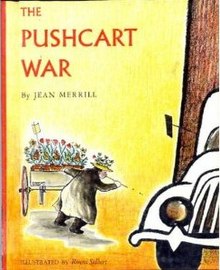
We are reading the Pushcart War.


In one scene, there is a poker game. Of course, the J's insisted that I explain the game and were eager to try it out. J3 was the huge winner tonight, while I busted out. Oh well.

Sunday, May 22, 2016

Build the chair (part 2)

In class, we played with the NRICH Chairs and Tables activity (our outline here). We came up with an extension that we explored at home: making a sequence with smaller and larger chairs.

Kick-off

I knew that J2 had incorrectly counted the cubes in the NRICH sample chair, so I kicked-off by asking him to show me how he counted them. This was a surprising, and unintentional, kick-off. His method was to decompose the chair into three sections: seat, back, and legs. This upper left 2/3rd of this picture show how he determined the number of cubes in each section.


First Sequence

The previous picture also shows notes about how J2 thought of making the chair bigger or smaller. His idea was to keep the same size seat, but make the legs and back of the chair longer or shorter. You can see our drawing of back for the two next smaller chairs.

Along the way, we looked at the total number of cubes in each chair. A simple pattern jumped out to him: each step is a difference of 6 cubes. He quickly realized this was because each leg required one more cube (4) and there are two on the sides of the back.

I asked him how many cubes would be in the 10th chair. When I asked him to explain his thinking, he said, well, going backwards, the 0th chair should have 10 cubes, each step is +6, so I need 10 + 6x10.

From algebra back to geometry

His idea of the 0th chair really excited me as this was one of the ideas I had been hoping we would uncover. We talked about how this chair would look (a 3x3 seat with one cube in the middle of a side as the back). This was not something we would naturally have created when asked to build a chair.

What we had done is gone through a sequence translate from geometry to algebra, naturally extend the algebra to a new case, translate the new algebraic case back to geometry.

Second Sequence

One other delight in this activity was that J2's sequence was not one I had in mind when outlining the activity. Of course,  wanted to share my version, as well.

I followed his decomposition into seat, back, and legs. See if you can understand my notes and picture how my chairs are growing through the sequence. Chair D3 is the starting example from NRICH.


I asked J1 to fill in the D1 chair to see if he got the pattern.

Not linear

J2 noticed that, this time, the gaps between cube totals were not the same, but the second difference is constant.

To round up the discussion, we wrote down an equation for the nth chair and calculated how many cubes would be in the 10th chair. Finally, we tried our trick of extending to the 0th chair. 


This time, we realized that there could be something interesting in the 1st chair, too. See if you can build a version of our D1 chair, using whatever your favorite building material might be.


Tuesday, May 17, 2016

Build the chair spatial reasoning (Gr 1 and 2)

who: Baan Pathomtham grades 1 and 2
where: in school

Here in Thailand, summer is over and we are back to school! We are kicking off the math games and exploration class today with an activity from NRich (chairs and tables) that has a surprising depth. Also, keep your eyes opened for the hidden reasons why we are starting with this activity.

Build a chair

The starting directive is simple: use unifix cubes to make a chair. Here's an example, from NRich:


To start, we ask the kids to get 15 cubes each. What does 15 mean? How do they know they've got 15? Do they think they will need more or less than 15 to make a chair?

After they have built their chairs, how many did they need? If it was less than 15, how many are left over? If it was more than 15, how many more did they need to add?

Chairs for bears

Once we've all got one chair, can we make two more for the three bears from Goldilocks and the 3 Bears? We need a small one for baby bear, a medium sized one for mama bear, and a large one for papa bear.

As the final construction challenge, we ask them to make a table sized to accompany their original chair.

Homework


  1. Based on the pictures above:  (a) find out how many cubes would be needed to build these shapes, (b) draw a 2d perspective of one of the shapes from one direction.
  2. For those who have construction sets at home, try making chairs of different sizes. What things were similar to using the cubes at school, what was different?

Extension

Building off the three bears activity is a nice extension:

  • What is the smallest chair we could make? How many cubes do you use?
  • How would you make the next larger chair? The next chair larger than that? How many cubes are used for those?
  • What about the tenth chair in this sequence? What would it look like? How many cubes would we use to make it?
  • Same questions for the 100th chair?
  • What is an equation for the number of cubes in the nth chair?
I'd note that these are challenging questions which go well beyond first and second grade. Also, there is no single correct answer, particularly as different students will have different ideas about what is required to be a chair or how the form should grow through the sequence.

Note: these questions follow the thinking of Fawn Nguyen's Visual Patterns.

Sunday, May 1, 2016

Reversed inequality

Recently, Mike Lawler posted a challenge base on the first question from the recent European Girls Math Olympiad (side note: what is "European" about this contest now that a US team participates?)

I enjoyed thinking about this problem and wanted to come up with something related to do with our kids. One way to see this problem is that it appears to reverse the direction of the inequality between the arithmetic mean and geometric mean. My version for younger students involves exploring this inequality first.

Discovering the Arithmetic Mean-Geometric Mean Inequality

I had J1 and J2 select two dice from our pound-o-dice. Initially, J1 chose a d20 and d6 while J2 chose a d12 and d6. I asked them to make a table with 6 columns and 7 rows (we ended up adding more, so probably better to ask for 8 columns and 10 rows). I had them label the columns:

  1. A
  2. B
  3. AxA +  BxB
  4. 2xAxB
They rolled their two dice and put the values into columns A and B, the calculated the other two columns as labeled.

J1's first results were 16 and 5. After filling in the rest of that row, he paused and then switched to 2d4. This wasn't a problem for our investigation, but he did miss some calculating practice with more difficult seed numbers.

After filling in 6 rows of data, I asked them what they noticed.


Here were some of the observations:
  • when A and B are the same, our calculated values are the same
  • when A and B are different, our calculated values are different
  • When A and B differ by 1, the calculated values differ by 1 (also vice versa)
  • AxA +  BxB > 2xAxB
  • We are only using positive integers

J2 really got into the spirit and asked for some more suggested columns. I told him to add:
AxA - BxB and (A-B) x (A-B). J1 also added the square of the difference.

With that, they noticed two more things:

  • AxA + BxB was larger than (A-B)x (A-B)
  • AxA + Bx B = 2x Ax B + (A-B)x(A-B)

You can see that they also added some negative numbers on J1's sheet and challenged one of these observations.

A picture proof

To finalize our exploration of the inequality, we used tiles to build intuition for a picture proof of this identity:

AxA + Bx B = 2x Ax B + (A-B)x(A-B)


This is one of the pictures we liked the most. In this case, A = 5 and B = 2. Along the left side and the bottom are rectangles AxB (the green + yellow and the blue + yellow regions). These two rectangles overlap in a BxB square (the yellow region) which they also highlighted with the 4-color square. The remaining red square is (A-B)x(A-B).

Side note: In our discussion, I was delighted that J2 would correct me whenever I slipped and said "greater than" instead of "greater than or equal to" when discussing the inequality.

Two quick algebra extensions
For kids who have already done a little algebra, proving the identity using the distributive law should be fairly straightforward. The other little extension is to show that our expression A2+B2≥ 2AB is equivalent to the arithmetic mean-geometric mean inequality.

Tuesday, April 12, 2016

Powers of a permutation and Santorini review

Two unrelated topics today. Or ... I guess one could argue that everything in math is related, but I don't see direct connections myself. If you spot some, let me know in the comments.

Rainbow permutations

We have a collection of crayons that can stack. Well, to be honest, mostly the kids break the tips off. The second most common use is to stick them on fingers as fancy fingernails. The fourth most common use is to actually draw or color with them.

J2 was engaged in the third most common use, stacking, when he noticed something new. He started with the colors stacked in rainbow order (R O Y G B Purple Pink). Then, he took 2 off the bottom and moved them to the top. Then, he took the bottom two and moved to the top and repeated. He noticed that, eventually, he got back to the starting order. Experimenting further, he tried the same process moving 3 from the bottom and repeating. Again, he eventually got back to the starting order.

Here is an example of the crayons stacked together:


In this case, he is moving blocks of 5:


After showing me, he suggested trying 4, 5, 6, then 1. He noticed a couple of things:

  • moving 6 is like moving 1 backwards (from the top to the bottom). 
  • Similarly, 5 and 2 are related, 4 and 3
  • 7 is prime, so maybe that is the reason the arrangement repeats
To test his hypothesis, he added another crayon (for 8) and tested. Again, he got back to the original arrangement. Hmm, doesn't need to be a prime!

Where should we take this first foray into group theory?

Santorini

Gordon Hamilton of Mathpickle, one of our favorite game and puzzle resources, has a Kickstarter for the newest version of his game, Santorini.


I encourage you to check it out. (For what it is usual disclaimer applies, I'm not financially related to this game or producers in any way.)

For reference, this is what the previous version of the game looks like:


Our DIY board (version 1)
While this version of the game will have nice custom pieces, the underlying game can be played with almost any collection of stackable objects. For our introduction to the game, we tried using our TRIO blocks:


To explain what you're seeing:

  • 1x1x1 cubes are used for building levels. I originally thought we would color coordinate (red for first level, pink second, etc), but J1 and J2 liked mixing up colors.
  • 4 unit straight connectors for our builders: magenta versus green.
  • Angle or arc connectors are radio antenae to serve as the fourth building level and block further building
  • Flags and wings as boundaries of the 5x5 board
Reactions
Both older Js enjoyed the game play. We quickly played 5 or 6 times. This game clearly has a lot of depth. We will have to play a lot more to see what patterns we can identify and whether we can develop any opening strategies. They are also very eager to play with some god powers. Perfect way to spend the rest of the holiday this week!

The TRIO blocks have pros and cons for this game. One of the best features is that it makes the game set-up robust to tipping the board, knocking the pieces off, or otherwise unsettling the position. It was clear to see the sizes of the levels and also immediate to identify towers that had already gotten killed (with a fourth level antenna).

In our play, there were two drawbacks. First, the straight connectors are a bit hard to remove from their positions. Second, the higher towers (2 and 3 levels) sometimes obscured allowed diagonal moves in a way that the stacking tiles version didn't. I wonder if this will also be the case with the new version of the game as the building levels seem tall relative to the size of the builders.

Longer-term, I wonder about buying customized games vs playing with generic materials. It is easy for the kids to grab a box off the shelf and start playing. Somehow, I suspect they will be less likely to grab a building set and a notecard with rules.

More thoughts on DIY game versions

Before Santorini, I had gotten excited about making DIY versions of the GIPF project games. I was thinking:

  1. these games will be fun to play, so great motivation to replicate them
  2. interesting challenge to make our own triangular grid board (squares we already have in abundance)
  3. good creativity prompt as we repurpose items
  4. it would make the kids feel power over the game structure and rules, leading to exploration of variations and deeper thinking about structure.

However, the kids, particularly J1, were surprisingly unenthusiastic. With Santorini, again, they didn't take much initiative in developing our DIY version. However, I wonder if they will be more motivated to modify or replace the TRIO blocks board since they now see that the game is fun and have experienced some of the limitations of our current version.

On the other hand, maybe they'll just push me to buy the commercial version.

Monday, December 21, 2015

marbleslides and desmos for 6 year old

J2 and I were playing around with Marbleslides last night. He had a lot of fun and clearly validated that the Desmos team has achieved their objective to "design for delight" (see their blog announcement of Marbleslides here).

Our version of bedtime math


While J3 has seen axes and graphing before, this was his first exposure to equations for lines. Really cool to see how Desmos lowers the threshold for exploring enough to make this easy and (again) fun for a young child. Now, I'm not under any illusion that he fully understood everything he was doing, but I believe these types of experiences build a comfort and background that is helpful whenever he formally encounters these ideas again. Feel free to disagree with me and let me know in the comments!

Use of Sliders

For some of the challenges, I gave him a generic equation and added sliders for the coefficients. Here's an example:
His choice of variable names
I wasn't really sure whether it was better to have him change the coefficients and parameters in the equation or via a slider. The great thing about the slider is the animated, continuous (looking) change in the graph as the parameter changes. The cost is that the extra variable introduces another level of abstraction ("this slider changes A which is a parameter in this equation which describes this line.") I'm not convinced either choice dominates, so we did some of both (with and without sliders).

The challenges: Spoiler Alert

J3 asked me to post his solutions to the first three challenges. Can you solve them with fewer lines?
Four lines for the first challenge


Can you even see how this solution works? Some kind of quantum effect, I guess? Solution has 2 lines


Whoa, a new kind of line! Solution has 2 lines

Tuesday, December 1, 2015

SolveMe Mobiles and BlockBlobs

Two activities that worked really well in class yesterday:

Mobile Balance Puzzles: from EDC

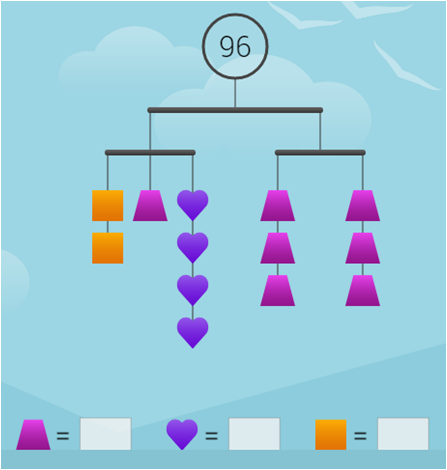
Several months ago, the great folks at EDC released SolveMe Mobiles, a collection of balance puzzles. The idea is pretty simple; you'll probably get the idea from just a couple of screenshot examples.

In many puzzles, some shape values are given and we need to find the ones that are missing so that the arms of the mobile stay in balance:


Sometimes, we are told the total weight of the shapes in the mobile. We then have to find the weights of the shapes so that the arms stay in balance:


Since we were introducing this idea for the first time, we did a simple version together, then gave the kids size more as a warm-up.

the most advanced puzzle we gave them had a side with three descending strings, like this:


We had a nice discussion about what this means: in real life, do all three of the hanging strings have to have the same value or not? What do we think for these puzzles, does it work like real life or not?


Side note: to online or offline?
For our class, we just had print-outs of the puzzles. This worked really well because it was easy for the kids to make notes and helpful drawings on the side of the pictures. The online system has a tool to write notes and draw on the screen, but it is slightly awkward to use on a desktop. Probably it works well on a tablet or smartphone.

Also, we brought out the unifix cubes as manipulatives for several of the kids to work through the puzzles. Of course, nothing would stop someone from doing the same when they are solving puzzles on a computer, but, in practice, I find that the idea just doesn't occur to them in the same way.

With the online version, you have two options that can give additional help. One is an animated test of whether the mobile is in balance. The other options shows numbers at the top of each string that represent the total weight under that position. Each of these makes the puzzle a bit easier by offering a guess-and-check strategy and a nice form of feedback.

Make your own
I always love getting kids to make their own versions of the puzzles. In the class, several of them finished a bit faster and I asked them to make puzzles for me. This feature is also built into the on-line version, which is a nice touch.


Block blobs

Our second activity of the day was Block Blobs. This comes from Beast Academy, though we made some small adjustments to their game.

The basic playing board is graph paper with a central dot. To make each game a manageable length, we split our paper into four sections for four games. Each section is about 20x30:


This was one slight deviation from the BA version: they use a 12x12 board. Each player has their own colored pencil to use as they mark out territory.

On a player's turn, they roll two dice, then they try to draw a rectangle on the board that uses those  two numbers as side lengths. For their first rectangle, they have to put one of the vertices on the center dot. For all subsequent turns, their rectangle must share at least 1 unit common boundary with an existing rectangle, may not overlap any existing rectangle and may not go off the board. The growing collection of linked rectangles forms their Block Blob.

Hmm, can you spot the illegal rectangle?


Two against teacher


Play ends when one player is not able to add the required rectangle to their blob. Then, each player figures out how much area they have covered and the one who covered the most wins. To make this final calculation a bit easier, we had them write the area inside each new rectangle as they added it.


Differences with the BA version
As mentioned above, BA suggests playing on a 12x12 board. We originally thought we would us 2d10 instead, so wanted boards that were at least two times larger in each direction.

Second, we required each player to start their block blob with a vertex on the center dot. The BA version requires this of the first player, but allows the second player to start their blob anywhere on the board. Since we were using larger boards, we wanted to facilitate the issue of competing for territory by having the blobs share a vertex. Another option would be to have each player start their blob in opposite corners of the board. This idea is similar to the game Blokus.

Third, we ended play when one player could not add a required rectangle (they pass their turn). The BA version stops play only when there are 4 passes in a row (two for each player). Though seemingly subtle, this was a major change. In our version, the player who gets squeezed out, either through weak play or bad luck, doesn't get penalized as harshly as in the BA version. This turned out to be very helpful because it meant that ending scores were much closer than expected, so (a) it was actually necessary to total the areas to see who had won and (b) the loser got a pleasant surprise when they saw that they were still very close.

For what it is worth, all credit for this important rule change goes to PK!

Of course, each of the versions can make for a fun game with slightly different strategic considerations.

Thursday, September 3, 2015

math games class catch up

It has been a while since I posted a summary of our math games, so this is just a quick catch up to summarize what we've been doing:

Grade 1

Addition war
2 players
pack of playing cards (A to 10)

Deal out all cards to both players and keep the cards face down in a stack. Each round, both players turn over the top two cards and add their values. The player with the higher sum wins and collects the cards in their points pile.

If there is a tie, those 4 cards are kept to the side as a bonus for the winner of the next battle. Repeat this with ties until there is a winner for one round.

After playing through the original stack, look to see who has collected more cards in their points pile. That person is the winner.

For a more challenging version, use face cards and assign values J = 11, Q = 12, K = 15.

Solo addition bridge
2 - 4 players (we played with 3)
pack of playing cards (A to 10 for beginner game, add face cards for extra challenge)

Deal out 5 cards to all players. They pick up these cards to form their hand. Proceeding clockwise, each player lays down one card from their hand, going twice around the group. Each player adds together the value of the two cards they played. The highest sum wins and collects all the cards played. That is one "trick."

After each trick, deal out 2 cards to each player to refill the hands to 5 cards.

The player who won the last trick is the first to play a card on the new round.

When there aren't sufficient cards to deal equally to all players, deal the hands equally (all players start each round with the same number of cards) and keep the remaining cards as a bonus for the player who takes the last trick.

We played with 3 players and, for the advanced game added 2 jokers to make a deck of 54 cards. Based on popular consensus, the jokers were assigned a value of 1,000,000. Interestingly, the extremely large value meant that the players were reluctant to play their jokers and, twice, both players kept them to the final trick so that the winner was actually decided by the higher of the second card!

Group addition bridge
4 players working as pairs (partners) with the partners sitting opposite each other
pack of playing cards (A to 10 for beginner game, add face cards for extra challenge)

Generically, play is the same as solo addition bridge, but each round the partners each play one card and the team that has the higher sum wins the trick. While there are still reserve cards in the deck, hands get refreshed up to 5 by dealing a single card to each player. The leader for each trick rotates clockwise so that everyone gets a chance to be first (second, third, and last) to play.

Second and Third Grade

Multiplication Blind Man's Bluff
3 players
pack of playing cards using A to 10 (A counts as 11)

One player deals a single card to each of the other players. They hold that card up to their forehead. The dealer announces the product of the two cards. Then, the two players try to figure out the value of the card on their own forehead.

Role of the dealer rotates after each round.

We played this as a cooperative exercise. To make it competitive, you can award points to the first player to get their card value.

There are two ways to make this more difficult. Adding face cards with made up values is one way. Instead, we had the dealer give one player two cards, add those, then multiply that sum by the value of the other card. 

Yet another step is to deal each player two cards, then multiply the two sums.
When playing this version at home, J1 came up with the idea of giving clues to figure out the value of the two individual cards. This was a really interesting activity because it got him to think about what characteristics help specify the two cards and which clues actually don't provide new information.
For example, if I know the sum of my two cards is 11, does it help me to know that I have one odd and one even number?

To make a standardized version, the second round of clues is to tell each player the product of their values. 

Largest Difference/Smallest difference
many players (at most 9 per deck of cards, fewer with advanced versions)
pack of playing cards A to 9

Deal out 4 cards to each player. They then form two 2-digit numbers and subtract the smaller from the larger. The player with the greatest difference wins that round.

For slightly greater challenge, deal out 6 cards (for two 3-digit numbers) or more (forming 4 or 5 digit numbers). Again, the aim is to form two numbers with the same number of digits that have the greatest difference.

For a much more interesting game, we shift the goal: now, we try to find two numbers with the smallest difference (larger minus smaller). After playing a bit, we had some good conversations about what the students noticed, what strategies they used, and whether there was always a unique answer.

Multiplication Pig (variation of addition Pig)
2 dice (we used 2d6)
2-3 players (or more, grouped into teams)

Players start with 200 points and try to work to 0 (or below).

Each turn, the player rolls both dice. If neither is a 1, they multiply the two values and add this to their score for the round. They can either choose to roll again or take their score for the round and subtract that from their cumulative score.

If two 1's are rolled, then  their overall score is set back to 200. If one 1 is rolled, then their score for that round goes to 0 and they lose their turn.

Variations come from varying to characteristics of the game:
- Start with 0 overall points and, each round, add the points for your round to try to break a target (practices addition instead of subtraction in forming the overall target)
- Add the two dice instead of multiplying (shifts the practice to addition instead of multiplication)
- Use dice other than 2d6, possibly more dice or differently shaped dice (note: the overall target and/or penalty conditions might require some adjustment)

Some PIG observations

Dice games are loud games, compared with card games. I think this is because the value of the dice is revealed to everyone at the same time.

Based on expected values, the optimal decision whether to keep rolling to bank the points for that round depends on how many cumulative points you have and your score for that round. However, we observed that the students chose to bank their points very early, relative to an expected value maximizing strategy. I think this is because their experience with the game causes them to over estimate the likelihood of rolling a 1 (or two 1's) and/or to underestimate how many points they can earn on a single roll because of the multiplication.

Thursday, June 25, 2015

A cheating friend (or funny dice)

who: J1 and J2
when: at dinner

The basic puzzle

In class recently, we've been using a warm-up puzzle where we tell the students we have two secret numbers and give them two clues: the sum of the numbers and their difference. The challenge is to find the two secret numbers.

This is a simple algebra problem that can also be attacked easily by guess-and-check (for small values) or by a systematic table of trials. These are the methods being used by the 2nd and 3rd graders, so the puzzles result in a lot of arithmetic practice as well as reinforcing different number bonds.

Our twist

Over dinner, I told the kids that a friend gave me a similar puzzle, but with a slight twist. This friend rolled a 6-sided dice twice and told me the sum and the difference of the values. Sounds the same, but easier, right...?

Unfortunately, our friends are all a bit tricky.
First clues
So, the first clues my friend gave me were that her two numbers sum to 12 and have a difference of 4. The two talked through these clues and found the answer (which I'll leave to you).

But wait: these were supposed to come from dice throws!?

Second clues
I told them that I'd gotten the same conclusion and had challenged my friend. When confronted with this result, the friend said, "oh, there was a mistake. Actually, the difference was 12 and the sum was 4."

After a minute, but before finding a solution, the J2 realized that there was something fishy about this one, two. How can two dice rolls have a difference of 12?!!

Are there two numbers that fit the clues, even if they aren't from dice rolls? Yes, J1 and J2 found them.

Third clues
So, the friend was tricking us again. So what were the actual values? This time, the friend claimed that the sum is 7 and the difference is 2.

At this point, both were highly suspicious, but also very curious to see what would go wrong. This time, they made a table with number bonds of 7 and the differences. It looked something like this:
7+0 = 7        7-0 = 7
6+1 = 76-1 = 5
5+2 = 75-2 = 3
4+3 = 74-3 = 1

At this point, they noticed a troubling pattern in the differences: always odd. J2 suggested adding another line to the table:
7+0 = 7        7-0 = 7
6+1 = 76-1 = 5
5+2 = 75-2 = 3
4+3 = 74-3 = 1
3.5+3.5 = 73.5-3.5 = 0
Ah, now we've got an even value! From there, it took another couple of minutes to find the combination of numbers that add to 7 and have a difference of 2.

Final answer, Final puzzle
Once again, the friend seems to be tricking us: these numbers aren't on a regulation 1 to 6 die either! It was time for the final revelation: actually, all of these were from my friend's dice throws, but they just had very strangely marked dice.

Looking over our work, we saw that we had only come up with 5 different numbers as answers in our puzzles. We confirmed that, yes, the dice was 6 sided, so what was the value of the last side?

This was the last clue from the friend: the average value of the faces on her die is the same as the average value for a regular die.

So, how are the sides of my friend's die marked?

Saturday, June 20, 2015

Crazy Tangles and the order of the months

who: J1, J2, J3
when; a couple of minutes scattered through the day, 5 minutes at dinner
what did we use: two colored pieces of string (shoelace weight)

Playing with string

2 years ago, Fawn Nguyen wrote a note about Conway's Rational Tangles. It was a great activity for her algebra class (so go read her note) and I thought our little ones might enjoy it. While getting a soldering iron to fix a toothbrush robot (another upcoming post?) I found two blue and red string that looked really perfect for this investigation.

There are two moves, twist and rotate. Since Fawn does such a fantastic job of showing these moves, I won't even bother trying to describe them. For us, we made it into a two person activity where we hold different strings in each hand. I introduced the ideas in the following sequence:

  1. told J1 that there were two moves and showed him. 
  2. Then we did a bunch of twists and I counted one each time. 
  3. After that, I told him a twist counts as +1. 
  4. We did a sequence (3 twists, rotate, one twist, rotate, two twists, rotate, two twists)
  5. at that point, he insisted on leading the moves, so he was in charge
J2 had been watching and basically understood the pattern, but we did something similar later as his turn.

J3 had her turn as well and basically just wanted to get tangled up in the string

Reactions
J1 got very excited about making conjectures about what the rotation operation does. His first guess was multiply by -1. We tested with twist, rotate, twist and found that we were back to state 0. However, when we did 2 twists, rotate, then 2 more twists definitely didn't get us to state 0.
Next conjecture was that rotate subtracts 2, but that also is disproven by the fact that TTRTT(0) is not 0. He is still working on it.

For J2, he liked to get complicated and started out with 10 twists and then a rotate. From that point, he let me call the moves (TRTTRTTRTTRTTRTTRTTRTTRTTRTT) and was totally delighted to see us get untangled back at state 0 after all of that.

J3 got a lot of mileage out of disrupting other people's tangles. This was certainly fun for her, but a bit frustrating for the older two.

Which month is first?

At dinner, I asked the kids which is first, January or February? J1 and J2 quickly said "January."
Next question, which is first, January or March? January again.
Next, January or April? Again, quick answer of January. P interjects, is that going to last?
January or May? J2 again says "January" quickly, J1 is starting to hesitate.
January or July? January again from J2, July from J1.

Why?
J2 is pretty clear; "January is the first month of the year, so it always comes first."
J1 has a different idea. It is June now, so our next July will come before the next January. Thus, July is first.

Next question, which comes first, January or December?
J2 again says "January, it is the first month of the year, so it has to come first."

What month comes immediately before January?
J2 says "December."

Note :J3 doesn't really know the months yet, so she wasn't very proactive, but she did enjoy repeating the others' answers.

This question occurred to me when reading Who's the Oldest over at Musings of a Mathematical Mom.

Tuesday, June 16, 2015

Is John a liar? and other good puzzles

who: J1 and J2
what did we use: Smullyan's Alice in Puzzle Land and some online games
when: after dinner

This post is basically a thank-you to all the people who create wonderful books, puzzles, and games. Also, thanks to the people who spread the message by telling us about these resources. In this case, we're directly indebted to A O Fradkin, Annie at the Math Forum, Mike Lawler for these specific activities.

Alice in Puzzle Land

The title of this post comes from one of the opening puzzles in Smullyan's book of logic puzzles: Alice in Puzzle Land. Here's how it goes:
John, and his brother, have the peculiar characteristic that one always tells the truth and the other always lies. Unfortunately, we don't know which one tells the truth and we don't know which one is John. Gosh, we don't even know John's brother's name! What single yes/no question can you ask one of the brothers to figure out which is John? 
What if we want to figure out whether John always tells the truth or always lies, what single yes/no question can we ask one of the brothers to determine this?
To be honest, I didn't get the answer, but J2 managed to figure it out after they posed a bunch of questions and we worked through the possibilities together, example "what if the one we are asking is John and he tells the truth?"

The Js (mostly J1 and J2) have had a lot of fun discussing this particular challenge and have also really enjoyed the tart-ingredient thieves series. They are currently working on the "very complicated logic puzzle" at the end of the first chapter to determine whether the Gryphon or the Mock Turtle was the tart thief.

SolveMe Mobiles

Since we started teaching the math games class at school last year, I have had a strong bias away from on-line games and puzzles. Part of this is simply that we wouldn't be able to use these puzzles in the class, but also because I wanted to help parents see that they don't need any special tools to help their kids have deep mathematical experiences.

Anyway, the SolveMe Mobiles and Game About Squares (below)  helped me recognize and reject this bias!

The mobile puzzles are from EDC, a group with which I am not affiliated, but which I hold in high regard. Each puzzle gives you a balanced mobile that, secretly, codes equations to solve for the weights of the various shapes. J2 (5yrs old) has especially enjoyed this and has just finished puzzle 51:

Even J3 (3yrs old) has gotten something out of this puzzle. She was looking at the screen and we (J0, J1, J2) asked: what do you see, what do you notice, what do you wonder (not all at once.) She talked about shapes, she talked about how many, she asked questions about what different things meant, she tested putting numbers into the blanks.

Game About Squares

Another cool puzzle: Game About Squares. I don't know who to thank for creating this and making it freely available, but it was part of a really nice Notice and Wonder post by Annie which is, itself, great and you should go read it. In the spirit of the game, I'm not really going to tell you much about it, just go play!


Sunday, May 31, 2015

Twist on an old puzzle and our number scavenger hunt

who: J1, J2, J3
when: after lunch, before violin lessons
what did we use: mini-white board and things around our neighborhood

Digit Substitution

You've seen these puzzles before: there are triangles, squares, and circles that represent digits in an arithmetic equation and you need to figure out which digit is represented by each shape. During a recent RightStart Math session, J1 got a couple of these. The puzzles were fun, but standard, each with a unique answer. We decided to add two twists.

How many answers?
The first twist was to find how many answers there are to this puzzle. You can see us mid-work, having already identified two choices for the circle and several options for the other two shapes.
The point is that it invites the kids to think carefully about the abstract relationships between the values that the shapes can have.


Build your own
I always love reversing a puzzle and having the kids build their own puzzles. I opened with the challenge to see if they could create a puzzle with no solutions. Initially, they draw the shapes at random and assume there's no solution. However, once we worked through a couple, they started to notice patterns and to carefully plot their strategies for making the puzzles impossible. Also, it led to discussions about what should be allowed as a solution: can a number have a leading zero, is it ok if two shapes represent the same digit, can we allow a shape to represent a negative number or a number larger than 9, etc.  Really cool thoughts that transcend the specific puzzles we suggested to each other.

Our number scavenger hunt

J3 went looking for numbers around our neighbourhood the other day. This was suggested long ago on Kids Quadrant last September, but I didn't really appreciate how good it would be for us until we started. Here are pictures J3 took of our finds from 1 to 4.

One swimming pool (that is soo big)

Two black metal pieces to open the door

Three plastic bottles (prior to us doing a civic duty and helping clean up)

Four light switches

Except the first, all pictures were taken by J3. We also found an office chair that has 5 wheels, but the picture didn't quite capture it.

Playing this game, J3 was really excited to count everything in sight. I was a bit surprised that she seemed to have very little prior expectation about whether any particular group would meet the target we were seeking, so we will make sure to play this again soon.