Showing posts with label puzzle. Show all posts

Tuesday, July 24, 2018

Playful Math Education Carnival #119

Welcome to Playful Math Education Carnival #119! Just to be clear, that exclamation is to express excitement, not factorial. Fortunately, you will have a bit of time before there's any danger of confusing this post with the edition (119 factorial).

Anyway, only the very coolest folks get to handle a MTaP edition that can be written with a factorial. And I just realized how close (and yet how far) I was to such glory.

119 Fun facts

  • 119 is the number to call for emergency services... in parts of Asia (wiki reference).
  • Of course, 119 backwards is 911 which is the US emergency services phone number
  • 119 is aspiring, the sequence formed by summing proper factors ends with a perfect number.
  • 119 isn't prime, but it almost feels like it
  • 119 = 7 x 17. I don't think products of consecutive primes ending in 7 has a name, but maybe it should?
Do you have other fun facts about 119? Please? Please?


Dedication

I'm saddened to note the passing of  Alexander Bogomolny this month, and I dedicate the edition of the  carnival to him. The material he developed and made available on his site
https://www.cut-the-knot.org/ is truly amazing and remains with us for our benefit.


Miscellaneous

Aperiodical has an article from Benjamin Leis on the Big Internet Math-off.
Something James Propp wrote as part of the Big Internet Math-off: A pair of shorts. 


Elementary

I was reminded of the game of Chomp! in Shecky Riemann's linkfest (most of which isn't elementary level, but worth investigating).

Cathy O'Neil tells her mathematician origin story. I hope all our kids can have an empowering math experience like this.

Discussion of a "square dancing" puzzle from Mike Lawler: part 1 and part 2. I think there is a lot more to explore here and hope some of you will write parts 3 and beyond... 

I always love game discussions. Set is a game you probably all know, but in case you don't here's an intro and a deeper analysis in the Aperiodical.


Pat Ballew writes about divisibility rules. Pat also discusses a fun XKCD in prime time fun.
I'm delighted at how this starts with something many take for granted (12 hour vs 24 hour time of day conventions) and then builds a fun exploration.


Middle school

Have you been waiting for someone to write the perfect post giving you an introduction to tons of Desmos activities? Well, Mary Bourrasa has done it for you.

Michael Pershan tweeted a pointer to a nice collection of logic puzzles on puzzling stackexchange.


Denise Gaskins pointed out a past note about factor trees and some cute wordplay from Danica McKellar's book: prime numbers are like monkeys.


This segues directly into a review of two number theory books by Ben Leis (also the author of the Big Internet Math off post above) in which he discusses some other visualizations beyond factor trees: 

High school

Ben Orlin invents and illustrates a new adage that there are no puddles in mathematics, only oceans in disguise. 


More advanced

Mathematical theorems you had no idea existed because they are false: https://www.facebook.com/BestTheorems/
Have fun finding counterexamples. Also, link disproves the conjecture that there is nothing worthwhile on facebook.

The Scientific American Blog has been running these columns on "my favorite theorem." Go back and take a look (I think this was their first one): Amie Wilkinson's favorite theorem.


A fascinating discussion of the Fields' Medal and some ideas about what it should be supporting. 


What was the score? Maybe the sum of scores was 119?

Wednesday, May 30, 2018

Ambiguity in math class

Math class is a special place. We've talked before about some of the special assumptions that are based into that context: teachers pose questions, students answer questions, all questions have answers, questions include all the necessary information, answers are usually "nice," problems can be answered with the tools students have (just been) taught, diagrams are indicative while the underlying true forms are perfect, etc.

Of course, not all math classes make these assumptions or leave them implicit, or are constant about which ones are in force, etc.

In this post, I want to pick up a thread related to the "one true answer" myth: problems that have multiple interpretations.

Example
You are driving from your house to a soccer tournament. The distance is 120 miles. For half of the trip, you drive 60 mph. For the other half, you drive 30 mph. What is your average speed over the whole drive?

Where's the ambiguity?
For the teacher who poses this problem, there is no confusion. Obviously, students are meant to calculate that it takes 1 hour to drive the first 60 miles and 2 hours for the second 60 miles. That means it took 3 hours for 120 miles, or 40 mph average speed.

The catch: what does "half of the trip" mean? As an alternative, it could mean half the time of the drive. If that feels contrived, consider the following natural statements about travel measured in time instead of distance:

  • "The drive took 3 hours; we stopped for a snack half-way." In this case, time and distance are equally natural in normal conversation.
  • "The flight took 6 hours;  I read half the time and slept the rest." In this case, time is the more common metric, but it wouldn't be considered unusual for someone to talk about the distance they flew.
  • "We were gone for 2 weeks, half at the beach, half visiting our cousins." Here, time is the natural metric, while it would seem strange to focus on distance. However, a vacation spent hiking the Appalachian trail or cycling across country would shift the balance back to distance.

Sources of ambiguity

I came up with four potential sources of ambiguity in math questions:

Things that can be measured in multiple ways. 

This extends the idea from “half a trip” ambiguity about distance or time. J1 and I had a discussion a couple of weeks ago where we measured chocolate bars and cookies using three different metrics: mass, cost, utils. For example, which is more:

  • 100 grams of chocolate that costs $2.00 and you value at 100 utils
  • 80 grams of fresh baked sugar cookie that costs $2.50 and you value at 90 utils

In business, it is common to have to deal with the ambiguity of whether “stuff” is measured in physical amounts or monetary value.

Pronoun ambiguity

For example: Ellis had 10 strawberries. Ellis gave 4 to his father and he ate 2. How many does he have now?

Who is meant by each occurrence of "he"? In each case, it could mean either Ellis or the father which leads to 3 distinct answers: 6, 4, or 2.

I accept that this is an example of bad English, but we're in math class and never claimed to be masters of language (did we?)

Tense ambiguity

In the prior story it could be that giving the strawberries away and eating them happened before the state where Ellis had 10. Let's add some extra story context to make this alternative more clear:
Ellis still had 10 strawberries. He bought a pack of 16, but Ellis gave 4 to his father and he ate 2.

I think this alternative interpretation is more of a stretch, but I've seen cases where the uncertainty about when things were happening is more natural.   

Assumption of scalability

Joe can bake 2 cookies in 20 minutes. How long does it take him to bake 4 cookies? 400 cookies? 4 million cookies? 4 quadrillion cookies?

I saw one math class question that involved writing books, a task which is very unlikely to happen at a constant rate.

Your challenges

  1. Find other sources of ambiguity that can infect (or add spice to) math class problems.
  2. For N a positive integer, create a puzzle that has N distinct solutions based on (reasonable) alternative interpretations.

Monday, March 6, 2017

Cryptarithmetic puzzles follow-up

I was asked to write a bit about strategies and answers for the puzzles we gave two weeks ago.

BIG + PIG = YUM
Because the digits in YUM are all distinct from BIG and PIG and there are only 7 letters in this puzzle, we should expect there to be many solutions.

The easiest way to get a feel for the puzzle is to start trying values and see what develops. This was part of the idea of using this puzzle as the opening challenge.

As we play with examples, the kids should notice these things that constrain our possible solutions:

  1. B, G, I, M, P, U, Y must all be distinct
  2. We are adding two three digit numbers and the sum is a three digit number
  3. B, P, and Y are all leading digits
  4. The largest sum possible with two numbers 0 to 9 is 18.
Some conclusions:
(a) G is not 0. If it was, then M would also be 0.
(b) B, P, and Y are all not 0. They are leading digits, the rules of our puzzles say they can't be zero.
(c) G + G is at most 18. It may contribute at most one ten to the calculation of U.  That will only happen if G is 5 or larger.
(d) I + I is at most 18. Along with a potential ten from G+G, that means we have at most 19 coming from the tens. That will only happen if I is 5 or larger.
(e) B+G is at most 9. If there is an extra hundred coming from the tens digits, B+ G is at most 8.
(f) If I is 9, G must be less than 5. Can you see why?
(g) If G is less than 5, I cannot be 0

After these observations, I'd suggest picking values of G, then seeing what values of I are allowed, then checking what remains for B and P. Because we aren't allowed to have duplicates, we quickly see that our choices are constrained.

For example, if G is 1 or 2, then I is at least 3 and we get the following possible solutions (B and P can be interchanged):
431 + 531 = 962
341 + 641 = 982
351 + 451 = 802
371 + 571 = 942
381 + 581 = 962

132 + 732 = 864
132 + 832 = 964
152 + 652 = 804
152 + 752 = 904
182 + 582 = 764
192 + 392 = 584
192 + 592 = 784

There are some more advanced ideas that could come out of trying to count or list all of the solutions, so I'd encourage people to explore. Even this simple puzzle can be a lot of fun!

CAT + HAT = BAD
The A in BAD is the key part of this puzzle. We can get two cases:
(a) A is 0 and T is 1, 2, 3 or 4
(b) A is 9 and T is 5, 6, 7 or 8.

Again, while there are a lot of solutions (and counting them would be a fun challenge) they are easiest to build up by choosing A (either 0 or 9), then T, then seeing what flexibility is left for C and H. Here are some examples:

301 + 401 = 702
301 + 501 = 802
301 + 601 = 902
302 + 502 = 804
302 + 602 = 904
103 + 403 = 506
395 + 495 = 890

SAD + MAD + DAD = SORRY
This was a puzzle without a solution. In this case, it isn't too hard to see that SORRY has too many digits. The best explanation was given by one student:
  • The largest three digit number is 999. 
  • If we add three of them, we will at most get 2997. 
  • SORRY has to be bigger than 10,000.
  • This isn't possible
CURRY + RICE = LUNCH
Unfortunately, this also doesn't have a solution, but the reasoning is more subtle than the previous puzzle.

Here, we can reason as follows:
  • R cannot be 0 because it is the leading digit in RICE
  • Because the tens digit of RICE and LUNCH are both C, R must be 9 and we must have Y + E > 10.
  • This also means R + C + 1 = 10 + C.
  • That will mean the 100s digit of RICE must be the same as the 100s digit of the sum.
  • However, the 100s digit of RICE and LUNCH are different.
Too bad, it was such a cute puzzle!

ALAS + LASS + NO + MORE = CASH
This is the most challenging puzzle from this set.

Some things we notice:
  1. There are ten letters (A C E H L M N O R S) and they must all be distinct.
  2. We are adding three 4-digit numbers and a two digit number to produce another 4 digit number.
  3. A, L, N, M and C are leading digits, so they can't be zeros.
  4. The tens and hundreds digits of CASH (S and A) are also involved in the sums for those digits.
Point 4 has a subtle implication, which I'll illustrate with the hundreds digits. Since L + O must be more than 0, but A is the hundreds digit of the sum, we must have some number of thousands carried over. Because A, L and M are all distinct and larger than 0, the smallest their sum can be is 1+2+3. Putting these two observations together, C must be at least 7.

In this case, I find it helpful to put together a table showing possibilities that we have eliminated:
We can see some more restrictions from the fact that A + L + M must be less than 9. That means we have only the following possible triplets (ignoring order):
{1, 2, 3}, {1, 2, 4}, {1, 2, 5}, {1, 3, 4}

One thing we notice is that 1 is in all of these triplets, so either A, L or M must be 1 and none of the other letters can be 1. Another thing we notice is that we don't yet have any way of differentiating A, L, or M, so any ordering of our triplets is possible.  That would mean we have 24 cases to consider.

Let's see how we would work through the cases, starting with A = 1, L = 2, M = 3, the first on our list. Now this, happens to be a stroke of luck, as we'll see.

Starting from the thousands digit, we see that this would make C = 7, if there is a single carry from the hundreds. Indeed, we can see that this must be the value (in the case we are testing), as the carry from there could only come from L + O (plus any carry from the tens digit). Since L is at most 5, L + O is at most 14 and any carry from the tens digit must be less than 6.

Now, in the hundreds digit, we have 2 + O + carry from the tens = 10, so O = 8 - carry from tens.
We know there must be at least one carry from the tens, so O is at most 7. Since 7 is already used by C, let's try 6. That means we need to get 2 hundreds carried over from the tens, so we need
A + N + R + carry from ones = 20, or N + R + carry from ones = 19. Since we have already used 6 and 7, the only way this is possible is if N and R are 8 and 9 (in either order) and we are carrying 2 from the ones.

At this point, the case we've worked through has:
121S + 21SS + 86 + 369E = 71SH

We still have to allocate digits 0, 4, and 5. and we know that S + S + 6 + E = 20 + H. Given our remaining digits, the biggest the left hand can be is if S is 5 and E is 4, making 20. The smallest the right hand can be is if H is 0. Fortunately, this makes the equality hold, so we get our final answer:

1255 + 2155 + 86 + 3694 = 7150

Through the process of checking this case, we learned more about how the carry from lower digits is restricted and it would be faster for us to check through remaining cases.
Let me know how many other solutions you find!

LOL + LOL + LOL + LOL + LOL + LOL + LOL + LOL + LOL + LOL +
LOL + LOL + LOL + LOL + LOL + LOL + LOL + LOL + LOL + LOL + LOL = ROFL

There are 71 LOLs, so this is 71 x LOL = ROFL. While this looks daunting, there are some ideas which take us a long way to the solution.

First, ROFL has 4 digits. If L were 2, 71 x LOL would be more than 14,000, so L must be 1. In fact, ROFL is less than 9861, so LOL is smaller than 9871 / 71 which is 139. We can quickly check
101, 121, and 131 and see that 131 works.

71 x 131 = 9301

Tuesday, February 21, 2017

Cryptarithmetic Puzzles for Grades 1 to 4

Inspired by a series of puzzles from Manan Shah, I decided to have the kids play with cryptarithmetic puzzles today. In addition to borrowing some of Manan's puzzles, I also used some from this puzzle page: Brain Fun. I've included some more comments below about the Brain Fun puzzles.

My main concern was whether the puzzles were at the right level. In particular, I was afraid that the puzzles would be too hard. In fact, I tried solving a bunch of them yesterday and actually found myself struggling. I'll ascribe some of that to being tired and sick. However, my intuition was to make some simpler puzzles of my own. In particular, I added:
  • puzzles that have many solutions: I figured that many solutions would make it easy to find at least one.
  • a puzzle that "obviously" has no solution. Now, obviously, the word "obviously" is a sneaky one in math, but I was pretty sure the kids could see the problem with this structure.

Grades 1 and 2

For the younger kids, I started with a shape substitution puzzle. This is one our family explored almost 2 years ago: Shape Substitution. I don't recall the original source.

Two reasons why I started with this. First, it has a lot of solutions, but there is an important insight that unlocks those solutions. Second, by using shapes, we can write possible number solutions inside them as we solve or guess-and-check the puzzle. This made it easier for the kids to see the connection that all squares have the same value, etc.


The second puzzle: BIG + PIG = YUM
Really just a warm-up practicing the rules and doing a little bit of checking that we haven't duplicated any numbers.


The third puzzle: CAT + HAT = BAD
Again, lots of solutions, but noticing leads to a good insight.

Fourth puzzle:  SAD + MAD + DAD = SORRY
This is a trick puzzle. The kids know that I like to tease them, so they are aware they need to look out for things like this. We discussed this in class and I suggested they give this puzzle to their parents.

Fifth puzzle: CURRY + RICE = LUNCH
When I translated this to Thai, all the kids laughed. I was sneaking a little bit of English practice into the lesson and then they realized that it was worth trying to read all the puzzles, not just solve them.

Sources: I think I made up all of these puzzles (original authors, please correct me if I'm wrong).

Grades 3 and 4

The older kids already had experience with these puzzles. We did refresh their memory a bit with BIG + PIG = YUM

I asked them to give me the rules and explain why those rules made sense. As with most games, I want to communicate that we're doing things for a reason, but those reasons can be challenged. If they think it makes sense to do it a particular way, we're open to their ideas.

Second puzzle:  SAD + MAD + DAD = SORRY
Same discussion as for the younger kids. When prompted, this was pretty easy for them to spot, but they weren't naturally attuned to think about whether a puzzle had solutions or how many. This led me to take a vote on all the puzzles at the end to see who thought the puzzles would have 0, 1 or many solutions.

Third puzzle: ALAS + LASS + NO + MORE = CASH
A puzzle from Brain Fun. I think this is one of the easier ones on that page. Again, a bit of English practice.

Fourth puzzle: LOL + LOL + LOL + .... + LOL = ROFL (71 LOLs)
This was from Manan. I think it is one of the easier ones in his collection, but it looks daunting. Turns out none of the kids in the class were familiar with (English) texting short-hand, so my attempt to be cool fell flat.

Fifth puzzle: CURRY + RICE = LUNCH
Again, everyone was delighted when I translated this one. We're in Thailand, after all, so at least one puzzle had to be about food.

The key exercise

The final assignment everyone (all four grades) was given was to make up a puzzle for me to solve. I was thinking it would be nice to have one in Thai, but we decided to keep it in English as further language practice.

Manan wrote a nice post about having kids design their own puzzles. If it goes well, this is actually the activity that ties a lot of the learning messages together: they think about structure, they think about what allows multiple or single solutions, they apply their own aesthetic judgment, they use their knowledge of the operations, they are empowered with an open-ended task that cannot be "wrong."

We'll see how it goes. At the very least, I expect a lot of work for myself when their puzzles come in!

An extra sweetener
Two kids asked if we could use other operations than addition. That prompted me to put this on the table (also from Brain Fun):

DOS x DOS = CUATRO

Brain Fun Problems

The first time I'd seen the Brain Fun problems, I added them to a list and called them "basic" (see this page.) When I actually went to solve them, though, they didn't seem so easy.

Big confession time: I actually looked at some of the solutions.  However, I was disturbed to see that the solutions involved extra information that wasn't included as part of the problem statement! For example, in THREE + THREE + FIVE = ELEVEN, the solution assumes that ELEVEN is divisible by 11. This seems to be the case for several of the puzzles involving written out arithmetic:

TWO + TWENTY = TWELVE + TEN (assume 20 divides TWENTY and 12 divides TWELVE, I wasn't clear about whether any divisibility was assumed for TWO and TEN)

I'm not sure if similar assumptions are allowed/required for any of the others.

Maybe I shouldn't complain, since this assumption creates an additional constraint without which there could be further solutions. Perhaps part of the reason it doesn't sit well is aesthetic. In the 3 + 3 + 5 = 11 puzzle, 3 doesn't divide THREE and 5 doesn't divide FIVE.

Lastly, there is a typo in the final puzzle of the Brain Fun page. That puzzle should be
TEN x TEN = FIFTY + FIFTY

Thursday, February 16, 2017

More Man Who Counted (gaps and notes)

As previously mentioned, we have been reading The Man Who Counted. While the story is good and there are nice math puzzles, we've found some of our best conversations have come from errors or weaknesses in the book. Here are three examples:

How old was Diophantus?

In chapter 24, we encounter a puzzle to figure out how old Diophantus was when he died. In summary, the clues are:

  1. he was a child for 1/6 of his life
  2. he was an adolescent for 1/12 of his life. (J1: "what's that?" J0: "a teenager")
  3. childless marriage for 1/7 of his life
  4. Five more years passed, then had a child
  5. The child got to half its father's age, then died.
  6. Diophantus lived for four more years
Perhaps we are wrong about our interpretation of the clues, but we noticed two things:
(a) the answer is not a whole number of years.
(b) the answer given in the book doesn't fit the clues.

For the first part, it seems a natural assumption of these types of puzzles that we are only working with whole number years. Sometimes, this is an interesting assumption to directly challenge.
Here, since the clues involve a second person (Diophantus's child) we felt whole numbers were a strong assumption. Also, the name Diophantus, you know?

Each clue required some discussion for us to agree on the interpretation. The one that seems most open is the fifth clue. In particular, did the child live until its age was half of the age of its father at the time of birth or to the point that, contemporaneously, it was half its father's age?

For completeness, I'd note that neither interpretation matches the book's answer. The first interpretation does allow a whole number answer, but it doesn't give whole numbers for all the listed segments of Diophantus's life.

Just so you can check for yourself, the solution given in the book is 84 years old.

How do you fix it?
We discussed several possible fixes:

  • accept answers that aren't whole numbers or require whole number segments for each clue. This allows us to take the alternative interpretation of the fifth clue (though that still isn't satisfying) or to accept the clues and just take a new answer. This isn't satisfactory because... Diophantus.
  • Change clue 4 or clue 5 to match the book's answer. This approach seemed to fix the puzzle without distorting it or changing the mathematics required to analyze it.
  • Change clue 1, 2, or 3. While possible, these seemed to open the possibility of changing the character of the puzzle. Also, these fractions were plausible based on our own experience of human life spans.
Of course, an even more satisfying answer would be to introduce a further variable and make the puzzle into one that makes heavy(ier) use of the integer restriction.

Clever Suitors

In chapter 31, Beremiz is confronted by a nice logic puzzle. Three suitors are put to a test, each is blindfolded and has disc strapped to his back. The background of the discs: other than color, the discs are all identical, there are five to choose from, 2 black and 3 white.

The first suitor is allowed to see the colors of the discs on the backs of his two competitors, then required to identify the color of his own disc and explain his reasoning. He fails and is dismissed.

The second suitor is allowed to see the disc on the back of the third suitor, then required to identify the color of his own disc and explain his reasoning. He fails and is dismissed.

Finally, the third suitor is required to identify the color of his own disc and explain his reasoning.  He succeeds.

Weakness 1
As a logic puzzle, we enjoyed this. Our problems came from the context in the story. This challenge was set to the three suitors as a way of fairly judging between them by finding the most clever suitor. However, this process was clearly unfair. In fact, it is inherent in the solution that it was impossible for the first and second suitors to determine the color of their own discs.

This led to a nice discussion about who really held the power in this process: the person who structured the problem by deciding what color disc should be on which suitor and what order they would be allowed to give their answers.

Extensions:
  • consider all arrangements of discs. Are there any arrangements where none of the suitors can answer correctly?
  • What is the winning fraction for each suitor? If you were a suitor, would you prefer to answer first, second, or third?

Weakness 2
Our second objection was non-mathematical, but again related to the story context. The fundamental problem wasn't how to choose a suitor. The fundamental problem was how the king could remain peacefully friendly toward all the suitors' home nations through this process.

For this discussion, we went back to the story of Helen of Sparta, which we'd read a long time ago in the D'Aulaire's Book of Greek Myths. Of course, that also led to discussion of the division of the golden apples, another puzzle we all felt surely could have been solved more effectively with some mathematical reasoning...

The Last Matter of Love

The last puzzle of the book is in chapter 33. It is another logic puzzle, again intended to test the merit of a suitor in marriage. The test:

  • there are five people
  • two have black eyes and always tell the truth
  • three have blue eyes and always lie
  • the suitor is permitted to ask three of them, in turn, a "simple" question each.
  • the suitor must determine the eye color of all five people
As a logic puzzle, we readers get some extra information:
  1. The first person is asked: "what are the color of your eyes?" The answer is unintelligible.
  2. The second is asked: "What did the first person say?" The answer is "blue eyes."
  3. The third is asked: "What are the eye colors of the first and second people?" The answers are "the first has black eyes and the second has blue eyes."
Simple questions
Our first objection was the part about asking "simple" questions. Having developed our taste for these types of puzzles through the knights and knaves examples of Raymond Smullyan (RIP, we loved your work!!!), the third question really bothered us. If you're going to go that far, why not ask the third person for the color eyes of all five people?

Personally, I would prefer that the puzzle require us to ask each person a single yes/no question.

As an extension: can you solve the puzzle with that restriction? 

Getting lucky
Again, we felt that this puzzle didn't meet the requirements of the context: to prove the worthiness of the suitor. Putting aside the question of whether this is really an appropriate way to decide whether two people should be allowed to marry, the hero here got lucky.

Extension: what eye color for the third person would have caused the suitor to fail?
Extension: what answer from the third person would have caused the suitor to fail?
Extension: for what arrangement of eye colors would the questions asked by the suitor guarantee success?
Extension: what was the suitors' probability of success, given those were the three questions asked?

Waste
Our final objection was the simple waste in the first question. From a narrative perspective, this is justified and even seems made to serve the purposes of the suitor. However, it opens another idea:
can you solve the puzzle, regardless of eye color arrangement, with only two questions?

Feel free to test this with yes/no questions only or your own suitable definition of a "simple" question.

The power of...

As a final thought, let me say that I think errors and ambiguity in a text are a feature, not a bug. It is another great opportunity for us to emphasize that mathematics is about the power of reasoning, not the power of authority.

Wednesday, January 18, 2017

Closest neighbor one-on-one

In my last post, I wrote about playing Denise Gaskins' closest neighbor fraction game with our 4th grade class. Yesterday, I spent time with J2 and used the game as a semi-cooperative puzzle.

This activity worked really well and the experience gave me some additional ideas about how to use the core ideas again with the 4th grade class.

Puzzle or game?
First, there were only two of us, one a kid and another an adult, so that background naturally makes the activity very different. As the key modification for play, we played all of our hands open and helped each other find the fraction in each of our hands that was closest to the target for that round. Then, we worked together to determine which of those two "champions" was closest overall.

Some of the consequences:
  • the activity was not really competitive (see below)
  • J2 had to do a lot more fraction work.
Let me explain the second point here. Because we were looking for the best play, J2 had to consider all of the combinations in his hand (20 choices). Some of those can be rejected quickly with simple analytical strategies depending on the target. Even this is good number sense thinking. Also, some combinations are close competitors and need to be analyzed more carefully.

If we were playing with closed hands, he could choose two cards, play a fraction based on them, and I wouldn't be able to say anything about whether those were his best options or not.

Second, while I write that "we worked together," as a sneaky dad, that means that I pretended to do work, while actually getting J2 to analyze my hand as well as his. Really, the only thing I offered was an alternative comparison strategy, once he had already worked through his own approach.

An example of some strategies
We found that some of the comparisons that arise naturally in this game are quite tricky, even for me. For example, quickly tell me which is closer to 1/3: 1/5 or 4/9?

We found that placing the fractions on a number line was a really helpful strategy for many of the comparisons. We also made very heavy use of the two strategies involving common numerators or common denominators.

Finally, you can see in this example that J2 is comfortable mixing decimals and fractions, for example converting to 1/2 to 3.5/7 to aid some comparison:


Our grid
Through our play, we filled out this grid, taking turns putting in our best results and congratulating each other when our hand was the ultimate champion for that round:


Competition and Strategic thinking
I was particularly pleased by one comment J2 made about this overall game: "this is mostly luck, how well we can play depends on the cards we get." This comment came after one round where he had several duplicate cards in his hand, reducing the number of distinct values he could play. We've discussed elsewhere my goals of helping the kids think about game structure, so I always love it when they bring those ideas up themselves.

Some thoughts about competition. While we played this game non-competitively, I'm not opposed to competition nor do I think that this game always needs to be played non-competitively. Ultimately, my litmus test is how to play in a way that is the most fun. If I were a more serious educator, I suppose I would also consider which way is the most educational, too.

It won't always be obvious what is the best way to play each game. In this case, I got to benefit from the prior experience with the class and my close knowledge of J2. Many times, I'll tell the kids that there are several ways to play and we'll try them out together, then review the experience.

Among other things, this is why I love handicap games like Go. By adjusting the starting advantages, we can create scenarios where it is very competitive and very fun, even though the players have very different levels of experience and current strength in the game. And also, there are things we can do together when we want a non-competitive activity.

Ideas for going back to class
From this time with J2, here are my ideas about taking the game back to the 4th grade class are:
  1. Spend a lot of time on fraction comparison strategies before we play
  2. Reduce the number of cards dealt to each player
  3. play as teams
  4. convert to open hands with a lot of talk about why we chose particular plays

An actual puzzle

As a reward for reading down this far, here's an actual puzzle related to the closest neighbors fraction game:

During the round where the target is 1/2, Jay plays 6/6 = 1. Was that her best play? How do we know?


Thursday, January 12, 2017

Compass only non-collapsing compass (Euclidea Series)

Since I've branched into this topic, I want to include some notes on additional references I've found and some results I've been able to get. First, an admission:

I'm still having trouble finding the intersection points of a circle and a line when the circle's center is on the line!
Another resource
James King (UW home page) has a nice session outline working through compass only constructions. Be warned, there are some spoilers for some of the Euclidea challenges in that material. Unfortunately, I can't tell from write-up when and where this was used. Maybe this NWMI meeting?

In Professor King's notes, he describes the construction I'm struggling with as "important and difficult," so I will have to redouble my efforts.

Non-collapsing compass from collapsing compass
As an aside, perhaps you have noticed that everyone else refers to the two types of compasses as collapsible and non-collapsible. Doesn't that terminology strike you as wrong, too? The point isn't that one type of compass is able to collapse, but rather that it always collapses when not drawing a given circle. Also, a common form of "non-collapsible" compass is able to collapse!

Just squeeze the legs together to collapse


Anyway, I was able to figure out the construction of a non-collapsing compass, just in time for Euclidea 13.2.

I'll give a construction below. For a more mild hint, the key is the ability to reflect points through a line we've already "constructed" (where we have two points on the line).

I've chosen to do this in GeoGebra so I can show a sequence, explain some of the reasoning, and grey out earlier parts of the construction that we don't need anymore. Check my work to make sure I didn't slip in any subtle straightedge moves!


Tuesday, January 3, 2017

Inscribed Circle (Euclidea series)

Sometime in the past two years, Sue VanHattum, introduced us to Euclid the Game. This is a nice series of classical construction puzzles (compass and straight-edge) built on top of Geogebra. We recently returned to it and saw a link to another version that we've been playing a lot recently:
Euclidea.

In EtG, there is a nice discussion in the comments section. Euclidea doesn't have this feature, so I decided to write blog posts chronicling some of our struggles and, hopefully, starting a place for discussion. I'm not planning to write about every challenge or post answers to all of them, but am happy to take requests. Otherwise, I'll write about the puzzles I find challenging and/or interesting for some reason.

Alpha Pack

I think there are two things worth talking about in alpha pack: (1) the puzzle that has stumped us and (2) the location of the V stars.

That darned square (or is it a diamond?)
The last puzzle in the alpha pack is the one that has stumped us. Our target is this inscribed square:


The kicker is to construct it in 7 elementary moves!

Our thought process
We need four line moves to draw the sides of the square. That means we have only 3 moves to find the other three vertices. We can get one by drawing the diameter of the circle, so we have two moves to find the other two vertices.

We can easily find those two side vertices with three elementary moves, but are really stuck on the idea needed to get one less move.


Some spoilers

Six move square
Our approach to get the construction in 8 elementary moves serves easily to get the 6 move construction. Below, I've included the finished picture which should be enough to see the approach (it isn't very involved anyway).


We found V stars in the following puzzles: equilateral triangle tutorial, 60 degree angle (1.1), and rhombus in a rectangle (1.5).


Age puzzles

Some quick puzzles created and discussed with J2 while at lunch today. For all, we made the simplifying assumptions that everyone has their birthday on the same day.

Basics/assumptions
Our friends were discussing their current ages: Jin 9, Jate 7, Panelia 6, Sophia 5, and Jane 4. The first two are boys, the latter three girls. All have their birthday on the same day of the year and are having their birthday today!

Add them up
The boys wondered: will it or has it ever happened that the sum of our ages is the same as the sum of the ages of the girls?

Doubles
A little twist on the previous question: when will the sum of the girls ages be twice that of the boys?

For those that know algebra: can you make sense of the solution?

Halves
The previous puzzle was a bit strange. What if we go the other way: when will (or were) the sum of the ages of the boys twice that of the girls?

Murky waters with products
What is the current product of the boys ages? The product of the girls ages?

Have those products ever been equal? We argued this based on the intermediate value theorem.
When were those products equal? We numerically approximated to the closest half year.

Some other families

J2 asked me to include these, which we'd discussed during a dinner last week.

Bill is five years younger than his sister. In seven years, Bill will be 2/3 his sister's age. How old are they now?

John is ten years older than his brother Joe. In six years, John will be twice as old as Joe. How old is Joe now?

What are your favorites?

If you have any of these types of puzzles, please let us know in the comments!

Sunday, November 13, 2016

Puzzling puzzlers

Preparing for classes today, we went through our lists and links to gather a list of puzzles for the kids. Hopefully, this will help short circuit the work we have to do next time.

Tuesday, May 24, 2016

Logic Puzzle collection and Dropping Phones

Recently, Mathbabe put out a request for riddles. There are some good links in the comments:
We've played with puzzles from almost all of these sources in the past, but this was a good opportunity to put together a nice list.

The one that stood out to me was on FiveThirtyEight. That's a site I read frequently, especially during this US election season ... and I was totally unaware of The Riddler feature. We kicked off with the oldest puzzle from their archive: Best way to drop a smartphone.

Breaking stuff

Right away, J1 and J2 loved the theme and were into questions about whether they could somehow keep the phones, if they weren't broken, or utterly destroy them, if they were broken. We talked about setting an upper bound with a very simple strategy of starting on the 1st floor and working up each floor. That's not a great answer, but it got them into modifications and improving strategies.

Through the conversation, it was interesting to see them start with the idea that the drops for one of the phones would be de minimis and could be ignored, but then start to pay attention to that aspect. Also, they had to grapple with the idea of balancing the number of drops that would be required in different cases.

While we didn't get to the optimal strategy, but the kids managed to get a version that, at worst, would take 19 drops for the 100 story building. Their intuition was based around taking the square root of 100. They could see that this probably wasn't the best answer, since there were still cases that, at worst, would take 10 drops and others that, at worst, would take 19.

Can you do better?

Smaller before bigger

The puzzle page poses the same challenge for a 1000 story building. However, we found something interesting when working on the version for a 10 story building: there is  strategy where all worst cases take the same number of drops, but it is not the optimal strategy!

It is a little hard to write about this without disclosing the strategy, but here's a hint:

  • 4 + 3 + 2 + 1 = 10 and 5 + 4 = 9
  • We are always allowed to assume that the phones will break if dropped from the top floor of the building

This led to another extension: what size buildings will have the same issues as for a 10 story building?

Probability comes in

Another extension is to think about the expected number of drops required and strategies that minimize this. Crucially, this extension introduces the idea about our prior beliefs about the sturdiness of the phones: where do we think the phones are likely to break, what is our confidence?

We didn't pursue this extension very far, but it did lead to some interesting conversations about terminal velocities. For those who want to follow that thread, this (other) stack exchange thread might suit you: How to figure out height to achieve terminal velocity.

Friday, April 29, 2016

4 Coins challenge

Recently, we were at lunch and the kids asked for a challenge to entertain themselves. I had just read this Numberplay column and had Lora Saarnio's Four Coins Problem in mind.

The basic rules are to choose values for coins in a new system so that any value from 1 cent to 10 cents can be made with a single coin or with two coins.

For our older two, this was a great on-the-go puzzle without pen and paper. Later, we got into some extension questions that required more careful organization of their observations and attempts.

Mostly, I want to report some of the extension questions that we found interesting. The key point: this problem is very accessible (J3 could also work on a simplified version) but it is ripe for a Notice & Wonder discussion that will reveal increasingly complicated and challenging extensions.

Note: we used names of neighboring countries, but none of the claims in these scenarios are true (as far as we know).

Number fussiness
In Burma, the president really likes the sequence 1, 2, 3. Is there a coin system we can suggest that includes coins with all three of those values?

No duplicates
We noticed that, for all the coin systems we created, there were always some values that were duplicated. What we mean is that there are two ways of using the coins to make that value. For example, in the coin system 1345, the following values can be made two ways:

4 = 4 = 1+3
5 = 5 = 1+4
6 = 3+3 = 1+5
8 = 4+4 = 3+5

Is there a coin system where all the values can be made only one way? If not, why not?

Two rival countries
Cambodia and Laos really love to compete with each other. As a result, they want coin systems where there aren't any shared coin values. For example, if Cambodia has a coin with value 5, then Laos can't have a coin value 5.

Is it possible? If not, what is the smallest overlap possible and how many possible coin systems achieve this smallest overlap?

Note: when we started this investigation, we had already designed a new system for Cambodia, so our starting question was whether there was a new system for Laos that wouldn't overlap this particular system for Cambodia, how much overlap was unavoidable, and then how to change both systems to minimize the overlap.

More values!
If we want to extend to amounts up to 20, how many coins are needed to have a compliant system (any value possible with only 1 or 2 coins)?

We haven't pursued this to a final answer, but the J's quickly recognized that, for any compliant coin system covering up to 10, they could create an 8 coin system that would cover up to 20. However, they also realized that four coins would be too few. This means that the minimum required to cover up to 20 is 5, 6, 7, or 8.

Coin triples
In the More Values! extension, we allow more than four coins in the system. The other way to relax the original constraints is to allow more than 2 coins to build a value. What can we achieve if we allow three coins at a time? Could we use fewer than four values in the system and still cover all amounts from 1 to 10? What about 1 to 20?

Monday, February 1, 2016

All your base are belong to us (cryptarithm extension)

If you don't know Futility Closet, I suggest you take a look. It is a fun and quirky combination of math puzzles, chess puzzles, and historical anecdotes

This recent post had a nice puzzle, Hidden sum, that led to a fun conversation with J2 and J1.
This was a fun puzzle on its own that I knew would appeal to J2, since one of his familiar number friends, 111, is lurking in the solution.

The base

Before I got a chance to discuss with J2, however, I spent some time considering a small clause in the question: "in base 10." Strangely, if this clause hadn't been included, I probably would never have thought to investigate in other bases. This restriction, though, seemed like an invitation to go exploring in other bases. Since the older J's had recently done some work in non-decimal bases, I thought they would enjoy this extra exploration.

I told J2 this puzzle. First, he worked through the base 10 version, including seeing an old friend (and familiar factorization) along the way, I asked what he thought about doing it in other bases. He was interested, so we started with binary. Luckily, his first idea was to consider possibilities for TTT. In binary, the only three digit TTT is 111, aka 7 in decimal. He saw that was prime, so couldn't be factored into two 2-digit factors. That proved to be the first key insight of the exploration.

We moved on to base 3, 4, 5, 6, 7, 8, 9, 10, and 11. At some point, J1 joined the game. Along the way, they made the following observations and conjectures:

  1. if 111 is prime, there is no solution. This is because TTT will have to have a 3 digit factor.
  2. If 111 is not prime, it will have one 1-digit and one 2-digit factor (why?)
  3. If 111 is not prime, neither factor will end with a 0 in the ones place (why?)
  4. Given a 2-digit number (ME) with a non-zero ones digit in the ones place (E not 0), and a (non-zero) one digit number X, there is a single digit value T such that multiple of T x X is of the form YE (a 2-digit number sharing the earlier value in the ones place). 

For the first three conjectures, "(why?" means that most of you should be able to prove these. For the fourth, this conjecture isn't true! However, there is something extra that happens in the scenario for the puzzle that gives extra information and makes it true when ME x X = 111

The sum

One other point is lingering for me: why does the original puzzle ask for the sum of E, M, T, and Y? Sometimes, this form of question is a clue that there is some interesting relationship that allows us to calculate the answer without finding values for all the variables. Though it is common, I still get a kick out of this, probably because there is such a strong instinct to solve for all the variables.

In this case, I really don't see a way to get the sum directly, without finding values for E, M, T, and Y. Any ideas?

If there isn't a direct path, why did they phrase the question this way? Without seeing the exam, my guess is that this is an information reduction operation that allows this to be a multiple choice question.

Thursday, December 17, 2015

Some easy logic grid puzzles

In our math games classes recently, we've been introducing more puzzles. One class of puzzle I loved as a kid is the logic grid. There are some nice websites that specialize in these puzzles, namely:

I wanted some easy puzzles to use as introduction and was surprised not to be able to find any two factor puzzles, so I went ahead and started creating some. Here are three, for your amusement. If you know a source of others, please let me know!


Some reasons why two dimensions aren't popular
I see two weaknesses of the small puzzles.

First, there is a strong temptation to make puzzles about people. That means names are one common dimension. If we restrict to two dimensions, then the puzzles are all of the form "match the people on this list with one of their attributes from this other list." That quickly feels repetitive.

I'm open to the idea that this is just my own weakness as a puzzle writer, maybe exacerbated by the fact that I've just started trying to write these. If so, then I should be able to create more interesting contexts over time. Puzzle 3 is in that spirit.

Second, structurally, 2 dimensional puzzles are missing some important and difficult inference rules. Let's use the terms (names and instruments) from my Puzzle 1 and add another dimension where the kids like different sports (football, tennis, volleyball, and biking). Taken from this paper, the key inference rules are:
  1. Related by elimination. For example, if we know that Aaron doesn't play violin, trumpet, or drums, then he must play piano.
  2. Not related by exclusion. For example, if the violin is played by Carly, the it isn't played by Aaron, Benjamin, or Diana
  3. Related by transitivity: No example from Puzzle 1. Using the extra dimension, if Benjamin plays violin and the violin player likes biking, then we can conclude Benjamin likes biking.
  4. Not related by transitivity: Again, our basic puzzles can't illustrate this. Illustrating with the extra dimensions, say Carly doesn't play piano and the piano player likes tennis, then Carly doesn't like tennis.

Empirically, the transitivity rules make puzzles much harder, partly because the grids make the other two rules visually clear.

Anyway, I'll test these out with the kids and report back.

Tuesday, December 1, 2015

SolveMe Mobiles and BlockBlobs

Two activities that worked really well in class yesterday:

Mobile Balance Puzzles: from EDC

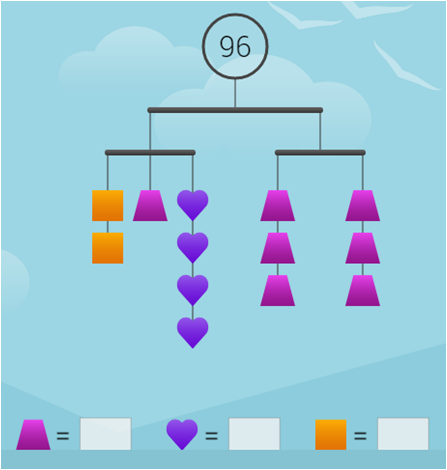
Several months ago, the great folks at EDC released SolveMe Mobiles, a collection of balance puzzles. The idea is pretty simple; you'll probably get the idea from just a couple of screenshot examples.

In many puzzles, some shape values are given and we need to find the ones that are missing so that the arms of the mobile stay in balance:


Sometimes, we are told the total weight of the shapes in the mobile. We then have to find the weights of the shapes so that the arms stay in balance:


Since we were introducing this idea for the first time, we did a simple version together, then gave the kids size more as a warm-up.

the most advanced puzzle we gave them had a side with three descending strings, like this:


We had a nice discussion about what this means: in real life, do all three of the hanging strings have to have the same value or not? What do we think for these puzzles, does it work like real life or not?


Side note: to online or offline?
For our class, we just had print-outs of the puzzles. This worked really well because it was easy for the kids to make notes and helpful drawings on the side of the pictures. The online system has a tool to write notes and draw on the screen, but it is slightly awkward to use on a desktop. Probably it works well on a tablet or smartphone.

Also, we brought out the unifix cubes as manipulatives for several of the kids to work through the puzzles. Of course, nothing would stop someone from doing the same when they are solving puzzles on a computer, but, in practice, I find that the idea just doesn't occur to them in the same way.

With the online version, you have two options that can give additional help. One is an animated test of whether the mobile is in balance. The other options shows numbers at the top of each string that represent the total weight under that position. Each of these makes the puzzle a bit easier by offering a guess-and-check strategy and a nice form of feedback.

Make your own
I always love getting kids to make their own versions of the puzzles. In the class, several of them finished a bit faster and I asked them to make puzzles for me. This feature is also built into the on-line version, which is a nice touch.


Block blobs

Our second activity of the day was Block Blobs. This comes from Beast Academy, though we made some small adjustments to their game.

The basic playing board is graph paper with a central dot. To make each game a manageable length, we split our paper into four sections for four games. Each section is about 20x30:


This was one slight deviation from the BA version: they use a 12x12 board. Each player has their own colored pencil to use as they mark out territory.

On a player's turn, they roll two dice, then they try to draw a rectangle on the board that uses those  two numbers as side lengths. For their first rectangle, they have to put one of the vertices on the center dot. For all subsequent turns, their rectangle must share at least 1 unit common boundary with an existing rectangle, may not overlap any existing rectangle and may not go off the board. The growing collection of linked rectangles forms their Block Blob.

Hmm, can you spot the illegal rectangle?


Two against teacher


Play ends when one player is not able to add the required rectangle to their blob. Then, each player figures out how much area they have covered and the one who covered the most wins. To make this final calculation a bit easier, we had them write the area inside each new rectangle as they added it.


Differences with the BA version
As mentioned above, BA suggests playing on a 12x12 board. We originally thought we would us 2d10 instead, so wanted boards that were at least two times larger in each direction.

Second, we required each player to start their block blob with a vertex on the center dot. The BA version requires this of the first player, but allows the second player to start their blob anywhere on the board. Since we were using larger boards, we wanted to facilitate the issue of competing for territory by having the blobs share a vertex. Another option would be to have each player start their blob in opposite corners of the board. This idea is similar to the game Blokus.

Third, we ended play when one player could not add a required rectangle (they pass their turn). The BA version stops play only when there are 4 passes in a row (two for each player). Though seemingly subtle, this was a major change. In our version, the player who gets squeezed out, either through weak play or bad luck, doesn't get penalized as harshly as in the BA version. This turned out to be very helpful because it meant that ending scores were much closer than expected, so (a) it was actually necessary to total the areas to see who had won and (b) the loser got a pleasant surprise when they saw that they were still very close.

For what it is worth, all credit for this important rule change goes to PK!

Of course, each of the versions can make for a fun game with slightly different strategic considerations.