Showing posts with label multiplication. Show all posts

Sunday, August 14, 2016

Block blobs redux

Last December, we played Block Blobs (notes here). This week, we are trying a slightly modified version for two digit multiplication.

The Game

Materials

  • 4d6. Two dice are re-labelled 0, 1, 1, 2, 2, 3 (see notes below)
  • Graph paper (we are using paper that is roughly 20 cm x 28 cm, lines about 0.5 cm apart)
  • colored pencils
Taking a turn
Roll all four dice. Form two 2-digit numbers using the standard dice as ones digits. Then, use your color to outline and shade a rectangle in the grid so that:
  1. the side lengths are the 2-digit numbers you formed with the dice
  2. At least one unit of the rectangle's border is on the border of your block blob
  3. Note: the first player on their first turn must have a corner of their rectangle on the vertex at the center of the grid. The second player has a free play on their first turn.
  4. Write down the area of your rectangle
Ending the game
The game ends when one player can't place a rectangle of the required dimensions legally.
When that happens, add up the area of your block blob. Higher value wins.

Notes

"Counting" sides
The side lengths of the rectangles are long enough that counting on the graph paper will be irritating. Instead of counting directly, they can measure the side lengths. For our graph paper, the link between the measurement and the count is nice, since the paper is very nearly 5mm ruled, so they just double the measure. I think this is a really nice measurement and doubling practice, too.

Dice labels
Other labels could be used on the special dice. We chose this arrangement because of the size of the graph paper. Rectangles with sides longer than 40 often won't fit and we think we will even need some single digit rectangles to allow a fun game length. An alternative we are considering is 0, 0, 1, 1, 2, 2.

As an alternative to labeling the dice with new numbers, you could label them with colored dots and give out a mapping table. For example:
blue corresponds to 3
red corresponds to 2
green corresponds to 2
yellow corresponds to 1
black corresponds to 1
white corresponds to 0
This would keep the tens digit dice distinct from the ones digit dice and allow rapid modification if you want to change the allowed tens digits (just tell everyone a new mapping). Alternatively, you could create a mapping using "raw" dice and even allow more strategic flexibility from the players. I have a feeling that this would be confusing to most kids, though.

Reinforcing the distributive law
To facilitate calculating the area and reinforce the distributive law, you might have the students split their rectangles into two (or four or more) pieces and calculate the partial products. You can further decide whether to ask them to split the sides in particular ways or encourage them to find the easiest way to split to help them calculate.

Monday, June 20, 2016

Secret Numbers (Addition Boomerang variants)

We have been enjoying Mathpickle activities in our math games classes recently. This week, the 3rd and 4th graders will be playing with some of the more advanced Addition Boomerang variations.

During our planning, we came up with one extra pointer to tie the activity more closely with multiplication. Also, we had ideas for variations and wanted to record our notes so we can use them again in the future.

Tie with multiplication

In Gord's video explanation, he sometimes records in the center of each loop how many times that loop has been used. We emphasize this and write some related equations to help draw out the connection between the repeated additions in this activity and multiplication.

The first way we do this is by making tally marks inside the loop every time that branch is chosen. At any time, you can pause and write down an equation for the current total in a form
AxN + BxM = Total

where A and B are the values of the loops, N and M are the number of times each loop has been used.

Alternatively, we can show a "completed" round of throws by simply writing the number of passes for each loop in the middle and, again, write out an equation showing the total as the sum of two products.

Secret Number Variations

We start with a basic addition boomerang lay-out, either with 2 or 4 branches, both players (or teams) share a common set of addends and take turns adding on to a common running total. In our variants, the players choose and write down a secret number that helps inform their target for the game:

  • Version A: players pick a number between 70 and 100. This is their target for the game and they win if the common total hits that value, whether the target is reached on their turn or their opponents turn.
  • Version B: players pick a number larger than 15. They win if the total hits a multiple of their secret number. For example, if they choose 17 and the running total hits 51 (aka 17 x 3) then they would win. If the total is a multiple of both secret numbers, then the player who chose the larger secret number wins.
  • Version C: players pick any number. They win if the total hits a multiple of their secret number that is larger than 60 (not equal to 60). If the total is a multiple of both secret numbers, then the player who chose the larger secret number wins.

Version B is, I think, the most directly playable.

Possible issues
I'm not sure how to deal with the case where both players choose the same secret number.

For Version A, it will be interesting to see what modification kids can find that will deal with the fact that it is very easy to miss any particular target. In the basic game, once the total is larger than your target, there is no hope of recovery. There are several ways to address this. I would be eager to hear any rule sets that kids create and hear about the experiences.

In Version C, I wonder if choosing 2 as the secret number is too strong a move?

Wednesday, May 18, 2016

Factors and division

who: grades 3 and 4 at Baan Pathomtham
where: in school

Sorry about the lack of pictures. This is a short and sweet note.

Dots & Boxes and Factor Game Mash-up

To start the year, we played a version of dots & boxes that integrates the factor game (here is one example). This is based on the game template from Mathified Squares Game that we used last year.
Instead of using dice to determine where each player can play, we introduce factors 1 to 6 at the bottom of the page and selectors.

As with the basic factor game, this version creates multiplication and division. This is the point we want to draw out for the game.

Homework

Play the game at home and write down 15 division equations that come up in the course of play.

*UPDATE* Having now played through this game fully, I really like this structure. Using the factor selectors drives some interesting thinking about common factors, especially during the middle and end-game phases.

We did find that it starts a bit slowly as players can make moves on distant parts of the board and decisions don't have clear connections to capturing squares. For the young kids, we recommend just pushing past that stage. For older kids, that can be an interesting (and difficult) strategic analysis.


Tuesday, February 16, 2016

Dots and Boxes variation

In grades 1, 2, 3, we played this variation of dots & boxes: Mathify the Squares Game.

I'm enthusiastic about this game, but can't resist a quick comment about the "mathification." Dots & boxes is already a mathematical activity, it doesn't need to be "mathified." This term implies confusing arithmetic and calculation with math, something I've written about elsewhere and, I hope, is clearly not implied by our blog.

In any case, I'll use the shorthand MD&B to refer to this dots and boxes variation.

Notes from playing in class


In class, we first introduced the kids to vanilla Dots & Boxes with a pre-printed grid of dots. We knew that it would be too much to play on a lattice covering the whole A4 sheet, but we thought a quarter of the grid would work. That turned out to be too big and the game started to seem monotonous to the kids as there was too much time spent on the opening (playing on squares that don't yet have any filled sides.)

We rectified this problem in 3rd grade and played on much smaller grids, with sizes between 7x7 lattices (which yield 6x6 squares) and 10x10.

After they were comfortable with the vanilla game, we introduced the product version with dice. In our case, we just had the players take turns and didn't give an extra turn when someone completed a square.

Some rule variations
There are some simple variations depending on how you deal with completed squares:

  • no extra turn (this was the version we played in class)
  • player adds another side to a different square with the same value. For example, say the dice are 2 and 4 (product 8) and the player fills a square. They also must add a side to another square with value 8.
  • player rolls the dice and adds a new side (a full extra turn)
  • player adds a side to any square (dice and square values ignored)
Of course, you could also make the extra turn optional instead of compulsory. You might also have some ideas about different ways to handle cases where there are no more free sides on squares with the required number value.

Probability questions

Dice games naturally lead to probability questions. Here were two that I really liked, based on scenarios from a recent game play:

What question are we asking?
What is the chance a player will get both the 20 and 36 boxes:


One great answer was 1/2. The reasoning: we are going to play until all boxes are filled and each of us have an equal chance to fill this box, so 1/2. This is not quite right, since the person who is about to roll has an advantage, but I thought it was an interesting interpretation of the question.

A 2x2 square
In this configuration, what is the probability that the next throw will allow the player to complete a box in the 4-30-25-15 zone?


A bigger D&B family

One of the reasons I thought this D&B variation was so cool is because of our games matrix. Whenever we play games, J1 and I talk about some key characteristics of the game, particularly the amount of randomness and the strategic complexity. These are not entirely independent dimensions, since a larger amount of randomness reduces the number or importance of each player decision, thus the strategic depth.

The mechanics of this game gave us some ideas about how to dial up or down the amount of randomness in this family of games. Here is our list of members of this family, roughly ordered from least random to most random:
  1. vanilla dots and boxes: no random element
  2. mash-up with product game: squares are still labeled, but players control the two factors using selectors (like in the product game) instead of using dice. This can be played with different collections of factors and different size boards (including board variations where a product appears multiple times or only a single time, where values are ordered or randomly distributed).
  3. half-way house: one factor is chosen by players moving a selector, the other is determined by a dice roll (either before or after the "free" factor is selected).
  4. MD&B game: as played in class and described in the first link
  5. MD&B game where each factor appears only once. This is a case of dialing up the randomness by reducing the strategic options of the players. 

Ideas for other games

I'm excited to see what other games we can modify use the underlying idea from the MD&B variation. To be clear: use numbers to label parts of the game and then constrain the players' actions based on a die roll to involve either the pieces with corresponding labels or board positions with those labels.

Three specific examples:
  1. Hackenbush variation where segments of the picture are numbered. This could nicely incorporate probabilities by putting values of the least likely dice rolls closer to the ground.
  2. Ultimate tic-tac-toe meets the product game: from Art of Math. This is an old post, but I just happened to see it when preparing this post.
  3. Dice chess. Here's the wikipedia article. For some reason, I often forget about this variation, even though it is a nice way to reduce the strategic complexity of vanilla chess for beginners and has some nice links with probability.
If you have some favorites, I would love to hear in the comments!

*Update*
Playing through the MD&B version several times, we came up with these rule variations that are worth your consideration:

  1. Game stops as soon as someone rolls a value that can't be played (alternatives are to let that person roll again or have them pass their turn)
  2. Remove some of the randomness: (a) on your turn, you roll and play a side with the required value, but they opponent also plays a side with that value. As we played it, that means moves (without filled boxes) go: A, B, B, A, A, B, B, etc. (b) When a player fills a box, they can choose to re-roll both, either, or none of the dice for their extra turn.
I think our favorite was a combination of all three of these components. Mixing 2a and b, you have to be careful to keep track of whose turn it is, but it lead helped bring out elements of strategy and more thinking about probability.

*Update 2*
Game phases
Above, we talked about how A4 (or even 1/4 of an A4, which I guess is equivalent to A6) is too big for beginning players of Dots & Boxes. They found the game "boring." J1 and I talked about this experience and it led us to considerations around game phases: opening, middle game, and end game. These are terms we first learned in chess, and we found it useful to contrast the two games.
Here were some observations:

  • Opening: a lot of choices, not obvious how most of those choices link with "scoring" or the winning objective of the game. At this stage, there seems to be little interaction between the players (there is enough space that most of their actions either don't bring opposing pieces together or there is a lot of open territory).
  • Middle game: still many playing choices, increasingly direct conflict between players, interim objectives within the game become more clear and there are some chances for plays that either score or more clearly move closer to the overall game objective.
  • End game: significantly fewer choices for each turn than the other phases, either because there are fewer pieces (chess) or most territory has been claimed. At this stage, players are able to focus on the overall game objective, rather than interim objectives.
What we realized is that the larger playing area for D&B significantly increases the length of the opening. Because this phase is the least connected with capturing boxes, it is the hardest for beginning players to see how their choices ultimate lead to scoring and it is the phase with the most available choices on a turn.

Monday, February 8, 2016

Consecutive capture and Multiplication zones (math games class notes)

The games last week were taken from Acing Math's collection of card games and John Golden's wonderful blog (here's a list of games).


Consecutive Capture

This game comes from John Golden. The idea is simple, but it is a fun game. We used this in the first grade class. We made some slight changes to his rules.
Materials: pack of playing cards, including jokers, a number line labelled -13 to +13
Players: Two to Four (though seems naturally a 2 person game)
In this games, red cards are negatives, jokers are zero, and black cards are positive. Players are dealt a hand, then take turns putting their cards on the number line. Whenever they form three (or more) in a row, they can collect the cards that form the run. The cards they collect from runs count as points toward winning. At the end of each turn, they draw a card to replenish their hand.
If a point on the number line is already covered by a card, a player can add another card with the same value on top. If that subsequently becomes part of a run, the player collecting the run only takes one card for each value.
Variations: as noted, you can play with different numbers of players. When there are multiple cards on a value, you could allow a run collector to take all of the stacked cards. In John's version, he lets black aces take the value of 1 or 14, up to the decision of the player who adds them to the number line (and red aces -1 or -14).

Multiplication zones

This is from Acing Math. For 2nd and 3rd grades, We modified the card values from their rules, keeping aces as 1, J = 11, Q = 12 and removed the kings.

Tuesday, February 2, 2016

war variations

Most of you have probably seen how the standard card game "War" can be modified to make an arithmetic drill game. Denise Gaskins probably has the best description here: Game worth 1000 worksheets.

We have used three variations of this game a couple of times: straight War (J3 and J2 playing with greater than, equal to, less than), addition war (grade 1), and multiplication war (grades 2 and 3). Frankly, I am often surprised how enthusiastic the kids are to play, since there aren't any choices for them to make when they play. For those who are ready to move on from the basic game mechanic, here are some extensions and related explorations.

Extension games

Build your deck
Currently, Vanguard, a deck building game, is very popular amongst the Js. One possiblility for War is to let the players arrange their deck in advance. In a sense, this is like a more granular version of rock-paper-scissors. I particularly like this variation for the 2 (or more) card versions where the kids need to think about how to mix high and low value cards. Also, the number of cards burned on each War battle can upset the organization for the rest of the deck, so that adds a layer of complexity for them to consider.

Choose your cards
My favorite variation is to deal a hand (between 3 and 6 cards, replenished after each "trick") to each player and then let them choose which ones to play. You can either require simultaneous play or, as we prefer, have each person play one card at a time going around clockwise, like in Bridge.

Explorations

Some exploration questions:

  1. In basic War (high card wins): will there always be a tie at some point during the first pass through the deck?
  2. In basic War: can there be a complete game (one player loses all their cards) without a tie ever occuring?
  3. Does basic War always end with one player losing all their cards or can there be cycles?
  4. How many times do we expect a tie on the first pass through the deck?
All of these questions can be explored for the different variations. For elementary kids, these are very challenging questions and I don't expect many answers. Two recommended ways to explore:

  • Play many games, record data and observations. Make conjectures and see if there are any counterexamples that disprove your ideas.
  • Play a simpler version of the game by reducing the number of cards in the deck. For example, play a demonstration game with only 6 cards: A, 2, 3 for two suits.

Tuesday, December 1, 2015

SolveMe Mobiles and BlockBlobs

Two activities that worked really well in class yesterday:

Mobile Balance Puzzles: from EDC

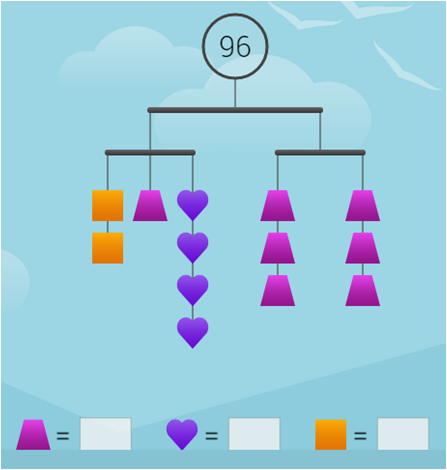
Several months ago, the great folks at EDC released SolveMe Mobiles, a collection of balance puzzles. The idea is pretty simple; you'll probably get the idea from just a couple of screenshot examples.

In many puzzles, some shape values are given and we need to find the ones that are missing so that the arms of the mobile stay in balance:


Sometimes, we are told the total weight of the shapes in the mobile. We then have to find the weights of the shapes so that the arms stay in balance:


Since we were introducing this idea for the first time, we did a simple version together, then gave the kids size more as a warm-up.

the most advanced puzzle we gave them had a side with three descending strings, like this:


We had a nice discussion about what this means: in real life, do all three of the hanging strings have to have the same value or not? What do we think for these puzzles, does it work like real life or not?


Side note: to online or offline?
For our class, we just had print-outs of the puzzles. This worked really well because it was easy for the kids to make notes and helpful drawings on the side of the pictures. The online system has a tool to write notes and draw on the screen, but it is slightly awkward to use on a desktop. Probably it works well on a tablet or smartphone.

Also, we brought out the unifix cubes as manipulatives for several of the kids to work through the puzzles. Of course, nothing would stop someone from doing the same when they are solving puzzles on a computer, but, in practice, I find that the idea just doesn't occur to them in the same way.

With the online version, you have two options that can give additional help. One is an animated test of whether the mobile is in balance. The other options shows numbers at the top of each string that represent the total weight under that position. Each of these makes the puzzle a bit easier by offering a guess-and-check strategy and a nice form of feedback.

Make your own
I always love getting kids to make their own versions of the puzzles. In the class, several of them finished a bit faster and I asked them to make puzzles for me. This feature is also built into the on-line version, which is a nice touch.


Block blobs

Our second activity of the day was Block Blobs. This comes from Beast Academy, though we made some small adjustments to their game.

The basic playing board is graph paper with a central dot. To make each game a manageable length, we split our paper into four sections for four games. Each section is about 20x30:


This was one slight deviation from the BA version: they use a 12x12 board. Each player has their own colored pencil to use as they mark out territory.

On a player's turn, they roll two dice, then they try to draw a rectangle on the board that uses those  two numbers as side lengths. For their first rectangle, they have to put one of the vertices on the center dot. For all subsequent turns, their rectangle must share at least 1 unit common boundary with an existing rectangle, may not overlap any existing rectangle and may not go off the board. The growing collection of linked rectangles forms their Block Blob.

Hmm, can you spot the illegal rectangle?


Two against teacher


Play ends when one player is not able to add the required rectangle to their blob. Then, each player figures out how much area they have covered and the one who covered the most wins. To make this final calculation a bit easier, we had them write the area inside each new rectangle as they added it.


Differences with the BA version
As mentioned above, BA suggests playing on a 12x12 board. We originally thought we would us 2d10 instead, so wanted boards that were at least two times larger in each direction.

Second, we required each player to start their block blob with a vertex on the center dot. The BA version requires this of the first player, but allows the second player to start their blob anywhere on the board. Since we were using larger boards, we wanted to facilitate the issue of competing for territory by having the blobs share a vertex. Another option would be to have each player start their blob in opposite corners of the board. This idea is similar to the game Blokus.

Third, we ended play when one player could not add a required rectangle (they pass their turn). The BA version stops play only when there are 4 passes in a row (two for each player). Though seemingly subtle, this was a major change. In our version, the player who gets squeezed out, either through weak play or bad luck, doesn't get penalized as harshly as in the BA version. This turned out to be very helpful because it meant that ending scores were much closer than expected, so (a) it was actually necessary to total the areas to see who had won and (b) the loser got a pleasant surprise when they saw that they were still very close.

For what it is worth, all credit for this important rule change goes to PK!

Of course, each of the versions can make for a fun game with slightly different strategic considerations.

Wednesday, November 18, 2015

Times square variations (math games classes)

In grades 2 and 3, we have been playing with variations of NCTM's game Times Square, one of their offerings on Calculation Nation. This is one of my favorite multiplication games because, like the puzzle Bojagi, it is fun and multiplication is integral to the game, it isn't just a set of flashcards in disguise.

Here's a basic Times Square board:
The AI doesn't understand edge vs center!
Players take turns moving one of the square windows at the bottom to select two numbers, then get to take possession of the square that is the product of the values the windows are on. In our starting game, the AI moved the first window to 6, I moved the second to 5 and captured 30 (5x6). The AI then moved from 6 to 1 and captured 5 (1x5). On their turn, the player can move either window, but has to capture an open area (you can't duplicate a product you've already captured or take over an area your opponent has previous captured). The first person to get 4 in a row wins.

A pen and paper version
We didn't have (or want) computers for all the kids to play online. Instead, we created a simple paper and pencil version. We made many copies of the board on a piece of paper, with the numbers 1 to 9 at the bottom. We then used small rubber bands (loom band left-overs!) to select the factors and players used colored pencils to claim their territory.

It was an easy, colorful, and fun implementation of the game:


Notice the sad faces where mom/dad won that round?

Noticing the structure
As usual with this kind of activity, there are many possible extensions, with two obvious groups being strategy (how do you win the game) and structure (what do you notice and could change about how the game is set up).

So far, we have been looking at structure. Here are some of the things we discussed relating to the basic board:
  1. What shape is the playing board? How many numbers are on it?
  2. What is the largest number? Why aren't there that number of spaces?
  3. What is the smallest number (positive integer) that isn't on the board? Why?
  4. What numbers are missing from the board?
  5. If we say an integer between 1 and 81, can you tell, without looking, whether it is on the board?
Make it simpler
The next iteration was an exercise in simplifying. Do we need to use all factors 1 to 9? What if we made an easier game with factors 1 to 4? Here is the version we came up with:


Surprise, surprise, we can still make a nicely shaped grid! Now, we aim for 3 in a row, like standard tic-tac-toe, but with a constrain that means we can't always move where we would like. With this simplified version, maybe we can go back to our strategy questions and gain some wisdom that will help for the 1 to 9 version?

Make it more complicated
What if we wanted a harder (calculation) challenge than 1 to 9? Are there other collections of factors that would give us nicely shaped grids? We had them work out creating a grid based on factors 1 to 13.

It was really interesting to see the different strategies that the students took to determining what would go on their boards. Some people tried creating full multiplication tables and then removing duplicates. Other people counted up from one and tested each number as they went along. Some people identified patterns, essentially working with the diagonal and upper half triangle of a multiplication table.

Here's a student, hard at work calculating the 1 to 13 board:


In this case, there are 72 distinct products, so the students also had a choice of making near-square boards that are 8x9 or 9x8. We didn't guide them to these shapes, but it was interesting that no one made a 6x12, 4x18, 3x24, 2x36, or 1x72 shaped board, 

For the 8x9 and 9x8 boards, we had them take some time to play on each version. Does play feel different on the two different boards? Is there a different strategy for the two boards? Perhaps you will also experiment with this.

Further exploration

A sequence
How is the sequence 1, 3, 6, 9, 14, 18, 25, 30, 36, 42, 53, 59, 72, 80, 89, 97, 114, 123, 142, 152... related to this game? These are the numbers of distinct products of the integers 1 to n as n grows. What can we say about this sequence? For example, how quickly does it grow with n? Is there a closed form for the nth term?

Can we see anything interesting if, instead of using integers 1 to n, we use a different collection of n integers? For an easy one, try using the first n primes. Maybe using n integers that are in an arithmetic sequence would be interesting?

This simple pencilcode program could get you started on gathering some data: TimesSquareBoards.

For some light, related reading: Number of Integers with a divisor in a given interval (Ford 2008) which was linked on this Math Stackexchange question.

Strategy and Structure
Ok, so we can take factors 1 to n, then create a board that arranges the distinct products into a rectangle. Because we see primes in the sequence above, we know that some of these rectangles are just 1 x p (or p x 1) shaped.  Even so, what can we say about winning strategies:
  • When does the first player have a winning strategy?
  • When does the second player have a winning strategy?
  • When does optimal play by both players lead to a tie (like classic tic-tac-toe)?
  • Are there n for which differently shaped boards have different winning strategies? Is there an n which has 3 differently shaped boards that cover each of the different strategy outcomes (one that is a first player winner, another that is a second player winner, a third that ends in ties?)
In particular, I think it would make for a delightful bar bet if, say, the first player had a winning strategy for the 8x9 board, while the second player has a winning strategy for the 9 x 8 board!

A picture, just for the heck of it

Having nothing to do with any of this, what estimation and math questions do you have about this picture:

Yes, these are gold, but just covered with gold leaf, not solid!

Monday, October 19, 2015

Damult dice extension

Apologies that it has taken me so long to post. We are on break between terms right now, which actually means I have less time than usual!

We played an extension of damult dice with the third grade class during the last week of classes that was very successful. Here is the quick story:

First, we played a round of the standard game, with a point target of 200. Every student had a chance to roll 3 dice, add two of them, then multiply the result by the third. At one point, on my turn, I had 124 points and the kids had 199 points. We stopped and I asked what they thought would happen. They quickly saw that I had no chance to win.

Next, we drew a card from a playing deck. In this case, it was a 5. Based on that draw, we then played damult dice again, but players are only allowed to count points that are multiples of 5. To soften this additional constraint, we added a fourth dice. In other words, players throw four dice, choose two values to add together, and choose a third value to multiply by that sum. If the result is a multiple of 5, they can add those points to their running total.

For the next game, we chose a different card to determine the multiplication family for that round.

Multiplication families practice

At the basic level, this variation made the game a really good way for the kids to practice their multiplication families. To focus the practice, I had actually doctored the playing cards ahead of time and took out many of the cards (face cards, 10, aces, and 2s).  For other student groups, I might take out the fives or the threes, if they were already very comfortable with those families, or I might include the twos and tens if they needed more work there.

Their observations were great

During play, the students quickly launched into observations and hypotheses about how to make use of their new degree of freedom (the extra dice) to overcome the constraint. For example, they realized that the only multiples of 5 possible are where one of the factors is already a multiple of 5. That means (a+b) * 5, a+b = 5, or a+b = 5. They had different observations when looking for multiples of 6 and again for multiples of 8.

These conversations became a natural step into thinking about the factors of our constraint and, even better, the prime factorization.

Another possible twist

For the class, we chose one multiplication family for each complete play of the game.  In subsequent play at home, we've tested two other versions. In one version, the player starts her turn by drawing a card, then needs to score points that are a multiple of that card's value. This adds a further element of randomness to the game as each player potentially faces different constraints on their turn.

Alternatively, we drew one card to constrain the next two turns. In other words, each player faces the same constraint as the other, but the multiplication family can change between a complete set of turns. 

My recommendation is to be flexible and try the version that suits your players the best. I think the first version is my favorite for encouraging the players to really think about what is required to make a point value that is a multiple of their specific constraint, to make observations and hypotheses.


Thursday, September 3, 2015

math games class catch up

It has been a while since I posted a summary of our math games, so this is just a quick catch up to summarize what we've been doing:

Grade 1

Addition war
2 players
pack of playing cards (A to 10)

Deal out all cards to both players and keep the cards face down in a stack. Each round, both players turn over the top two cards and add their values. The player with the higher sum wins and collects the cards in their points pile.

If there is a tie, those 4 cards are kept to the side as a bonus for the winner of the next battle. Repeat this with ties until there is a winner for one round.

After playing through the original stack, look to see who has collected more cards in their points pile. That person is the winner.

For a more challenging version, use face cards and assign values J = 11, Q = 12, K = 15.

Solo addition bridge
2 - 4 players (we played with 3)
pack of playing cards (A to 10 for beginner game, add face cards for extra challenge)

Deal out 5 cards to all players. They pick up these cards to form their hand. Proceeding clockwise, each player lays down one card from their hand, going twice around the group. Each player adds together the value of the two cards they played. The highest sum wins and collects all the cards played. That is one "trick."

After each trick, deal out 2 cards to each player to refill the hands to 5 cards.

The player who won the last trick is the first to play a card on the new round.

When there aren't sufficient cards to deal equally to all players, deal the hands equally (all players start each round with the same number of cards) and keep the remaining cards as a bonus for the player who takes the last trick.

We played with 3 players and, for the advanced game added 2 jokers to make a deck of 54 cards. Based on popular consensus, the jokers were assigned a value of 1,000,000. Interestingly, the extremely large value meant that the players were reluctant to play their jokers and, twice, both players kept them to the final trick so that the winner was actually decided by the higher of the second card!

Group addition bridge
4 players working as pairs (partners) with the partners sitting opposite each other
pack of playing cards (A to 10 for beginner game, add face cards for extra challenge)

Generically, play is the same as solo addition bridge, but each round the partners each play one card and the team that has the higher sum wins the trick. While there are still reserve cards in the deck, hands get refreshed up to 5 by dealing a single card to each player. The leader for each trick rotates clockwise so that everyone gets a chance to be first (second, third, and last) to play.

Second and Third Grade

Multiplication Blind Man's Bluff
3 players
pack of playing cards using A to 10 (A counts as 11)

One player deals a single card to each of the other players. They hold that card up to their forehead. The dealer announces the product of the two cards. Then, the two players try to figure out the value of the card on their own forehead.

Role of the dealer rotates after each round.

We played this as a cooperative exercise. To make it competitive, you can award points to the first player to get their card value.

There are two ways to make this more difficult. Adding face cards with made up values is one way. Instead, we had the dealer give one player two cards, add those, then multiply that sum by the value of the other card. 

Yet another step is to deal each player two cards, then multiply the two sums.
When playing this version at home, J1 came up with the idea of giving clues to figure out the value of the two individual cards. This was a really interesting activity because it got him to think about what characteristics help specify the two cards and which clues actually don't provide new information.
For example, if I know the sum of my two cards is 11, does it help me to know that I have one odd and one even number?

To make a standardized version, the second round of clues is to tell each player the product of their values. 

Largest Difference/Smallest difference
many players (at most 9 per deck of cards, fewer with advanced versions)
pack of playing cards A to 9

Deal out 4 cards to each player. They then form two 2-digit numbers and subtract the smaller from the larger. The player with the greatest difference wins that round.

For slightly greater challenge, deal out 6 cards (for two 3-digit numbers) or more (forming 4 or 5 digit numbers). Again, the aim is to form two numbers with the same number of digits that have the greatest difference.

For a much more interesting game, we shift the goal: now, we try to find two numbers with the smallest difference (larger minus smaller). After playing a bit, we had some good conversations about what the students noticed, what strategies they used, and whether there was always a unique answer.

Multiplication Pig (variation of addition Pig)
2 dice (we used 2d6)
2-3 players (or more, grouped into teams)

Players start with 200 points and try to work to 0 (or below).

Each turn, the player rolls both dice. If neither is a 1, they multiply the two values and add this to their score for the round. They can either choose to roll again or take their score for the round and subtract that from their cumulative score.

If two 1's are rolled, then  their overall score is set back to 200. If one 1 is rolled, then their score for that round goes to 0 and they lose their turn.

Variations come from varying to characteristics of the game:
- Start with 0 overall points and, each round, add the points for your round to try to break a target (practices addition instead of subtraction in forming the overall target)
- Add the two dice instead of multiplying (shifts the practice to addition instead of multiplication)
- Use dice other than 2d6, possibly more dice or differently shaped dice (note: the overall target and/or penalty conditions might require some adjustment)

Some PIG observations

Dice games are loud games, compared with card games. I think this is because the value of the dice is revealed to everyone at the same time.

Based on expected values, the optimal decision whether to keep rolling to bank the points for that round depends on how many cumulative points you have and your score for that round. However, we observed that the students chose to bank their points very early, relative to an expected value maximizing strategy. I think this is because their experience with the game causes them to over estimate the likelihood of rolling a 1 (or two 1's) and/or to underestimate how many points they can earn on a single roll because of the multiplication.

Wednesday, July 29, 2015

ABCs of logic puzzles

who: J1
when: while on holiday from school

After a long gap, I had a chance to look at Tanya Khovanova's math blog again recently. She has a nice mix of questions/puzzles, some of which are beyond our kids right now while others are perfect. Yesterday, we talked about a pair of problems involving a trio of puzzling characters: Alice, Bob, and Carl.

My hidden number
In the first puzzle, Carl has a secret number and gives out some clues. This puzzle shares characteristics with the (recently) famous Cheryl's Birthday puzzle. In particular:

  1. There is some common information
  2. There is some private information that the characters in the story have, but we don't have
  3. The characters make comments about whether someone else can solve the puzzle
  4. Being told something you already seem to have known (e.g., "You don't know the answer") actually gives the character enough additional information

I like Tanya's puzzle more than CBP because it is more self-contained and also invites us to a bunch of (elementary) number theory observations in addition to working through the logic.

Here are some highlights of the discussion:

  • Realizing that there are some numbers where it is sufficient to see either the 10s or the 1s digit to reconstruct the whole number (given multiple of 7, less than 100, etc)
  • Realizing that there are some numbers where one person could know the answer, but the other doesn't and that it could be either the person with the tens or the ones digit.
  • Thinking about what it meant to Bob when Alice said that he didn't know the number.
  • Identifying related clusters of multiples of 7 (like {14, 84}, {21, 28, 91, 98}) that helps us see some (slightly) more subtle relationships between numbers we don't normally associate

Where's the party
In the prior puzzle, we could trust everything that Alice, Bob, and Carl said as being true. In our second challenge, where's the party, we now confront a problem where there is always something distorted in their comments.

Once again, we felt there were some parallels with some of the scenario's from Smullyan's Alice in Puzzle Land. You have to play with the statements you are given to extract the useful information.

The key issue in our discussion of this puzzle was the process of going back and forth between "true" numbers and numbers spoken by the characters. This led us to talk about functions, like Alice(t) is the number Alice will say when she is talking about true number t and the inverse functions. J1 called the function inverse operator Undo, so Undo(Bob)(Bob(t))=t and Bob(Undo(Bob)(s)) = s.

Suddenly, J1 had so many questions about these new objects, Alice(), Bob(), Carl(), and their Undo relatives:

  • When are they the same, i.e., Alice(t) = Bob(t)?
  • Which one is larger, for a given true number t?
  • Do we ever have Alice(t) = Undo(Alice)(t)?
  • etc, etc

This was an invitation to make some pictures, a simple graph of the three functions. Here is J1's and then the one we made together:


The pictures then gave us some new things to notice. For example:

  • Carl only says the largest number for a bounded region of true numbers
  • For any true number, Carl never says the smallest number

A call for puzzle extensions/mash-ups 
J1 asked something I wouldn't have considered on my own: are these the same Alice, Bob, and Carl in the two puzzles? If so, does something interesting happen if we combine the distortions of the second puzzle with the basic set-up from the first puzzle? What if Alice and Bob don't know Carl's constant?

Please go forth and consider this version, as well as create new ones of your own. If you need further inspiration, consider this mash-up Cheryl's sweets, from the fantastic Aperiodical crew.

Wednesday, July 15, 2015

Some comparisons (two tmwyk transcripts and a puzzle)

who: J1
when: just before bedtime

the value of being alive

J1: Daddy, now I've got a question for you
J0: Ok?
J1: if I get a new book every time I write 20 pages in my journal, how valuable is each page?
J1: The books are about 150 baht
J0: How much?
J1: let me check, I think the price is on the back cover . . . 169 baht
J0: if you could tell me what I need to calculate, I'll calculate for you
J1: hmm, so 20 pages is 169 baht, I want to know how much one page is, so I need to divide by 20.
J0: do you think it will be more or less than 10?
J1: less than 10
J0; Are you sure? How do you know?
J1: Well, 10 * 20 is 200 which is more than 169
J0: what about 5 baht per page? Is it more or less than that?
J1: More, 5* 20 is half of 10*20, so 100, which is less than 169.
....
<we figure out that the amount per page is 8.45 baht/page>
....
J1: That's not very much!
J0: How much did you get for your birthday?
J1: [x] from grandma, [x] from grandpa
J0: well, how much is that per day. Is it more or less than 10?
J1: More than 10
J0: how <interrupted>
J1: how do I know? well . . .10 * 365 is ...
<some discussion of whether he was right, various other estimates of the amount of money per day>
J0: How does that compare with each page of your journal?
J1: More...but what if I include the [present a] and [present b]?
...
<he estimates how much different presents cost, figures the total, estimates how much that is per day, etc>
...
J3 (who has been listening all this time): wow, J1, that's a lot of money!

J3 explores bricks

Earlier in the evening, J3 has been building sticks with 1x1x1 TRIO cubes. She made four, all the same length, then handed two to me as drumsticks. I counted the cubes in one (I got 11) and then she counted one of hers (she got 12). I put them side-by-side and we saw they were the same length.

J3: but...daddy, I really counted 12, you are wrong
J0: are you sure they should have the same number.
J3: yes, let's count them again, together
<I point at the cubes and she counts them, 11>
J3: Ok, now I'm going to build a shape and you see if you can make a copy. It will be tricky!

A birthday puzzle

With their current ages expressed as whole years (you know, the way everyone talks about ages, except for mothers of very small children):

  1. What is a number sentence that relates the ages of J1, J2 and J3? Hint, oldest is 8, middle 5, and youngest 3
  2. Will this ever be true again?
  3. Was it ever true in the past?
  4. When/why not?
  5. What about multiplying? Will it ever be the case that AgeY(J1) = AgeY(J2) * AgeY(J3)?
  6. Was this ever true in the past?
  7. When/why not?
Note that there is a complication since they were not all born on the same day, so the difference in their year ages changes depending on the day of the year we are considering.

J2 wanted to investigate more precisely, so he asked to work things out in months. That meant we had to calculate how many months are between them.

Thursday, July 9, 2015

A magic trick and magical discussion (part 1)

who: J1 and J2
where: in bed
when: just before going to sleep

Another mystery process trick
I found this post Little Math Magic on JD2718's blog. We did something similar at the beginning of the year with calendars (here) and the kids really liked making a choice, doing some calculations that obscure the choice, then seeing if I can figure out their choice, so I expected that they would enjoy this, too. Computationally, it is a bit more challenging for the kids as it involves squaring 2 digit integers.

14 Squared
talking though 14 squared, J2 asking if we could do 10*10 + 4 *4. We talked about why that doesn't work. In fact, J1 raised the example of 11x 11. Since J2 knew that this is 121, they were able to compare with the other "algorithm" and see that 10x10 + 1x1 isn't right.
J1 said that, instead, we could do 10 * 14 + 4 * 14, which J2 then calculated. When he got to 196, he was delighted, since he did recognize that old friend. Also, he mentioned 169 was another familiar square friend: "13 squared, right?"

From 196, we keep the 6 and then square that, getting 36. We keep the 6 again. Finally, we need to multiply this result by our original number, so 14*6. J2 remembered 4*14 was 56 from an earlier calculation, so he just calculated 14x6 = 14x4 + 14x2= 56 + 28 = 84.

At the time, it felt really good to hear them helping each other work through these calculations, especially their thought process checking the possible algorithm for multiplying 2 digit numbers.

Next time
Well, now that they understand the algorithm, we still have to do it as a trick, where they don't tell me their starting number. After that, let's see if they can figure out how it works?

Tuesday, June 16, 2015

Is John a liar? and other good puzzles

who: J1 and J2
what did we use: Smullyan's Alice in Puzzle Land and some online games
when: after dinner

This post is basically a thank-you to all the people who create wonderful books, puzzles, and games. Also, thanks to the people who spread the message by telling us about these resources. In this case, we're directly indebted to A O Fradkin, Annie at the Math Forum, Mike Lawler for these specific activities.

Alice in Puzzle Land

The title of this post comes from one of the opening puzzles in Smullyan's book of logic puzzles: Alice in Puzzle Land. Here's how it goes:
John, and his brother, have the peculiar characteristic that one always tells the truth and the other always lies. Unfortunately, we don't know which one tells the truth and we don't know which one is John. Gosh, we don't even know John's brother's name! What single yes/no question can you ask one of the brothers to figure out which is John? 
What if we want to figure out whether John always tells the truth or always lies, what single yes/no question can we ask one of the brothers to determine this?
To be honest, I didn't get the answer, but J2 managed to figure it out after they posed a bunch of questions and we worked through the possibilities together, example "what if the one we are asking is John and he tells the truth?"

The Js (mostly J1 and J2) have had a lot of fun discussing this particular challenge and have also really enjoyed the tart-ingredient thieves series. They are currently working on the "very complicated logic puzzle" at the end of the first chapter to determine whether the Gryphon or the Mock Turtle was the tart thief.

SolveMe Mobiles

Since we started teaching the math games class at school last year, I have had a strong bias away from on-line games and puzzles. Part of this is simply that we wouldn't be able to use these puzzles in the class, but also because I wanted to help parents see that they don't need any special tools to help their kids have deep mathematical experiences.

Anyway, the SolveMe Mobiles and Game About Squares (below)  helped me recognize and reject this bias!

The mobile puzzles are from EDC, a group with which I am not affiliated, but which I hold in high regard. Each puzzle gives you a balanced mobile that, secretly, codes equations to solve for the weights of the various shapes. J2 (5yrs old) has especially enjoyed this and has just finished puzzle 51:

Even J3 (3yrs old) has gotten something out of this puzzle. She was looking at the screen and we (J0, J1, J2) asked: what do you see, what do you notice, what do you wonder (not all at once.) She talked about shapes, she talked about how many, she asked questions about what different things meant, she tested putting numbers into the blanks.

Game About Squares

Another cool puzzle: Game About Squares. I don't know who to thank for creating this and making it freely available, but it was part of a really nice Notice and Wonder post by Annie which is, itself, great and you should go read it. In the spirit of the game, I'm not really going to tell you much about it, just go play!


Monday, June 8, 2015

Math is all around (proof without words)

Ok, I can't resist writing a little explanation. These are pictures of activities from the last 2 months that never quite made it into blog posts or, if they did, I just like the pictures and wanted to show them again.


A fractal tree made from rummy king tiles (part of our Natural Math/Moebius Noodles Multiplication explorers course):

Another fractal tree:

Is it an alien or a self-similar bug? How many body segments would we need to draw for the next smaller level?

Family Tree fractal:

I think this was a substitution fractal, again, Multiplication Explorers:

Halving sequence, another activity from the Multiplication Explorers course:

This little piece was 1/16536th of the starting square (2-14)

How many animal hybrids can we make?

Many ways to make a whole. How many ...?

Even in the round:

A version of Pascal's triangle made into a puzzle. I think we made all the cells mod 10. Hand cut!


Some pictures we saw at an exhibit in one of the halls at NASA in Houston. We did our own calculations and didn't agree with their claims about how many stamps or how many coins were used.


Finally, a couple of nice magic squares, fraternal twins or identical? I can't take credit for this, but don't remember where I saw it (prob on twitter):

Saturday, May 23, 2015

15 piece tangram (more math from trash)

who: J0 and J2
what did I use: a postcard advertising some property for sale

Note: when I originally wrote this, J2 and J1 were busy doing something else. By the time I had half composed this post, J2 had noticed what I was doing and started playing with the tangrams again. More evidence that the easiest way to get kids into an activity is just to have it out and available or doing it yourself.

15 piece tangram

In Bangkok, we get a lot of junk mail touting property viewings. One postcard was just the right size and durability to use for a 15 piece tangram set. I would encourage you to make and play with your own 15 piece set (or a 7 piece, if you don't already have one).

In fact, you should do what I didn't do this time: work with your kids to cut apart the original square or have them make their own sets by themselves. Even just following the diagram is a geometry experience as well as an exercise in scaling.  Our card was 15cm on a side, the diagram I used gave dimensions based on a 3 inch side.

I was a little concerned about the dissection of the central square because of the circular curves. I traced out the dissection with a ballpoint pen that made a slight indentation in the card, then traced over that outline with the tip of a very sharp knife. It isn't perfect, but I'm very pleased with the result:

The image adds some hints when we want to reform the basic square. Good or bad?

I was, perhaps, remiss in not providing full credit to the tangram book we are using. here it is, in all its Dover Publications glory, Tangrams 330 Puzzles by Ronald C Read.  Looking over my shoulder, J2 said, "the book actually had 334 puzzles." So, boom, 4 free puzzles!

Platonic Solids Defying Gravity I

Unrelated, J2 made a temporary installation of mathematical art today in the kitchen: Gravity Defying Platonic Solids I. Except for the obvious one, he also took the pictures included here:


Friday, May 22, 2015

Tangrams and math at the market

who: J2 and J1
when: all day (sick kids at home)
what did we use: tangrams

A quick-start activity and conversation from our kids' recent home-sick days.

Tangrams

(Note: people like pictures, but I don't like spoilers. I've included some of our tangram pictures at the bottom of this post)

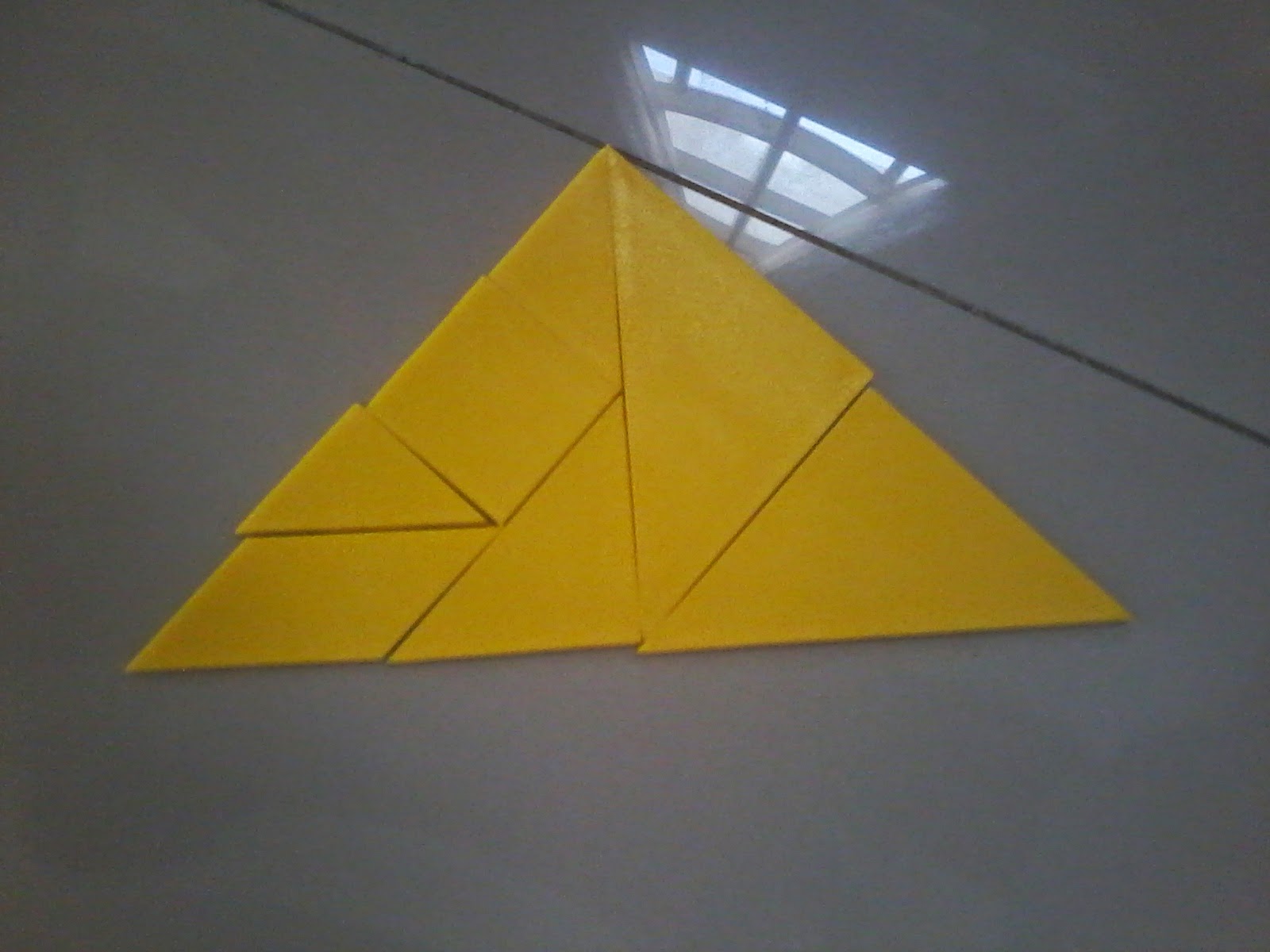
We got a book of tangram puzzles from the grandparents when we were visiting. It was a good catalyst for getting out the nice tangram set that came with our RightStart math kit. While the book gave us some good ideas, the best one was a simple progression we (J2 and I) came up with on our own: make isosceles right triangles with 1, 2, 3, 4, 5, 6, and 7 pieces.

When we did attempt puzzles from the book, we quickly noticed that we never came up with the same solution that the book had. Admittedly, we only did about half a dozen puzzles, but this led to the natural question of how many solutions we could find for our triangle progression. That naturally opens a really interesting discussion about when you should consider two solutions to be the same (rotations, reflections)?

Another path to follow is related to dissections: we had a sense that some solutions are more satisfying than others because they can't be broken into "typical" sub-shapes. Making this idea more precise is difficult, but worth pursuing.

One last path for the triangle progression is to see what solutions are possible simultaneously. There are several ways to specify this, but here is a specific challenge for you:
Let P be a set of positive integers summing to 7. Using the 7 traditional tangram pieces at one time, make isosceles right triangles so that, for each p in P, there is exactly one triangle with p pieces.
Can you find a set P that works?

Math at the market

Someone was nice enough to buy me a bag of passion fruit. For some reason, the price came up: 80 baht for 1 kg (we weighed it, just to confirm). I recalled another market where I had purchased 800 grams for 100 baht. Of course, that leads to instant discussion:

  • Which seller has a cheaper price? How do you know?
  • How much cheaper is one price than the other? What are sensible ways to compare?
  • Why might the prices be different? Different place and time are obvious ones.
  • If the two sellers were next to each other in the market at the same time, would people only buy from the cheaper source? Why/why not? What factors complicate this?
Also, if you were paying attention, you will realize that, yes, this is how I thank someone for giving me a gift: lead them along a mathematical conversation!

Some pictures

Avoid this section if you don't want hints about some tangram configurations.

We thought our approach to making a letter "L" shape was better than the one suggested by the book. Both have an annoying triangle tip poking out. Our version otherwise has a common and consistent width on the two legs which the book didn't have.


Simple rectangle. This is an example of something that comes quickly once you figure out the classic 7-piece square.


One of the members of our triangle family and a cousin of the class square. This gives away solutions for 1, 2, 5, and 7 piece triangles, so sorry about that.

Monday, May 18, 2015

The Miller's Puzzle (a multiplication investigation)

who: J1 and J2
what did we use: good old pencil and paper
when: intermittently through the weekend as they recovered from being ill

Denise Gaskins (of Let's Play Math, you know, one of my top recommendations for parents) included a game from Dudeney's puzzle book: The Canterbury Puzzles. The game is a good one which we will use in an upcoming class, but I won't steal her thunder on that one, so go subscribe to her newsletter and find out for yourself.

I'm always excited to see a new source and had never heard of Dudeney or the book, so I went to look. My suggestion is to skip the introduction and go right to the puzzles. One of the first for our play is the Miller's puzzle. Nine numbered sacks are arranged as below:


You notice that 7x28 = 196, but 34 x 5 is not 196. Can you swap sacks, keeping the 1-2-3-2-1 arrangement, so that the products on both sides are the same number in the middle?

Bonus: those sacks are heavy, so how can you get a solution swapping as few sacks as possible?

Our initial attempts

First, the kids were intrigued and suspicious: is 7x28 really 196 and is 34x5 really not 196?

196 is, of course, an old friend: the square of 14. J2 was really excited to see it appear in this puzzle and the factorization 7 x 28 was a nice complement to his identification of 14 x 14.

Second, their inherent sense of efficiency kicked in and they wanted to see if they could fix the problem by simply changing the three bags on the right side. In itself, that was a good discussion about:

  • What are all of the possibilities?
  • How do we know, without multiplying, that 43x5 and 45x3 won't be 196?
  • What are 43x5, 35 x 4, 53x4, 45x3, 54x3?
  • What parity do we get when multiplying an even and an odd? When checking our answers, we can at least look to see if we got the right parity.
Their third step was to try a couple of other simple products with the numbers 1 to 9. Overall, this part of the play had some good conversation and a lot of multiplication practice.

A way forward

I didn't give solutions, but I did ask some questions to help guide the investigation further:

  1. Where could the 1 go?
  2. Where could the 5 go?
  3. Where could the odd digits go?
Don't just take those questions in turn, think about them, then see if your answers to one question give new insight into the others.

Another Idea

I like to look for calculation short-cuts and encourage you to do the same. That gives rise to another mini-hint: what are the relationships between the following number pairs and how can you use that to simplify your search for a solution:

1&2, 2&4, 3&6, 4&8
1&3, 2&6, 3&9

Also, isn't it sad that this cute sequence isn't a solution: 4 x 54 = 216 = 8 x 27? So close . . .

    Finally, once you have found solutions, you have opened a new can of worms: how many sack moves does it take to go from the Miller's original arrangement to your solution? How can you tell that you've found the solution with the least moves?

    An unrelated picture

    A slightly more related picture