Sunday, July 24, 2016

Beast Academy and Dreambox (reviews)

Conflict of interest statement: I do not have a current or pending financial relationship with Art of Problem Solving, but I have several friends on their board and have had direct contact with several other people there. We purchased and currently own all of the books I review below.

I have no relationship with Dreambox. We tested the program using their free trial and then paid for a 6 month subscription.

Beast Academy

What is it?
Beast Academy (from Art of Problem Solving) is a book series with 10 "guidebooks" and 10 parallel "practice" books targeted to 3rd, 4th, and fifth graders. Note that the first of 4 books for fifth grade has only recently come out and they are planning to extend to 16 x 2 books covering 2nd to 5th. We do not have either 5A or 5B yet.

We have read all 8 books from 3a to 4d; J1 and J2 have gone through practice books 3A - 3C.

While these are not math exercise apps, I'm going to borrow some of the elements I've used in past app reviews. One key point I want to emphasize for both books and apps: the way you use them can also determine their benefits or costs.

TZB3
To drive this point home, let's start with Tracy Zager's Big Three criteria (see here):

1. No time pressure: Neutral since this is really up to you, parents.
Do you set a timer when they start a page of practice or a question? Do you require a certain amount of time spent on math practice? While the books do not suggest or impose a sense of time pressure, there are story segments involving math competitions that imply speed is important.

One time element that is and has always been great about physical books is that they sit around. This means they are available and tempting. Almost every day, there will be someone flipping open one of the BA guidebooks, even J3 for whom the material is too advanced right now.

2. Conceptual basis: yes (pass)
The books introduce models, contexts, and conceptual ways of considering problems and techniques. 

3. How are mistakes handled: again, this depends on you and your kids
My approach is to go through the problems and select ones to discuss. I don't use the answer key, so I do the problems myself. This means we have three categories of questions to discuss (a) answered correctly and I found interesting, (b) answered incorrectly, (c) answered correctly by the kid, but I made a mistake. 

Also, I am very positive in how I talk about mistakes. The key message is that these are actually the best learning opportunities and create a chance for us to understand our own thinking.

Preliminary summary: whether Beast Academy (or any printed material) passes the thresholds depends on how  you plan to use it. If you want to deviate from Tracy's guidelines, either adding time pressure or incentives based on minimizing mistakes, you probably should think carefully about whether that's wise.

The good

For my kids, the stories and themes in the guidebooks hit the right tone. They are engaging and funny, with a humor that is occasionally silly or corny. An extended quote from The Princess Bride certainly wins some extra points as well. More bonus points for becoming, via malapropism, the source of J3's current catch-phrase, "I get it: pointillism!"

For me, the organizing theme of the material seems to be "ideas you encounter when playing with math." In some cases, the exercises create "aha moments," like when J1 realized he didn't always have to calculate side lengths of a polygon to use his knowledge of its perimeter in a challenge. In other cases, like calculating (n+1) x (n-1) there are interesting patterns to notice and connections to make.

I'd note that the workbooks are absolutely essential as there is a lot of material that is introduced in the context of exercises. I think these books are excellent, well selected, well sequenced, with enough repetition to facilitate mastery and enough variation to avoid boredom. In fact, I really enjoy doing the problems myself.

Overall, we find the practice books an especially good source of cues for quick (5-15 minute) math conversations.

The Bad
Any worksheet-based system is weak in generating exploration and deeper investigation. Beast Academy partially addresses this by including open-ended games and an occasional investigation. While nice, this point remains a weakness. I don't want to belabor this point, since it is not a unique problem with Beast Academy. Indeed, I think it is a universal issue with static educational material.

Unfortunately, the only solution I know is to involve a human guide. Fortunately, I am able to play that role, asking their thoughts about interesting problems, helping them form connections with earlier or other material, getting them to follow useful side-branches or to continue more deeply into a particular area.

Eventually, of course, we hope to develop enough mathematical habits of mind that the kids will do these things on their own. Realistically, I don't think that will happen until they are well clear of any elementary age material!

The Ugly
I don't see any fatal flaws in Beast Academy.

Grand Summary
If you can use the material the way we do, I highly recommend Beast Academy.
If you can't or don't feel comfortable engaging as your kids' mathematical guide, these books are probably still one of the best options. Just don't set up a timer and demand perfect answers to all the questions!

Dreambox

Dreambox is a math facts, basic skills system. It has material from pre-school through high school. We have spent a lot of time with the elementary grade material and a little sampling of the high school content.

TZB3
Dreambox was one of Tracy Zager's positive examples in her app post, so we already expected it would pass these three criteria. After spending so much time with the system, though, we've seen that not all activities within DreamBox completely satisfy the checklist:

1. No time pressure
Some activities do include time pressure. For example, there are a family of "games" around multiplication automaticity where a collection of calculations stream across the screen. This really does raise the stress level for kids.

In a slightly different form, there are other activities involving virtual manipulatives that require the student to do something using the minimum number of moves. Like the time pressure, this seems to create confusion where the kids can get something right, but still get it wrong.

2. Conceptual Basis
I mostly concur with Tracy's original assessment. Almost all activities have a conceptual component. The timed calculations mentioned above don't, so those get a double demerit.

3. How errors are handled
Again, mostly agree with Tracy. However, there are some activities where, for a minor mistake, one is required to redo a number of manipulations, rather than fix the earlier work.

The good
The underlying math curriculum here is solid, if basic. The clear strength of this system is the pictorial representation of manipulatives offering models that build number sense, reflect operations, and show place value. In the early years section, where we have been spending most of our time, almost every activity is based around one of the manipulatives.

The other thing Dreambox does well is present a sensible progression for the different activity streams. I think this works especially well for J3 who is going through much of the material for the first time. As she encounters a new formulation, she will study it for a while and then there is a clear moment when she has figured out the new complication.

I'll give two examples. For J3, there is an activity to replicate a number bead pattern and then click the number of beads in the arrangement. Her primary tool is to count the beads one-by-one. In the most recent module, she gets a short view of the arrangement and then it is hidden (it can be revealed again, if you choose). This is forcing her to build new skills, either memorizing the arrangement to mentally count or a more advanced counting technique.

For J2, one of the place value exercises involves grouping items into pallets (1000s), cases (100s), boxes (10s) or loose items (1s). The current module asks him to consider multiple different ways to pack a given number. For example, 1385 items could be packed in 1 pallet, 3 cases, 8 boxes, and 5 loose items, or 13 cases and 85 loose items (among many other options).

One other strength of DreamBox is the email feedback to parents. Christopher Danielson recently noted this in a post: Parent Letters.


The Bad
I have seen three areas of weakness with Dreambox: the way mathematical tasks are presented, the pace of adaptive adjustment, and the absence of rich tasks. I'll talk about each of these in turn.

The theme gives an irritating appearance of choice. For example, in the early elementary section, the kids can play with dinosaurs, pirates, pixies, or animals. Under each of these, they have a further choice about what story to explore. Those choices, at least, lead them to different narratives and animated sequences.

At that point, all of the stories involve finding missing items. Users then see another choice asking where in 6 map regions they want to look for the missing items, but this isn't really a choice as there are no differences between regions and they will have to go through each region eventually.

Similar to Prodigy Game, the math tasks are presented as an annoyance to be overcome, the cost the student has to pay to move on with the story. Again, I find this creates unfortunate subtext to the mathematical experience.

Second, the adaptive adjustment is very slow, if it actually exists. In their FAQ, I see that they get questions about how to increase the challenge level, so this seems to be a common experience. Part of the problem is that they intentionally start students with material below their grade level.

Finally, the tasks in Dreambox are basic. While they may present a challenge for a new learner, as J3 is experiencing, they should eventually become so easy that they are boring. In some way, this feels like learning to solve math class tasks without having to develop or use any mathematical habits of mind.  Further, the thrill and fun of playing Dreambox lies in unlocking the animated stories and collecting tokens, not in doing math.

For J1 and J2, this thrill has worn off after about 2 months with the system.

The ugly
Nothing in Dreambox is a show-stopper.

Summary
Properly understood as a basic curriculum substitute or source of practice exercises, Dreambox is a solid application. Just don't make the mistake of thinking it will either foster a love of math nor deeper mental habits.

*Update* A quick comparison with ST Math
I was sitting on this review, partially written, for a long time. One thing that got me to finalize the review was going through the demo challenges on ST Math with J2. We had previously tested ST Math many years ago with J1 and it was really good. Once again, this is what I saw with J2: really cleverly presented scenarios that gave us good models for the math and a really fun user experience. After playing for about 30 minutes, J2 said: "this is a lot more fun than DreamBox."

If I can get a subscription, we'll test it more extensively and write a review to see whether that really holds up.

Wimbledon game

We have been playing the game Wimbledon from John Golden. J1 and J2 absolutely love the game and J3 has enjoyed pretending to play as well. Definitely try it out!

Below is a session report sharing some of our experiences with the game, including some alternative rules (aka mis-reading).

Our basic play
For the serve, we allow the following options:
(1) serve a single card from the top of the deck
(2) serve one or two cards from your own hand

We also allow returns that have the same value, if the largest card in the combination is higher. For example, 8 + 2 can be played on top of 7 + 3.

When playing doubles, we followed tennis conventions: one player serves the whole game, return of serve alternates. For the return of serve, the designated player must return on their own. For other returns, either of the partners alone or in combination can play cards for a return.

Having gone back to John's original post, I now see that we played with the inverse rules for aces. On the serve, we counted them as 11, all other times 1. We didn't distinguish between aces played from the hand or served from the deck, those were all 11s. That formed a strong advantage for the servers, while making aces essentially worthless for all other players.

With three players, I had the kids play as partners and I played with a ghost partner. The ghost partner would contribute cards randomly. When the ghost played cards that weren't large enough to be legal plays, we considered that an unforced error and awarded the point to the other team. While the ghost was able to hold serve for one game, it was a big disadvantage. An alternative for three players would be to have the ghost partner with the server and for everyone to take turns serving. This would put the server advantage (with our "house rules" for aces) against the ghost disadvantage.

A modification
In our play, we have found that the 10 value cards and aces (on serve) dominate game play. Here are two ideas to address that:

  • Assign face cards values 11 for Jack, 12 for Queen, and 13 for King. Ace, on serve, can have a value 14.
  • Allow players to combine as many cards as they like. This would probably work best with our "Further extension" rules below. A possible sub-variant is to only allow gradual escalation where the players can step from single card plays to 2 card plays, from 2 to 3, etc, but could not jump from a single card play to a 3 (or more) card play.

My instinct is that the variation we will like the most is to differentiate the face cards and allow gradual escalation for multi-card plays.

Further extension
Now that we've gotten comfortable with the basic and doubles games, we are considering a more complex version. The idea we are considering is to somehow limit the players' abilities to refresh their hands by redrawing so that burning a lot of cards will have a cost.

This is the rule modification, written for a 2 person game:

  1. Create a draw pile for each player with 15 cards.
  2. At the start of the game, each player draws 5 cards into their hand.
  3. Points are played as in the normal rules
  4. At the end of a point, the players refresh their hand up to 5 cards from their draw pile
  5. If a player runs out of cards in their draw pile, they cannot draw additional cards to refresh their hand.
  6. If both players run out of cards in their draw pile, then shuffle the pile of face-up played cards and give each player a new draw pile with 10 cards.
  7. Repeat step 6 as often as needed
The idea of this variation is to thematically mimic the idea that one player could push too hard, too fast, and get tired out relative to the other player. Strategically, our idea is that this will also create a tension between dumping your own low cards and letting the opponent dump.

Friday, July 8, 2016

Humbling Improv

Last night, I was part of an improv comedy show. Probably my first time performing on stage for ... at least 25 years.

How did I do? A lot of room for improvement. Not at all a surprise, but what really sticks with me is that the mistakes I made were in the absolute basics of improv:

  1. Listen to the other players
  2. Accept
  3. Who where what
Messing these up is common for beginning players and comes from a desperation to get laughs. I thought I was immune. I didn't think I was desperate. Heck, I didn't even care about the audience reaction.

But still, I made those mistakes and played badly. The experience was an interesting opportunity for better self-understanding and a vivid reminder to focus on the basics.

It was a great chance to fail and learn.

Wednesday, July 6, 2016

Am I dreaming?

Three Js playing cards together. Kid-initiated, kid-managed, no parents involved in any role:


Then, the game devolves a bit, based on excitement about a new set of library books that mommy has gotten:


Monday, July 4, 2016

Evens/odds and a quick update

Early years math seems to put a strange emphasis on even and odd numbers. Recently, a friend asked whether there was a point to this. Maybe it is just one of those little bits of terminology that we are asked to memorize for no reason?

By chance, this was something I had started considering about a month ago. It did seem strange that we spend so much time on this simple way of splitting integers. I wondered if it was worth the attention. From that point, my awareness was raised and I started noticing where it occurs and ways it links with more advanced concepts and future learning. My conclusion is that even/odd is surprisingly deep.

First, it is a simple version of concepts that will be developed further. For example, the alternating (starting with 0) even, odd, even,odd, even... is an illustration of a pattern. They will soon see other alternating patterns, then more complicated patterns and 2d or 3d patterns.

For another example, evens are multiples of 2, odds are numbers with a non-zero remainder when dividing by 2. This leads to understanding other multiple families, division, and division with remainder.

Second, the even/odd distinction is helpful for improved understanding of different calculations. For example, the observations that even+even = even, while odd + odd = even, etc. These can be used to help self-check their calculation and also will form early experiences with algebra. Similarly,
even x odd vs odd x odd reinforce understanding of multiplication. Again, this gets broadened for multiples of 3, 4, 5, etc.

Third, there are a lot of more advanced results that are easiest to prove by parity arguments. Sometimes we are working with a set of things that are even and the key observation is we can pair them up. Other times, we have a set that is odd and the key insight is that, when we pair them, one must be left over.

Recently, with the J1 and J2, we were looking at some constrained ways to put the numbers 1 to 25 on a 5x5 checkerboard. They were able to prove that some versions were impossible simply because 25 is odd, so there are more odd integers in 1 to 25 than even integers.

Lastly, there are techniques in computer science that involve even vs odd. This comes up pretty naturally because of the essential use of binary.

Some games

Recently, J1 and J2 have gotten hooked on some classic card games. In particular, we've been playing a lot of 3-handed cribbage. It is a nice way to do some simple addition practice and build intuition about probability. Probability is now getting even more share of mind: in the last couple of days we started playing poker together. This was actually inspired by some of our reading together.

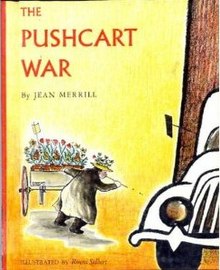
We are reading the Pushcart War.


In one scene, there is a poker game. Of course, the J's insisted that I explain the game and were eager to try it out. J3 was the huge winner tonight, while I busted out. Oh well.

Monday, June 20, 2016

Secret Numbers (Addition Boomerang variants)

We have been enjoying Mathpickle activities in our math games classes recently. This week, the 3rd and 4th graders will be playing with some of the more advanced Addition Boomerang variations.

During our planning, we came up with one extra pointer to tie the activity more closely with multiplication. Also, we had ideas for variations and wanted to record our notes so we can use them again in the future.

Tie with multiplication

In Gord's video explanation, he sometimes records in the center of each loop how many times that loop has been used. We emphasize this and write some related equations to help draw out the connection between the repeated additions in this activity and multiplication.

The first way we do this is by making tally marks inside the loop every time that branch is chosen. At any time, you can pause and write down an equation for the current total in a form
AxN + BxM = Total

where A and B are the values of the loops, N and M are the number of times each loop has been used.

Alternatively, we can show a "completed" round of throws by simply writing the number of passes for each loop in the middle and, again, write out an equation showing the total as the sum of two products.

Secret Number Variations

We start with a basic addition boomerang lay-out, either with 2 or 4 branches, both players (or teams) share a common set of addends and take turns adding on to a common running total. In our variants, the players choose and write down a secret number that helps inform their target for the game:

  • Version A: players pick a number between 70 and 100. This is their target for the game and they win if the common total hits that value, whether the target is reached on their turn or their opponents turn.
  • Version B: players pick a number larger than 15. They win if the total hits a multiple of their secret number. For example, if they choose 17 and the running total hits 51 (aka 17 x 3) then they would win. If the total is a multiple of both secret numbers, then the player who chose the larger secret number wins.
  • Version C: players pick any number. They win if the total hits a multiple of their secret number that is larger than 60 (not equal to 60). If the total is a multiple of both secret numbers, then the player who chose the larger secret number wins.

Version B is, I think, the most directly playable.

Possible issues
I'm not sure how to deal with the case where both players choose the same secret number.

For Version A, it will be interesting to see what modification kids can find that will deal with the fact that it is very easy to miss any particular target. In the basic game, once the total is larger than your target, there is no hope of recovery. There are several ways to address this. I would be eager to hear any rule sets that kids create and hear about the experiences.

In Version C, I wonder if choosing 2 as the secret number is too strong a move?

Monday, June 6, 2016

Broken Ruler and Multiplication refresh

Ruler Explorations

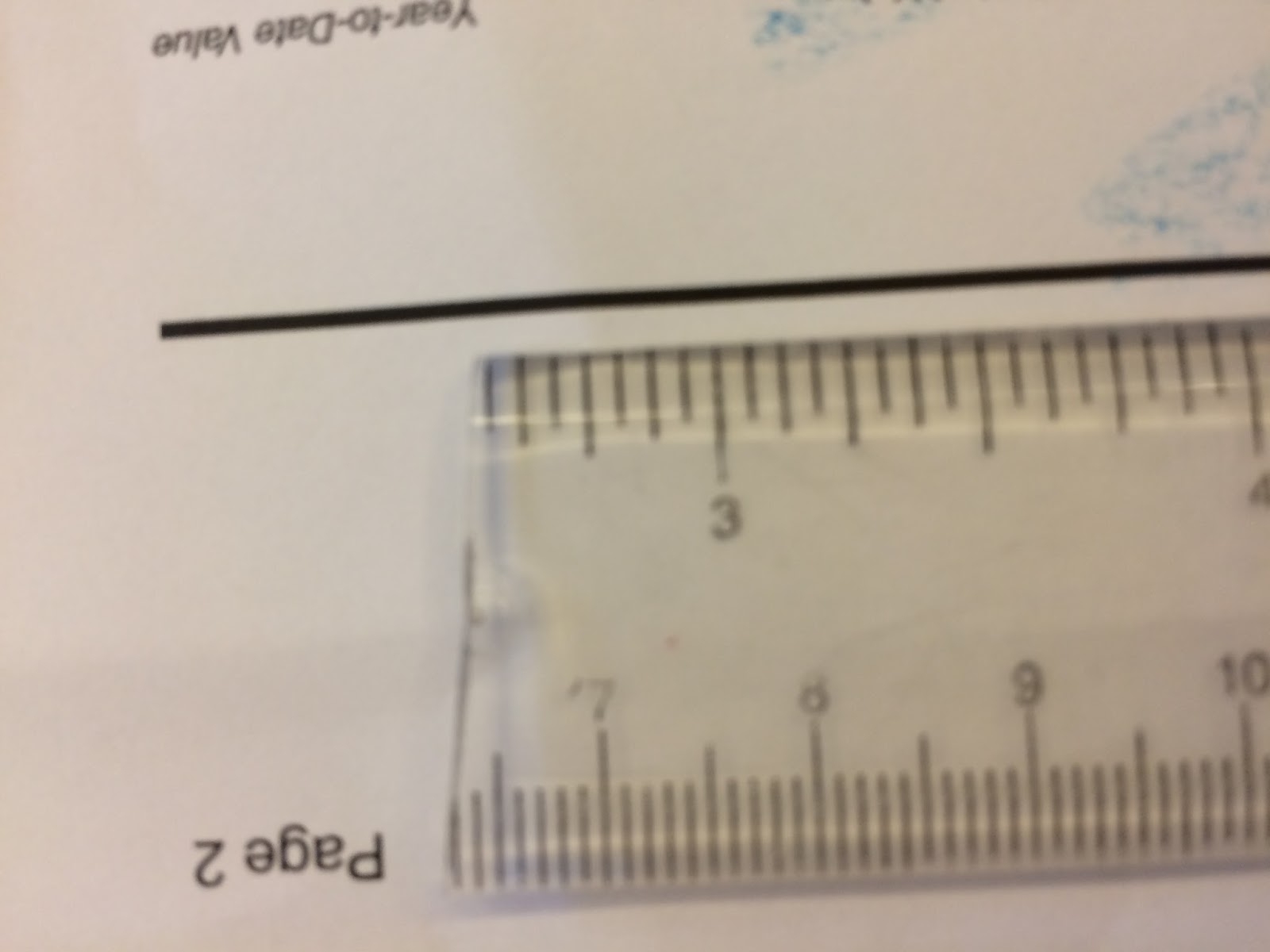
We noticed that one of our tools, a ruler, had gotten broken.

Is it still useful? As a challenge, J2 looked at measuring a noodle from his soup.


There were two ideas:
  1. the noodles were too long, so had to be broken in pieces to measure with the remaining ruler
  2. Our ruler doesn't have to start at 0, we can use subtraction!
While we were talking about this, I recalled the idea of Golomb Rulers. We came up with a ruler that was marked only with 0, 1, 3, 7, 11, 12 cm. This lets us measure 1, 2, 3, 4, 5, 6, 7, 8, 9, 10, 11, and 12cm distances.

What if this ruler gets broken? For example, we imagined cutting our ruler between the 1cm and 3cm markings. What measurements are still possible? Is there anything interesting in the relationships between how many ways there were to measure a distance before the break and how many ways to measure after?

Multiplication Refresh

We recently re-watched Graham Fletcher's Progression of Multiplication. Both J1 and J2 did some practice around this. The most interesting point was J2's reaction to Graham's comment at 4:54: "This sucks!"

"Why did kid's say that?"  "Hmm, let's try out a couple of examples..."

We rolled dice to randomly generate digits for an example and were lucky to get 35 x 34. J2 quickly saw this as 35 x 35 - 35 and knows a pattern that let him quickly calculate 35 x 35 = 1225. As a result, 35 x 34 was pretty easy for him to calculate.

Then, he worked through a graphical representation and a powers-of-ten version. At the end, we got to compare and contrast the different approaches.


Continuing to play with some old activities

Fold-and-punch
We did some more fold-and-punch activities. This time, we folded the paper, then drew a location for the punch, and tried to figure out how many holes would result and where they would be. We broke out our serious hole-puncher:
Unfortunately, must be operated by an adult
In this example, we got a small surprise that the result wasn't a power of 2:


Chairs (and tables)
Another round of building chairs, following the NRICH activity. This time, with J3:


We got to compare and contrast our designs:

  • how many cubes were used for the legs? Which one had more and how many more?
  • How many cubes were used for the whole chair? How did they compare?