Sunday, March 2, 2025

Mathish-ish

 Read Jo Boaler's Math-ish and thought it would be useful to pull out the valuable points and provide an overview of the rest.

Encourage Metacognition Through Eight Mathematical Strategies

This is from page 39-45. I'd note that this set of ideas is somewhat typical for the book: though described as methods to encourage "metacognition," these are closer to problem solving strategies.

This list is populated with ideas that will be familiar from other standard sources, like Polya's How to Solve It or Cuoco's Mathematical Habits of Mind. Nonetheless, these are still solid cues for a teacher/tutor to either help with the problem solving process (1, 2, 3, 5, 8) or to move beyond simply finding a right answer (3, 4, 6, 7.)
  1. Take a step back
  2. Draw the problem
  3. Find a new approach
  4. Reflect on "why?"
  5. Simplify
  6. Conjecture
  7. Become a skeptic
  8. Try a smaller case

Reflection cues

From page 48, a quasi-infographic with seven cues that are actually directed toward metacognition. 
  1. What mathematical concepts did you learn today?
  2. How is the idea you learned today related to others you have learned?
  3. What opportunities did you get to struggle? How did that feel?
  4. How could you use the mathematical concept in your life?
  5. What different strategies or approaches to the problem were helpful to you?
  6. Are there areas that you do not understand and would like more opportunities to learn?
  7. Can you write your own problem for someone else to try to solve?
Boaler suggests asking students to answer one of these questions, of their choice, in place of standard homework problems. From my personal experience, it takes consistent effort to get students to take these reflection questions seriously.

Group work

Initially, I noted two blocks in this section (pages 52 and 53): a set of 5 roles during group work and 8 "mathematical ways of working." On returning to this discussion, I was more struck by the things that Boaler does not cover related to group work. In particular:
  1. The critical importance of finding activities that truly require group engagement and cooperation.
  2. The typical level of frustration that most students associate with their prior group work experiences.
For example, of the 8 "participation quiz" behaviors, only two of them somewhat depend on the group (underlined and bold):
  • Recognizing and describing patterns
  • Justifying thinking using multiple representations
  • Making connections between different approaches and representations
  • Using words, arrows, numbers, and color coding to communicate ideas clearly
  • Explaining ideas clearly to team members and the teacher
  • Asking questions to understand the thinking of other team members
  • Asking questions that push the group to go deeper
  • Organizing a presentation so that people outside [the group] can understand your [group's] thinking

Struggly

Boaler advertises a website, Struggly, that seemed worth investigating. It maybe hard to get a full sense from the demo activities, but I didn't see anything either bad or special here. If other people have used it, please let me know what is unique about Struggly (in comparison with ST Math, for example.)

Integrating math history

Boaler cites (page 86) several aspects in the history of Fermat's Last Theorem and Andrew Wiles' proof:
  1. The vast amount of valuable ideas that emerged in the course of attempts to prove FLT
  2. The fact that Wiles' initially announced proof had a gap
  3. The way that professional mathematicians persistent through their work over extended periods of time
Personally, I do find it tempting to incorporate biographical and historical information in math classes, but I don't think I have found a way to do this that fully resonates with students or has the effect that I want.

What matters in pre-college mathematics

I'm on board with the idea that only a small number of key concepts from pre-college mathematics are really critical for students and a sharp distillation is helpful. Starting on page 95, Boaler identifies three candidates. For what it is worth, the source is David Coleman, the CEO of the College Board. In general, the College Board doesn't seem a force for good in education, but these three candidates seem plausible.

Number sense/arithmetic

An ability to calculate with basic arithmetic operations, an understanding of fractions, and a sense of estimation. Here is where Boaler really hits her "ish" concept, an acknowledgement that almost all real-world incarnations of mathematical concepts are approximate, rather than exact.  I would prefer to broaden this a bit and say that strong number sense should include an ability to switch between the approximate and precise and a recognition of the differences between them.

Data literacy/Data analysis and problem-solving

In this section, Boaler rehashes the (now) obvious point that data is abundant and students/citizens should have some facility to interpret and analyze data.  Some nice visualizations are included:
  • Stephen Curry's 2015-2016 shot performance (page 124)
  • NCAA Women's Soccer PSxG for penalty shots (page 125
  • Examples from dear-data.com
  • Student data representation from the student's life (page 127)
The youcubed data science course: https://hsdatascience.youcubed.org/curriculum/
I will try to find time to review that specifically.

Linear Equations

This section does not really justify why linear equations have a distinguished place in the top 3 concepts.  I may return to this to back-fill potential reasons, but most of what is cited (pages 129-131) is spurious, rather than real linear relationships.

Fractions

Visual representations of 1 ÷ (2/3):
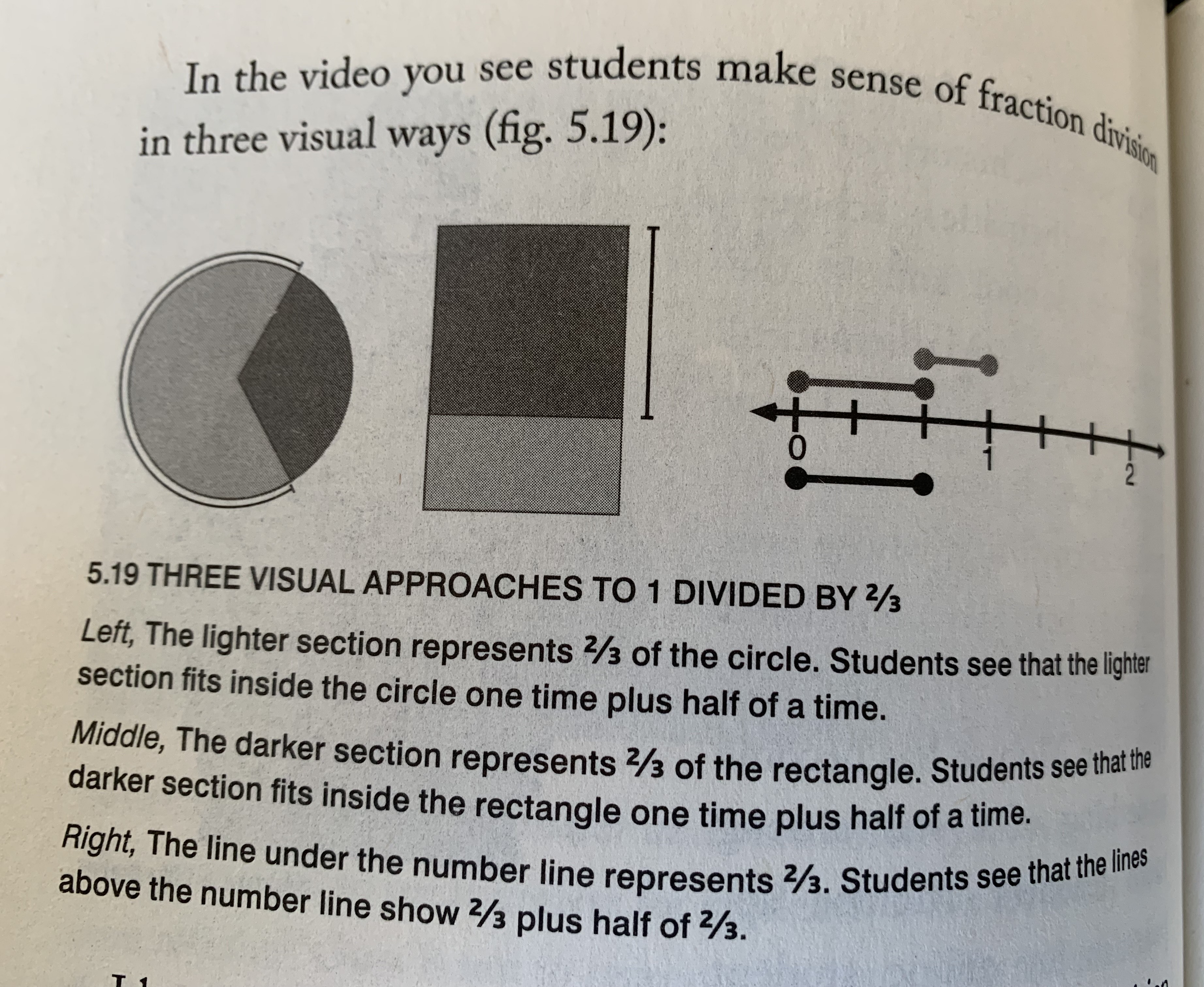
In several parts of Math-ish, Boaler emphasizes the importance of understanding fractions, in contrast to a rote/algorithmic approach to calculating with them.  I think these visual representations are the best thing she offers as a step toward ways of understanding.

Sunday, July 3, 2022

Korean Air (according to google translate)

A survey request from our recent flight:

대한항공과 함께 즐겁고 편안한 여행 하셨는지요?

고객님의 소중한 의견을 듣고자 설문조사를 실시하고 있습니다. 잠시만 시간을 내주시면 감사하겠습니다.

We hope you had a pleasant trip with Korean Air.

Please answer this short survey to share your valuable feedback with us.

邀请您参与简短的问卷调查,与我们分享您的宝贵意见。

サービス品質向上のためのアンケート調査を行っております。ご協力お願い申し上げます。


The Korean text (according to google translate, my emphasis added):

Did you have a pleasant and comfortable trip with Korean Air?

We are conducting a survey to hear your valuable opinions. Thank you for taking a moment.

The Chinese text (atgt,mea):

You are invited to participate in a short survey to share your valuable opinions with us.

The Japanese text (atgt,mea):

We are conducting a questionnaire survey to improve service quality. Thank you for your cooperation.

Perfect numbers: Lichtman's Theorem (Part 1)

This summer, we are working through Jared Lichtman's recent proof that the primes achieve the maximal Erdős sum over primitive subsets of the natural numbers.

Quanta Magazine had a very nice article describing the theorem (formerly a conjecture of Erdős) which is the inspiration for this project. The article is here.

I will be posting notes on our conversations. The most important thing to understand: this project is about the journey and not the destination. We may not (probably won't!) get all the way through the paper. Along the way, we will take plenty of detours and excursions.

Wednesday, August 11, 2021

Possibilites for G4G

  1. misère version of go problems
  2. slinky tangles (more seriously, links with secondary structure for alpha-helix protein folding) 
  3. caesar cipher rotations: inspired by this which was probably mentioned on ACX or DSL
  4. Chebyshev machines with mindstorms
  5. multi focus version of ellipse (constant string length)

Monday, December 28, 2020

Queen's Gambit comments

Putting this here for no particular reason.

Queen's Gambit: B+/B. Entertaining, with some issues.


1. 

The ending was too perfect, but we knew something like that would happen from nearly the first scene (as soon as we knew Borgov's name). I wonder if it would have been better with a slight twist: if the final game had been a legitimate draw. Probably the general audience doesn't know this, but it is (now) very common for top level chess matches to end with a draw.  I'm not sure how common that was in the 60s.


To support that result, they probably would have had to lay a bunch of groundwork earlier.  maybe a game with Shaibel that ends with a drawn position and he has to explain why it isn't worth continuing to play? As it is presented in the show, a draw is just a trick, when one player thinks they have lost, but they think the other player doesn't see how to win, then they offer a draw as a psychological play on the lack of confidence.


2.

They did, eventually, address all my major issues (drugs, genius). Also, the way they set up the team support was well done.  First, they show us that the soviet players are collaborating.  The audience  probably thinks that's cheating, but it serves to legitimize the support from the US players (which, as depicted, is pretty implausible, since it involves exactly the 6 serious male players who have appeared more than once).  Then, during play, Borgov deviates from the ideas the team had considered, so we see that Beth actually does win "on her own."


3.

By coincidence, I just read The Big Bounce, a novel from the 60s.  One theme of that book was "women are bored and unsatisfied with life, have to turn to substances or craziness to occupy themselves." It is very condescending.  Unfortunately, there were also echoes of that in TQG: Beth herself, the society girl from high school, Beth's bio and adoptive mothers, Cleo.  Jolene and Packer(? the woman from the first chess tournament) are exceptions, but they don't get much screen time in those roles.


Perhaps would have been nice to see more of her bio mother. I didn't really understand what was going on with her, so maybe she was trapped. Didn't seem that there was anyone trapping Alma, the adoptive mother. There were nods to the idea of some generalized social pressure (the first Life interview, the society club high school student, the two women getting paired in the first tournament), but it was all pretty diffuse.  For example, we didn't ever see any US Chess Federation opposition to Beth playing in the open division for the US championship.


4.

Other misc thoughts: 

(1) Beth's affection for Townes doesn't really ring true.  Fine that she had a crush on him for a while, but I didn't buy that it was a deep love simmering for years and years. 


(2) I didn't understand the lack of consistency in the post-sex scenes between Beltik and Benny. In the first, Beth is shown to be cold because she is immediately thinking about chess, but, in the second, she is shown not comprehending that Benny would immediately think of chess afterwards.  


(3) Cleo says (and Beth seems to agree) that Benny is only in love with himself. While we definitely see that he thinks highly of himself, he has clearly gone out of his way to help Beth, for no discernible benefit to himself.


(4) The Cleo sabotage evening had several things that didn't sit well.  First, Cleo knows that Beth has a big day ahead and completely undermines her. It was such an extreme degree that I almost thought there would be a reveal of Cleo getting paid off by the Russians or some other group opposed to Beth. Second, it shows Beth waking up in the bath. Could that possibly be a thing? If she were so unaware that she wouldn't notice the discomfort, wouldn't she drown?

Saturday, May 16, 2020

Chinese and Weiqi (go) videos

A collection of videos for studying go and chinese together, for J1:

— Beginning level tutorial, this series is made almost 20 years ago, classic but outdated (https://www.bilibili.com/video/BV1ZW411h7Mf?from=search&seid=14516269619931393154)

— Beginning to mid-level life-death problems ( https://www.bilibili.com/video/BV1Rx411Y79F?p=1)

— Bad moves analysis (in Chinese literally translate to ‘smelly’ or ‘stinky’ moves) (https://www.bilibili.com/video/BV1cJ411w7bz?p=1)

 — Ancient complicated life-death problems from the 1700s, some are doable, some are so massive and even challenging for pros (https://www.bilibili.com/video/BV17x411x7hL?p=1)


  Ke Jie’s 15 best games voted by fans https://www.bilibili.com/video/BV1BW41177kC?p=1

— Pro game, commented by Ke Jie (https://www.bilibili.com/video/BV1kJ411x7bZ?p=1)

— AlphaGo VS AlphaGo 50 games (https://www.bilibili.com/video/BV1ob411e7DN?p=1)


— CCTV (China Central Televison) ‘s documentary about weiqi (https://www.bilibili.com/video/BV1s4411B7Np?from=search&seid=2724260708536054014)


Tuesday, February 11, 2020

What is 8?

I've had a chance to spend more time doing math with the kids again and am hoping to write up our activities more consistently.  Let's see how this works out!

Graham Fletcher created a set of  Progressions videos for various elementary school themes. J3 and I recently went back to his page and found he had a new(er than we knew) progression on early number and counting.  Even for this simple topic, the video highlights some points we hadn't considered explicitly, for example distinguishing producers (of a number) and counters. Also, the cardinality point that smaller natural numbers are nested within larger numbers wasn't something we had talked about, but we soon realized it was part of many examples in how we understand numbers.

With that as inspiration, J3 and I decided to search for a range of examples of a single number, we chose 8, in different forms.  There is at least one obvious version we're missing.

Add a comment (with picture, if you can) to show other forms of the number 8!

Marking 8 on the 100 board, an easy place to start:


8 beads on the abacus shows the relationships 3+5 = 8 and 10-2 = 8 (also 100- 92 = 8)

8 can hide in plain sight. Without labeling the three lengths, it would have been hard to recognize the longer one as 8 cm and, for you at home, impossible to know without reference to show the scale.


It happened that, within the precision of our scale, two chocolate wrapped chocolate bars were 8 oz (2x3.5 oz of chocolate + about half an ounce of wrapping for each):

8 cups of water ended up being a lot, so this version unintentionally revealed a relationship 4 + 2 + 2 = 8

Though I'm not sure I can articulate why or show supporting research, I feel it is very valuable to build experience with physical models of numbers to create familiarity and intuition about what they are/mean. In particular, I hope this helped J3 anchor the importance of units of measure and scale in the interpretation of numbers.

Finally, this construction has nothing to do with the number 8 (or does it???)

Thursday, May 30, 2019

Quick 2019 resources for parents

A quick list of resources for an elementary school parent


Resources depending on prep time:
  • Grab-and-go

  • More prep time, in increasing order of advanced time required
    • http://mathpickle.com/: the puzzles and games are very good. 
    • Math Teachers at Play blog carnivals: https://denisegaskins.com/mtap/.  Variable amounts of prep time, but usually there’s at least one activity that is ripe for exploration, may take a bit of reading through the carnival to find a suitable one.
    • Mike's Lawler's blog: wonderful collection of (mostly) videos of his family working through problems, puzzles and mathematical explorations. Because his kids are older, it will take a little time to find something you think is suited for your son and then a bit to organize the activity.
    • Georgia State math standards: Despite the name "standards," these documents have a full curriculum with a collection of really great activities. As with any full curriculum, not everything is a complete winner, but there are enough gems. Also, this is probably the best resource for finding material to complement a kid's weaknesses.
This page is still the most comprehensive list of our favorite resources: http://3jlearneng.blogspot.com/p/favorite-educational-resources.html
Unfortunately, it is a little dated as I haven’t really been maintaining this blog in the last 2 years.

Friday, August 3, 2018

A context investigation

Note: I drafted this a while ago and never finalized the post. Reading it again, it seems fine and maybe interesting without additional work, so I'm publishing it.

Fake Math Models


Robert Kaplinsky wrote a note recently discussing fake math models and unnecessary context. This prompted an activity with the kids.

This issue seems to have come up a lot recently, so I've noticed a pattern: I really hate bad contexts.

Robert wrote: "it looks like the context is completely unnecessary to do all of the problems."
I would go farther: this context is harmful. The context creates a conflict between the specific new material (rational vs irrational numbers) and other important concepts (measurement and measurement error). Subtly, we are discouraging students from
(a) forming connections across topics. For my taste, surprising connections has to be one of the most beautiful and delightful aspects of math.
(b) using all of their ideas and creativity to understand a challenge.
(c) putting new mathematical ideas into a broader mathematical context (maybe I'm just repeating point a?)

I admit that the example only touches on these points lightly, but I suspect the accumulated weight over the course of a school math education is substantial.

If I were full-time in a classroom with a textbook, I'd be tempted to use it as follows:
1. create censored versions of all problems and examples (as you did)
2. work through the questions with the kids
3. Ask them what context they think the publishers originally included and why
4. show the published version
5. discuss (does the published version relate to the math, does it help them understand, does it add confusion, does it conflict with something they know, etc)

Tuesday, July 24, 2018

Playful Math Education Carnival #119

Welcome to Playful Math Education Carnival #119! Just to be clear, that exclamation is to express excitement, not factorial. Fortunately, you will have a bit of time before there's any danger of confusing this post with the edition (119 factorial).

Anyway, only the very coolest folks get to handle a MTaP edition that can be written with a factorial. And I just realized how close (and yet how far) I was to such glory.

119 Fun facts

  • 119 is the number to call for emergency services... in parts of Asia (wiki reference).
  • Of course, 119 backwards is 911 which is the US emergency services phone number
  • 119 is aspiring, the sequence formed by summing proper factors ends with a perfect number.
  • 119 isn't prime, but it almost feels like it
  • 119 = 7 x 17. I don't think products of consecutive primes ending in 7 has a name, but maybe it should?
Do you have other fun facts about 119? Please? Please?


Dedication

I'm saddened to note the passing of  Alexander Bogomolny this month, and I dedicate the edition of the  carnival to him. The material he developed and made available on his site
https://www.cut-the-knot.org/ is truly amazing and remains with us for our benefit.


Miscellaneous

Aperiodical has an article from Benjamin Leis on the Big Internet Math-off.
Something James Propp wrote as part of the Big Internet Math-off: A pair of shorts


Elementary

I was reminded of the game of Chomp! in Shecky Riemann's linkfest (most of which isn't elementary level, but worth investigating).

Cathy O'Neil tells her mathematician origin story. I hope all our kids can have an empowering math experience like this.

Discussion of a "square dancing" puzzle from Mike Lawler: part 1 and part 2. I think there is a lot more to explore here and hope some of you will write parts 3 and beyond... 

I always love game discussions. Set is a game you probably all know, but in case you don't here's an intro and a deeper analysis in the Aperiodical.


Pat Ballew writes about divisibility rules. Pat also discusses a fun XKCD in prime time fun.
I'm delighted at how this starts with something many take for granted (12 hour vs 24 hour time of day conventions) and then builds a fun exploration.


Middle school

Have you been waiting for someone to write the perfect post giving you an introduction to tons of Desmos activities? Well, Mary Bourrasa has done it for you.

Michael Pershan tweeted a pointer to a nice collection of logic puzzles on puzzling stackexchange.


Denise Gaskins pointed out a past note about factor trees and some cute wordplay from Danica McKellar's book: prime numbers are like monkeys.


This segues directly into a review of two number theory books by Ben Leis (also the author of the Big Internet Math off post above) in which he discusses some other visualizations beyond factor trees: 

High school

Ben Orlin invents and illustrates a new adage that there are no puddles in mathematics, only oceans in disguise


More advanced

Mathematical theorems you had no idea existed because they are false: https://www.facebook.com/BestTheorems/
Have fun finding counterexamples. Also, link disproves the conjecture that there is nothing worthwhile on facebook.

The Scientific American Blog has been running these columns on "my favorite theorem." Go back and take a look (I think this was their first one): Amie Wilkinson's favorite theorem.


A fascinating discussion of the Fields' Medal and some ideas about what it should be supporting. 


What was the score? Maybe the sum of scores was 119?

Wednesday, May 30, 2018

Ambiguity in math class

Math class is a special place. We've talked before about some of the special assumptions that are based into that context: teachers pose questions, students answer questions, all questions have answers, questions include all the necessary information, answers are usually "nice," problems can be answered with the tools students have (just been) taught, diagrams are indicative while the underlying true forms are perfect, etc.

Of course, not all math classes make these assumptions or leave them implicit, or are constant about which ones are in force, etc.

In this post, I want to pick up a thread related to the "one true answer" myth: problems that have multiple interpretations.

Example
You are driving from your house to a soccer tournament. The distance is 120 miles. For half of the trip, you drive 60 mph. For the other half, you drive 30 mph. What is your average speed over the whole drive?

Where's the ambiguity?
For the teacher who poses this problem, there is no confusion. Obviously, students are meant to calculate that it takes 1 hour to drive the first 60 miles and 2 hours for the second 60 miles. That means it took 3 hours for 120 miles, or 40 mph average speed.

The catch: what does "half of the trip" mean? As an alternative, it could mean half the time of the drive. If that feels contrived, consider the following natural statements about travel measured in time instead of distance:

  • "The drive took 3 hours; we stopped for a snack half-way." In this case, time and distance are equally natural in normal conversation.
  • "The flight took 6 hours;  I read half the time and slept the rest." In this case, time is the more common metric, but it wouldn't be considered unusual for someone to talk about the distance they flew.
  • "We were gone for 2 weeks, half at the beach, half visiting our cousins." Here, time is the natural metric, while it would seem strange to focus on distance. However, a vacation spent hiking the Appalachian trail or cycling across country would shift the balance back to distance.

Sources of ambiguity

I came up with four potential sources of ambiguity in math questions:

Things that can be measured in multiple ways. 

This extends the idea from “half a trip” ambiguity about distance or time. J1 and I had a discussion a couple of weeks ago where we measured chocolate bars and cookies using three different metrics: mass, cost, utils. For example, which is more:

  • 100 grams of chocolate that costs $2.00 and you value at 100 utils
  • 80 grams of fresh baked sugar cookie that costs $2.50 and you value at 90 utils

In business, it is common to have to deal with the ambiguity of whether “stuff” is measured in physical amounts or monetary value.

Pronoun ambiguity

For example: Ellis had 10 strawberries. Ellis gave 4 to his father and he ate 2. How many does he have now?

Who is meant by each occurrence of "he"? In each case, it could mean either Ellis or the father which leads to 3 distinct answers: 6, 4, or 2.

I accept that this is an example of bad English, but we're in math class and never claimed to be masters of language (did we?)

Tense ambiguity

In the prior story it could be that giving the strawberries away and eating them happened before the state where Ellis had 10. Let's add some extra story context to make this alternative more clear:
Ellis still had 10 strawberries. He bought a pack of 16, but Ellis gave 4 to his father and he ate 2.

I think this alternative interpretation is more of a stretch, but I've seen cases where the uncertainty about when things were happening is more natural.   

Assumption of scalability

Joe can bake 2 cookies in 20 minutes. How long does it take him to bake 4 cookies? 400 cookies? 4 million cookies? 4 quadrillion cookies?

I saw one math class question that involved writing books, a task which is very unlikely to happen at a constant rate.

Your challenges

  1. Find other sources of ambiguity that can infect (or add spice to) math class problems.
  2. For N a positive integer, create a puzzle that has N distinct solutions based on (reasonable) alternative interpretations.

Tuesday, February 20, 2018

What is your function? More excuses to delay bedtime


J1 (5th grader, looking for an excuse to stay up): What are you working on?

J0: I'm writing a review of a book.

J1: The one we got from math circle (Martin Gardner's Perplexing Puzzlers and Tantalizing Teasers)? 

J0: No, the one about Funvillians.


From Natural Math!


J1: Tell them that it was fun!

J0: You really enjoyed reading it. I'll make sure to mention that. I was thinking that we should have used it as an inspiration to make our own adventures.

J1: You mean, like creating new characters with their own powers? We could have heroes who control fire and ice, some others that can go forward and backward in time.

J0: Is that how the Funvillian powers worked? I thought they needed to have inputs. For example Marge's power only works on two exactly identical objects.

J1: Sure, the current time is an input and the output is the time in 5 minutes. Or another one can do the reverse.

[pause, maybe he's starting to go to sleep?]
J1: Or... maybe we could make up some adventures where the Funvillians from the story have to solve their own challenges.  They could meet some villains... not Villians! (laughing)

J1: The one who can duplicate things ... what if that power could be used on people? After they were copied, would they all have to do the same things? For example, if I were copied and I raised my arm, would the other one have to raise his arm, too? Could they think different thoughts?

J0: Well, when they copied two toys, they could play with the toys separately. The toys didn't have to do identical things.

J1: Oh! But what if they were changed a tiny amount? Would they still be considered identical and could they get reduced down to one copy?

J0: I don't know. Where do you think the powers come from?

J1: maybe from living in their magical land. Probably when they have spent enough time there, a power develops.

J0: There, so that's what I'm going to write about. Thanks!

J1: Remember to tell them it was fun!


On Fridays for the last several months, my fifth grader and I have been spending 2 hours in the evening doing math together. By that time of the week, I'm not always feeling energetic enough to properly plan an activity or exploration. Looking to give myself a break, last week, I brought Sasha Fradkin's book Funville Adventures for J1 to read during the session.

He was engrossed and finished it with some amount of time to spare. Maybe 90 minutes of reading, leaving us 30 minutes to discuss.  He had read the addendum, so was already primed for talking about functions. In addition, he still remembered past conversations about "function machines" and programming functions. Using the characters as references, though, he found it much more intuitive to understand invertible and non-invertible functions. We talked about examples of arithmetic functions that were similar to different characters' powers and had fun giving examples of what would happen if different characters used their powers in succession.

The experience, so far, suggests that this is a helpful model for understanding functions, more human and vivid than what we'd previously done with function machines.

And remember, it was fun!
(now go to bed!)

Tuesday, October 24, 2017

Math Teachers at Play Blog Carnival #113

Welcome everyone to the 113th Math Teachers at Play blog carnival! As usual, I'm lucky to have the best month to curate. 113 is the prime MTaP because:
  • 113 is prime
  • all permutations of the digits are prime
  • all 2 digit subsets of the digits are prime
  • the product of the digits is prime
  • the sum of the digits is prime
  • 113(4) (113 in base 4, the smallest base that is sensible) is also prime!
  • 2113 - 2 is divisible by 113. Wow! (see Jordan Ellenberg's Favorite Theorem)

October is for Play

October is a perfect month to talk about mathy play because of:

Later this week is the largest international games convention in Essen, Germany. I'm jealous of any of you who get to go. For the rest of us, I've collected a bunch of great math games and explorations to keep us happy.

Before we move off Spiel, though, take a look at the logo above again.
What do you notice?
What do you wonder?

Click this button to compare with another version of the logo:


Elementary

In the spirit of Malke Rosenfeld's Math in Your Feet, Mrs. Miracle's post about beat passing games can inspire a whole-body exploration of patterns. I like expanding beyond visual patterns and the fact even very small children can create their own beat pattern.

For some reason, this old Christopher Danielson post resurfaced on my RSS reader. While it is an old one, I hadn't seen it before, so maybe you missed it too or will appreciate reading it again: Armholes. Maybe it is easier to be patient while waiting for the kids to get dressed if we are also exploring math at the same time?

How many holes?


An online math competition for elementary kids: BRICS Math. I like using math competition questions as a jumping off point for further conversations and explorations. Sometimes the questions have natural extensions (what if we changed this number?) and other times we just talk about what the kids found interesting about the question or what it made them think about.

Iva Sallay (who has hosted the last edition of MTaP) makes a Halloween 10 Frame (just in time!)

Here are some wonderful images and gifs from Gábor Damásdi. They could be a good prompt for Notice & wonder for young kids and older ones:

AO Fradkin talks about a tricky game that helps develop mathematical language: A figure with pointy things...
This question: why do we bother with defined terms and mathematical language fits nicely with Chasing Number Sense's exploration of the definition of a polygon: Polygon is a shape that is really big.

Denise Gaskins, the wonderful unifying force behind this blog carnival, reminds us of 30+ things to do with a 100 chart. I have one more to add: our family first learned to play Go on a 100 chart with some small blue cubes and bananagram tiles, before we had a chance to buy our first dedicated board. Here's an old snap from the beginning of the year:


Middle School

If you like chained fraction puzzles (we do!) and you like thinking about concrete manipulatives (we do!!) then you'll enjoy this post from Bridget Dunbar: Thinking in th Concrete.

Another post from Iva Sallay uses candy to teach equation solving: Solve for X with candy. With Iva's help, we're certainly ready for a mathy Halloween.

Presh Talwalkar at Mind Your Decisions occasionally posts viral puzzles with some nice explanations. I enjoyed this one (octagon in a paralellogram) because it fit with a problem solving strategy we've been practicing recently: test a special case. Here, we tried starting with a square, then discussed whether that was really a "special case" or fit the general situation.

Mike Lawler, as usual, has some fun posts, this time I picked out his videos talking about Tim Gowers's intransitive dice.

Different from Tim Gowers's dice?

Huge jars of coins are wonderful, for so many reasons. Kristen (Mind of an April Fool) shares a fun 3-act lesson: Sassy Cents. Our family has gotten a lot of mileage out of doing notice and wonder at home with similar 3-act lessons.

Jim Propp contributed to the excitement of Global Math Week with a sort of History of Exploding Dots. I have an especially warm feeling for this story because he includes mention of the "minicomputer" idea created by Frederique Papy. These minicomputers figured prominently in my own elementary math education.

High School/More advanced

Continuing with the theme above around language, definitions, precision and math, Mr Orr gives us 3 Desmos Activities for Talkers & Drawers.

Curiousa Mathematica shares a Putnam exam question that is actually very accessible: Spots on a ball. Try to think about it before reading the solution.

Patrick Honner talks about some of the math related to gerrymandering in Wasted Votes. In his discussion, he describes a game that sounds very much like Mathpickle's A Little Bit of Aggression (pdf here.)

SolveMyMaths has done a series this month on trig identities. These build step-by-step pictures to help understand what is going on, for example, in the angle addition formulas. Take a look (they are easier to understand than this final step picture, but it is one of my favorites):


Teaching Resources

For all of us who sometimes have to find a math curriculum for our kids, David Wees has created his checklist of necessary characteristics: Questions about Curriculum.

What makes a good school? Jane Mouse (in russian) explains that there is no "best" school. For those of us who teach our own kids, one interpretation is that we should try to expose the kids to a variety of modes and styles. Also, what is working now might change over time.

Sam Shah offers a number of hacks for making your own material. My personal recommendation is for you to try this out with your kids: make problems together and discuss the process. What makes a good question? What makes a hard vs an easy question? Can you create problems with only one, more than one, or no answers?

Resourceaholic (Jo) has, you guessed it, a presentation on resources: Power of Six presentation. Be sure to take a look at Jo's Resource Library for ideas when you need secondary school material.

I'm sure there are a lot of other great posts with families and teachers sharing their math games and explorations. Please add comments to let me know about your favorites from the month (or older ones)!

Friday, July 28, 2017

math recommendations for a 3 year old

I was recently asked for suggestions by a parent of a 3 year old.

There are a lot of different resources I could suggest, but they really depend on the child and the parents. The main question for customization is about the parents: what are their starting assumptions about math/math learning and how much do they want to engage on selecting/planning activities?

For example, if a parent doesn't really get the growth mindset, I would advise a heavy dose of Jo Boaler. If the parent wants open explorations and can build their own specific tasks, maybe the Vi Hart videos are good inspiration.

That aside, there are a few resources/products good enough that I’m willing to give blanket recommendations:

  1. Lots of tools for measuring. Playing with measuring has so many benefits, I can’t list them all, but some of the highlights are (a) seeing math and numbers all around us, (b) tactile engagement, (c) inherent process of comparison, and (d) natural connection with language as the kids and parents talk about what they are measuring/why. The links I've provided just show examples, I am not necessarily recommending them over other versions.
    1. Set of plastic measuring cups (imperial units and fractions)
    2. Tape measure (we just used standard adult tape measures, but as a recommendation, you need to be careful about tape measures that have fast return springs for cutting or catching small fingers)
    3. Balance scale and set of standard weights (this math balance is a good option and one we bought)
    4. Timer (we liked this one)
    5. For older kids, a step counter, GPS wrist-watch showing speed, thermometer, pH meter, electricity meter are all interesting additional measuring devices.
  2. Talking Math with your Kids:
    1. E-book
    2. Blog. I recommend reading all the posts, I think they are a superset of the material in the e-book, so this is a better resource unless you want the “curated” highlights. This link goes directly to posts tagged 3 years old.
    3. Tiling toys and shapes book in the TMWYK store. I particularly like Which on doesn’t belong? A better shapes book.
  3. Denise Gaskin’s Playful Math books: these talk about general habits and methods in an intro section, then specific activities (mostly games) in the rest of the book.
  4. I got a lot out of these storybooks (free to print) with my kids: CSMP Math Storybooks.
  5. Standard gambling tools: playing cards and dice (I like pound-o-dice for the assorted colors, sizes, shapes)
There are some computer games/systems, a lot of board games, and mechanical puzzles, but the stuff above is where I think parents should start for young children.

What do you think of my recommendations? Any additions you think are worth adding to make a top 10?

Monday, July 24, 2017

Math Teachers At Play Carnival #110 Summer Vacation Edition


Hello again math folks! I've been in the middle of a major transition, moving between Asia and North America, so haven't really had time to post recently. Putting together this month's carnival was a nice opportunity to see what everyone else has been writing about and get some new ideas!

As you scan through the links I've highlighted, please don't get too fixated on the grade level splits. These are really approximate and I expect you will find worthwhile activities for all ages in every section.

In Memoriam: Maryam Mirzakhani

On the 14th of July, Maryam Mirzakhani passed away. She was the first woman to win the Fields Medal. It would be wonderful if you could do some exploration in her honor this month. One of her areas of research was on pool tables. Here are some places to get an idea of the way mathematicians have been inspired by this game:

If you find other kid-friendly projects related to Mirzakhani's work, please tell me in the comments!

Some 110 facts

This was the best number carnival to be able to host, because:
  • 110 = 10 * 11. That means it is pronic, the product of two consecutive integers.
  • 110 looks suspiciously like a binary number. Binary 110 = decimal 6. Decimal 110 = Binary 1101110, which I like to read as 110 1 110
  • Because it has an odd number of 1s in its binary expansion, 110 is odious
  • 110 is a Harshad number because it is divisible by the sum of its digits
  • The element with atomic number 110 is Darmstadtium (Ds).
  • 110 is the number of millions of dollars spent in March for a Basquiat painting, the highest amount paid at auction for a work by an American artist.

A number talks picture that caught my eye

I'm not sure there is anything especially 110 about this picture, but there are a lot of mathematical questions to ask and things to observe here:


In a related vein, if you and your kids need some mesmerizing math gifs, take a look at Symmetry.

Elementary skills

Denise Gaskins has written a lot to help parents engage playfully and mathematically with their kids. In this blog post, she has collected highlights that are great with young students and worth remembering for older ones, too: How to Talk Math with Your Kids.

I love board games and think there is still tremendous value in the physical games that electronic versions miss. Here's an example from Sasha Fradkin, where cleaning up after playing gives us a chance to think about whether skip counting is just a chant or if the words mean something: Skip counting or word skipping

While she's at it, Sasha Fradkin also has a nice puzzle activity with Numicons. I would think of this as a progression step toward tangram and other dissection puzzles.

Which one doesn't belong is a math meme you should know already. If you don't, ask in the comments and I'll point you in the right direction. Christopher Danielson has recently introduced Which Poster Doesn't Belong? While you are visiting his blog, enjoy his story about The Three Year Old Who is Not a Monster.

Exploding Shapes is a catalyst for notice and wonder from The Math Forum. I really like this because here are many different directions to go and no single "right" answer. Also, let's give a cheer because it looks like this recent set of posts shows the math forum folks have returned to posting nice conversation starters.

Swine on a Line by Jim Propp is a nice game/puzzle that seems a great companion to James Tanton's Exploding Dots. Hmm, maybe July 4th inspired me to look for lots of explosions...?

Middle school(ish)

Rupesh Gesota starts with a nice puzzle and shows us how it was analyzed by several different students: One Puzzle, Many Students, Many Approaches. I particularly like how the introduction to the puzzle encourages us to think of different methods.

Mike Lawler has done a huge number of really great explorations with his kids. Here are some recent projects with books from the Park City Mathematics Institute: Playing Around. If you haven't been following Mike and his kids, I really encourage you to go through his past posts.This blog is fantastic for great projects and connections with other resources.

Curious Cheetah shows us several ways to calculate square roots. I would say, like long division, the value isn't in memorizing the algorithms, but understanding how they work and using them to play with numbers.

Manan Shah has a couple of nice summer explorations. The first is an excursion into the digits of prime numbers: Prime Numbers. The second is a coin flipping and gambling game to ponder during these warm vacation months: Summer Excursion Coin Flipping.

There are other, problem-based, posts on Benjamin Leis's blog, but this one made me jealous of his recent purchase of the A Decade of the Berkeley Math Circle.

High school/more advanced

Thinking Inside the Box, Simon Gregg takes a new look at a familiar shape, the cube. His comment about the exploration really nicely captures something that is beautiful about mathematical exploration: "I came back to a familiar place from an unfamiliar starting place."

A cute absolute value game now appears as a nicely animated game: Absolute Value. I think this is a nice simplification and implementation of the original game.

There's an improv game where the players have to switch between movie genres. Film noire or "hard boiled detective" comes up every time. This TedEd video could introduce fractals and this film genre at the same time.

Michael Pershan puzzles over two measures of steepness in his trigonometry class: When Measures of Steepness Disagree. I really like the questions he raises about how to use two different scales that measure the same concept, but are not linearly related.

Also, Michael links to the New Zealand Avalanche Advisory, with a nice graphic showing a case where the greatest danger of avalanche is in the middle of a slope range:


Dave Richeson breaks down an impressive rainbow photo:


Fair sharing is a really interesting theme to motivate a lot of great math. Tanya Khovanova looks at a couple of fair sharing problems and strategies in Fair share sequences.

Also, check out the sister carnival to this one: The Carnival of Mathematics over at The Aperiodical.

Techniques for teaching

This post is an old classic, but I've been reminded of it because it is used in a workshop that I frequently attend: using student reflections.

Have you visited NRICH recently? No?!?! Go over now (here's the link) and find a really cool activity to do with your kids. Seriously!

Some tips on giving feedback: Effective feedback for deeper learning.

Using Desmos to check your work: Desmos is the new back of the book.

A thought piece on the modern role of teachers: Teachers Sow Thirst for Learning. If you can read Indonesian (which I can't) you may find some other interesting pieces here on math education.

A special announcement

James Tanton is leading a project for a world-wide week of math this fall. Please take a look at the project page Global Math Week