Tuesday, August 12, 2014

Dots and Boxes (and adding and multiplying)

who: J1 and J2
when: while waiting for lunch during a Chinese religious holiday
what material did we use: paper and pencil

Games, Games, Games!

So, I've been (binge) reading the posts over at Talking Math with Your Kids. I suggest you go over there an do the same (binge reading).  Try to absorb as much as you can, then go back from time to time in order to reinforce the new habits.

Here, I want to offer you a cheat: games. One key objective of TMWYK is to achieve the moment of reflective wonder ("I wonder why/what/if/etc") and games have the wonder built in: ("I wonder what I need to do to win?")

To provoke a rich conversation, the games can have pretty simple rules.  We've written about others in past posts; recently we've played several rounds recently of dots-and-boxes.

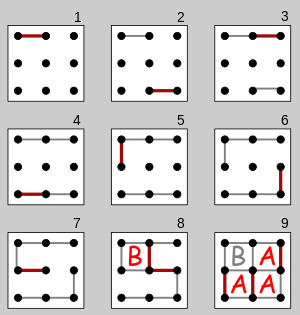
On a piece of paper, you start with an array of dots. Each player takes turns drawing a horizontal or vertical line connecting adjacent dots. If one player completes a box by drawing the fourth boundary line, they take possession of that box and get to take another turn. Here's the wikipedia page, from which I'm borrowing this helpful illustration of a simple 3(dot)x 3(dot) game:


Sample topics we've discussed:

  • How many dots are there?
  • How many boxes will there be? 
  • Is there a relationship between the number of dots and boxes?
  • Can this game (for a particular grid) end in a tie?
  • Simple strategy: filling or avoiding long chains.
  • More advanced strategy: double cross
  • Symmetrical play: what happens if the 2nd player copies the moves of the first player (reflected through a line or point of symmetry)? This is interesting for other games as well.
Other than the mathematical content, these games have been a welcome distraction during the dead time waiting around family obligations.

Oh, and for the other Thai readers here, Happy Mother's Day!

Thursday, August 7, 2014

Adding and Subtracting Games

Who: J1's first grade class
When: in class time or extra time around school
Where: at school
Why: to accompany lessons on adding and subtracting
What will we use: cards (playing cards or number cards), dice, possibly some packaged games

These are ideas for enrichment and deepening activities, to be discussed with the teacher. Do you have any thoughts on which are the best games? Please comment below. 

Future posts will repeat this exercise looking for activities that support time+calendar work and another around money.

Games
(1) Blackjack:
Game A: Use number cards instead of playing cards, no double down
Game B: With playing cards, can use simplified traditional rules (no double-down).
Game C: To focus on adding by a particular number, redefine the face cards to that value, e.g., 9, to make the frequent additions more challenging.

Note:  B or C can be modified to fix the value of ace as 1 instead of allowing the 1 or 11 option.

(2) 21 (as with blackjack, these can be played with traditional playing cards or number cards)
Game A: deal out n cards to all players (n should be between 4 and 7, depending on number of players). Players take turns putting down a card and adding to the sum until the next player can't stay under 21. The last player to play collects the cards which have been played.  Count number of cards played at the end as points.

Game B: Same as A, but each player can add or subtract the value of your card from the accumulating value of the pile. The value of the pile has no bounds and gets collected by the player to land exactly on 21.

Game C: modify the value of the face cards (if using traditional playing cards).

(3) Strike it out: described on this NRICH site and blogged about here

(4) Number bonds of multiples of 5
We blogged about this game here: http://3jlearneng.blogspot.com/2014/06/a-game-to-practice-number-bonds-of.html

(5) Sum swamp/Chutes and Ladders
For those who don't know Sum Swamp, players roll three dice, two with number values and one with addition/subtraction operators. They perform the indicated calculation and move that number of spaces along a path toward the finish line. In other words, it is chutes and ladders, but with the operation die added.

Game A: play with 2d6
Game B: play with other pairs of dice. I think Sum Swamp will work up to 2d10, but the path is probably too short for larger dice. Chutes and Ladders can probably work up to 2d20, but I would impose a rule that the winning player has to land exactly on the final square (or maybe within 5?)

(6) Dotty Six
Game A: describe on this NRICH page
Game B: change the target to complete each box to 10 and use tally marks instead of dots
Game C: change the target to another higher number (I suggest either 15 or 20) and use tally marks.

(7) Pass the peas, again, NRICH
Though the kids will probably end up throwing dried food at each other?
Game A: as described
Game B: use 2 dice and then multiply the die value with the value of the number square it lands on, then subtract those from your residual figure.

(8) Subtraction squares

Challenges
(1) Eggs in a basket: NRICH
(2) 5 steps to 50: NRICH. Their version only uses 10s and 1s, but the step sizes can be changed. Also, they don't specify what dice to use, so I would prefer 2d10 to get 0 to 99 as the range of starting values. I made a pencilcode program to explore this (here) but now see that I missed the point about using dice to start, so maybe an interesting constraint is formed by using 2d6?

Investigations
(1) Play with a number balance (as pictured on this page)
(2) using a digital scale: weigh pairs of objects separately.  Figure out how much you think they will weigh in together and then check.
(3) magic boxes: another NRICH activity

note on materials:
Dice: [n]d[m] = use m-sided dice and we need n of them. For example, 1d6 is a single six sided die (usually with standard 1-6 markings), 3d8 means three octahedral (8-sided) dice.
Traditional playing cards: 52 card deck, two through 10, jack, queen, king, ace
TPC numbers: 40 card deck using ace (1) through 10
number cards: special card deck using numbers, we got ours through Abacus Math


Wednesday, August 6, 2014

Zero...One...Two...Three... (Counting)

Who: J3 (and a little bit of J2)
When: at times you want to help teach counting (e.g., all the time)
Where: anywhere there's stuff to count
What we use: whatever is available, fingers if that's all we've got

Many of you have heard me say this before: "there are three kinds of mathematicians, those who can count and those who can't."

I never get tired of that (why?), so I should take the opportunity to publicly apologize to everyone who has (or will hear) me say it many times. Part of what lies behind the joke is how fundamental the basic counting skill seems to be for everything else in our standard math education curriculum. I've heard a high school-focused educator claim that many kids struggling at her level are really dealing with the lack of a firm grasp of one-to-one correspondence (a sub-skill for counting). If you really want to, you can see this skill highlighted as a foundation block in the US Common Core Standards: base skill level in counting and cardinality,

So, what do we do? Basically, we play these 4 simple games (from Amy at Kids Quadrant) almost all the time until the kids are counting fluently. There are only some small points I can add to Amy's great post:
  1. start with 0. I make two balled fists and wiggle them when I say zero, unless I'm counting hands in which case I just say 0. The point is to make sure they realize 0 is also a number.
  2. be silly: this is a game for them kids, so feel free to make silly sounds and gestures.
  3. try to find things they can grab and move around as they count. My intuition is that the more of their body involved and the bigger the motion, the more they will remember.
  4. (optional) try counting in other languages. If you don't care which language, Chinese and Thai are good choices because of the logical naming system they employ (I think other Asian languages are similar).
Here's another really interesting post from KidsQuadrant outlining the skills behind simple counting: here. What I want you to take away: even though counting seems easy, even obvious to you, be relaxed about how long it takes to click for your kids and keep enjoying it as a repeated game.

Combinatorics

When I tell the joke and say "count," I'm internally thinking about combinatorics.  I have long felt a bit weak in this area, with anxiety that my counts were either leaving out cases or double counting somewhere. That's the real reason I like this joke so much, because the self-deprecation has a meaningful kernel of truth.

Tuesday, August 5, 2014

Pattern replication

who: J1 and J2
when: just after breakfast and mid-afternoon, in between rounds of Sleeping Queens
where: in our play room and in my office at home
what did we use: pattern blocks and an oversize book (and play Sleeping Queens)


With J1 out of school all week, I've plenty of opportunity to use the activities that I'd listed in advance of our math party. I particularly wanted to try the second of my pattern blocks challenges:
Pattern Blocks Activity B: needs pattern blocks and a large pillow to block the view.  With a friend, take turns making a secret design and verbally describe it to the friend to tell them how to replicate it.
J1 was reluctant to humor me, since he wanted to play Sleeping Queens (all day long, as it turned out). However, when I explained what I wanted to do, he got more interested, saying, "ah, we've done this at school before, it's easy." I was about to set up half a pillow fort to use as  screen to block his design when I realized we had inherited a gigantic (roughly 1 meter tall) book about mummies that was perfect.

J1 set up a design and then started describing it to me and I asked questions when I didn't understand.  Here are the two patterns,


So we got pretty close, thanks primarily to his use of the word "tessellate" to describe shapes that fit snugly together. You can see that we each took for granted the orientation of the top green triangle. J1 didn't tell me which way to point it and I didn't think to ask.

Then, I went behind the screen and put together a fish about to chomp some square orange food, but our communication was really poor and J1 made the design on the bottom:


We got interrupted, otherwise I would have liked to try a couple more times in each role.  In the afternoon, I got a chance to do it again with J3. Not surprisingly, he went for a more complex design than he could describe, including a slightly innovative orientation for the orange squares. He was having trouble giving me instructions, so we ended up with him just rebuilding the original in front of me. In any case, he'd used more than half our orange squares, so we couldn't do a faithful reproduction.


Incidentally, the second design above is what he put together when he was playing with the blocks on his own afterward.

My lessons:
I really liked this pattern activity.  First, it gives a semi-natural reason why they might care about some basic elements of math such as number and shape. Those form some of the basics for explaining what pattern they've created.  Similarly, it is a natural place to start introducing angle measures and concepts like parallel and perpendicular.  When I am describing my designs, I try to use a full range of vocabulary and encourage them to ask about any words they don't know.

Second, like the flexagons, it is a mixed math, art, and language activity.

Third, this was something the kids found engaging but challenging, so it seems like the right level for their current abilities.  In general, it is hard to find things that fit like this.

Sleeping Queens

Finally, the game Sleeping Queens loomed over our day.  One of the friends had brought and left it yesterday for the math party. J1 had played it at school and was really excited; left to his own devices, he would have played continuously and it really was the last thing he did before going to sleep. By the end of the day, J2 was also playing along (and winning). I have to give it a positive endorsement on their enthusiasm alone, but I do have two caveats: for our small children, they feel they are being attacked when someone steals their points (a standard part of the game play) but the game seems to simple to suit older children (and certainly won't be much of a mathematical experience for them).

Baby pictures
Just for amusement, here are some snaps by J3:
Does the Pharaoh approve our pattern design?

Our future coconut crop?

Monday, August 4, 2014

Math party (and flexagons!)

Who: Baan Pathomtham First Grade Class+J3
When: 9am - 2pm
Where: our house
What will we used: see below
Why: oh why, oh why? (actually, it was fun!)

First, thanks to all the kids for being so friendly and polite.  Thank you for leaving everything tidy when you left, though that was under a mother's supervision and probably not surprising.  What did amaze me was when Tanya stopped everyone from rushing to eat a snack and you all went right away to collect the toys/games/crafts.

Second, did any of our plan survive reality? Yes, actually some of the things we prepared went well:

  • Passports: the kids enjoyed having their activities noted and getting stamps in the passports
  • Flexagons: everyone got to play a bit and learned about flexing the hexaflexagons and tetraflexagons. A couple even made their own hexaflexagons and someone decorated a blank I'd left around.
  • Pizza: as usual, kids enjoyed assembling their pizzas and were astoundingly patient while they baked.


  • Origami stars: some kids were interested in making these
In truth, though, this was simply a group that wanted to play games and could nearly have been left alone the whole day with a selection.  As it was, they played a lot of Uno, managed part of a game of Settlers of Catan, and played some assorted other games: Sum Swamp, Walk the Plank, Spot It!, and Squares


Some lessons (for me):
  • Though fairly small, our play room is large enough to host two distinct stationary activities, but they have to be child-selected to be sufficiently engaging for the two groups to remain intact
  • Origami (including flexagons) for this age probably needs a smaller group (one-on-two likely works). The kids have the skills required, but either they found it to concentrate, I found it too hard to concentrate, or a friend would suddenly come over and try to take control of the project.
  • Activities requiring a meaningful amount of preparatory instructions either need to make sure the whole group is listening first, or have the instructions delivered by one of the children.
  • Kids need more encouragement taking things apart (see Flexagons, below)
Below are a sample of the passports, the flexagons, and folded stars from today.

Flexagons
I promised to write up our flexagon experience. After the party today, I'm even more enthusiastic about this activity. There are three reasons why I strongly suggest you start playing with them today:

1. Cheap and easy to make
This is great because, if you break them, then just make more! Since even learning how to flex the shape takes some investigation and practice, there's a danger of tearing a flexagon. That should be encouraged! Cut them open to see how they are folded, force them if you can't see how to flex it. Taking things apart is a great habit/skill.

I think the kids today were overly anxious about their investigation. Perhaps this was the other side to the coin of them being so polite? In any case, this is something I would actively seek to encourage in the future.

2. Mix Art and Math
A blank flexagon isn't much fun, it has to be decorated to make the mystery really come out. For people with a traditional conception of mathematics, this may seem odd: art as a tool to explore the mathematical structure? Yes, yes!

So, if your child doesn't like art, this is a back-door into drawing some patterns or pictures.  If they love art, then this is a back-door into equilateral triangles, angles, rhombus, hexagon, how many sides a piece of paper has, state diagrams, etc.

3. You probably don't know much about flexagons
That means you can let the child lead this activity and just let it develop. That's great because they can be the teacher or you can be equal partners.

Alternatively, you might get excited and have your own questions about flexagons. In this case, this is a chance for you to investigate and for your kids to see you investigating. Do you try to figure it out on your own, draw diagrams, build other models, dissect specimens, experiment, watch videos on youtube, look at wiki pages, ask a friend, talk with your child, all of these things? A great opportunity to show your child how you explore something that interests you.

My flexagon recipe:
Only steps 1 through 6 are really required
1. Watch the Vi Hart video: http://www.youtube.com/watch?v=VIVIegSt81k
2. Make a trihexaflexagon by using tape to complete the loop
3. Color it
4. Flex it and think about how it works
5. Take it apart (this is why we used tape)
6. Make a bunch of additional trihexaflexagons, use different ways to make the series of triangles (folding, compass, 30-60-90 drafting triangle, printed template, etc)
7. draw more pictures and patterns
8. Try making a hexahexaflexagon (again, using the basic comments from the video)
9. Look at some templates online, including Tri-tetraflexagon, Flexagon Portal, More templates and more
10. watch the second part of the Vi Hart flexagon series: http://youtu.be/paQ10POrZh8
11. watch this third Vi Hart flexagon video: http://youtu.be/AmN0YyaTD60

Sunday, August 3, 2014

Grand Catch-up

Who: everyone in the family
When: over the last week
What material did we use: see below, a lot of different goodies
Where: all over the house

We haven't posted many activity summaries recently, so this is a review of what we have been doing so that you don't think we've been slacking off.

Calculating and Roman Numerals
Remember my doubts about roman numerals when they were introduced (here)? P has since found that they come up frequently when J1 and J2 are discussing some other calculation (adding 2 digit numbers without paper and pencil was a recent one).  It seems that the kids like the process of conversion or the feeling that they are speaking in a type of code.

Mathsemantically, they appear to appreciate the idea that number names are not the same as number concept. Frankly, I don't know when they developed this appreciation as we've always been a bilingual household (Thai and English) and introduced counting in other languages (Spanish, German, Chinese, Korean, Tagalog, Armenian) when they were very young.

Tip: for kids around 7 years old, try introducing the numbers in a different language and see if they enjoy the disassociation of names and objects as they play with calculations.

Food Math
We've had another round of pizza dough (with J3, our 2 year old) and our first attempt at gougeres (J1 and J2).  The pizza dough with J3 went as usual: a lot of fun measuring, a bit of flour outside the mixing bowl, excessive use of the scale to weigh whatever she saw.

The gougeres were a dairy indulgence, with milk, butter, and cheese as main ingredients. This was my first opportunity to try them since J3, our dairy intolerant one, was out for the day with mommy. We roughly followed this recipe, halved because the remaining munchkins had already decided they wouldn't like them and I couldn't justify eating 20-30 cheese puffs myself (and I'm not generous enough to share them with anyone else). In any case, by the time I thought to snap a picture, we only had 5 left for a nice little pentagonal arrangement.


Mathematically, the activity was interesting because we halved the recipe and we had a debate about how many eggs to use. While the presenter explicitly says 5 eggs, both boys were sure we only saw her use three and we all agreed that she had reserved one for the egg wash. Coincidentally, P brought home some very small eggs later in the day, so we got to have a little (very little) discussion of whether one egg is a proper measure. I'll have to remember to return to that again.

As we've hinted on other occasions, we try to recognize little unplanned opportunities for inserting some numerical discussion into everyday conversation.  Quesadillas at lunch were a chance to talk about fractional parts of a circle based on 1/8.  Below is one serving in the 6/8 (aka 3/4) uneaten state:


Some bites and a cheeky smile later brought us: "daddy, what about this one?"

I offered 1/3rd of an 1/8th for the partially eaten piece and we calculated that this plate still had 7/24th. Maybe I should have rushed to get a clock and show them 3.5 hours?

Catan (Catan, Catan)
Somehow, Settlers of Catan got back on J1's radar and he's been asking to play it everyday for a while. We are still working on a version that fully integrates J2 and it is a bit stale without trading between players.  I tried to introduce a bit of trading today, but J1 was too suspicious of my motives and would rather trade at an unfavorable rate with the bank than trade with me.  For now, we still start him with 2 cities against my 2 settlements, and we also allow all the players to start with the resources from all the hexes associated with both of their developments.  Otherwise, we find the game takes too long to get moving.

You can see J1 (red) in the process of beating me (orange) below:


I can tell these sessions have started to develop his intuition for dice probability.  When allowed to set up a board configuration of his own choosing, he put the 6s, 8s and 9s together on the hexes associated with his developments.

And some geometric designs from J2 while he was watching us play:


Hexaflexagons
I plan to have more discussion of this tomorrow after our math party. For now, suffice it to say that I made some flexagons, left them around the house, and both the boys were really excited to make, decorate, and investigate them.  Almost all of them are trihexaflexagons, so that's what they've come to expect.  I gave J1 a hexahexflexagon with numbered faces and he was delighted to discover the extra faces.  I'm looking forward to seeing how the other first graders respond.

Since it isn't fair to entirely leave you hanging, I'd refer you to this Vi Hart video for a great intro to flexagons: http://www.youtube.com/watch?v=VIVIegSt81k

Friday, August 1, 2014

activities for a math party

Who: 6 classmates of J1 + J1 + J3
When: all morning + lunch
Where: our house
What will we be using: see below

Some planning notes for a math (and English language) party at our house next week.

Misc:
- Brief explanation of basic rules of the house as everyone arrives: be kind, be respectful, be safe, persevere
- Explain schedule, particularly if there are going to be full group activities (reading a story, making food, eating food, change to 100 board pattern)
- have water, fruits and cut vegetables available for snacking throughout the day
- activities set up in stations around the house with some printed guidelines. Tidy up after you finish each activity (to make it appealing for the next people)!
- Kids will go through the activities in pairs, may depend on attendance.  
- Maybe J1 allowed to join whichever pair he wants? Otherwise, create group of 3 to deal with odd number?
- Do we need a map so that the kids have some idea of what is available? How many activities do we really need for 4 hours (which will include lunch)?

Passport
To start, everyone gets a passport book and decorates the back cover with their name, partner's name and own design. The book is to record which activities the children have done through the day.

100 Board
Guess my pattern: needs 100 board and 2 colours of tiles (5-10 minutes total time)
3 or 4x through the event, J0 will set up some patterns on the 100 board.  Kids guess what the pattern is each time. Pattern ideas:
- odds and evens
- multiples of 5
- squares
- Fibonacci sequence
- Primes

Pattern Blocks
Activity A: needs pattern blocks, design cards, and a camera
- Copy some pre-made designs
- Make your own design and take a picture (adult will help with the picture?)
Activity B: needs pattern blocks and a large pillow to block the view
With a friend, take turns making a secret design and verbally describe it to the friend to tell them how to replicate it.

Stacking blocks 
Tallest tower: needs collection of building materials (we will use duplo, stacking blocks, trio blocks, polydrons and magnatiles), measuring tape and camera.
- build the tallest tower you can
- estimate the height
- measure the height
- take a picture

Origami
Ninja stars: needs paper cut into squares (or even better, 1x2 rectangles)
- take apart some pre-made stars and investigate
- think about how to make them and ask questions
- try to make your own
- decorate
- throw them at designated targets (maybe this is too risky to encourage?)

Hexaflexagons: needs paper cut into strips
- with help, make a trihexaflexagon
- decorate the sides
- explore
- make more if interested
- make a hexahexaflexagon (advanced, gets an extra stamp)

Other origami: can be added according to interest of children
- animals
- polyhedra
- etc

Story
Reading: needs a selection of books
- Select a book with your friend
- read and discuss with an adult (depending on preference, kids can read themselves, adult can read to them, take turns, etc)
- Should this be done all together or pairs?

Writing: needs paper, pencils, some coloring pencils/crayons
- modelled on the story we have read
- insert yourself and make some additional change to the structure
- write your story
- illustrate/decorate

Games
Pick a game and play with your friend
- Sum swamp
- Chess
- Chinese checkers
- Chinese chess
- Uno

Programming
Pencilcode intro
- Adult shows them basic intro to pencilcode set-up
- let them explore the gym, other people's code and play

Food: I'm inclined to drop these ideas for the first trial run of this event; mini-pizza is the strongest contender to keep
Mini-pizzas: needs pizza dough (shaped), tomato paste, cheese, cut veg
 each pair gets a blank dough to top and decorate as they desire
- bake
- eat

Coconut faces: needs coconuts and craft material
- Ask an adult to open a coconut for you
- Make a face on the top
- drink it and pretend the face is making silly noises at your friends

Mini-bread experiments: needs water, flour, yeast, salt, eggs, sugar, milk, oil, honey, seeds, cheese
to be done with J0 supervision, have everyone do this all at one time?
- each pair gets to measure out 150 gr flour, 2.5 ml salt (1/2 tsp)
- measure optional wet ingredients (egg, milk, honey, sugar, oil) up to 80 ml total
- add water to top up wet ingredients to 80 ml
- mix wet and dry
- knead and shape
- rise
- bake
Note: generic ingredient ratio should be checked against some sample recipes